

India extends mandatory GST e-invoicing to reverse-charge purchases and imported services from January 2027
Brings new transactions into its digital tax reporting regime
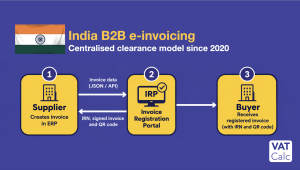
India’s Central Board of Indirect Taxes and Customs (CBIC) has confirmed an expansion of mandatory GST e-invoicing from 1 January 2027, under Notification No. 04/2026–Central Tax, dated 26 October 2026.
The changes bring purchaser-side transactions into India’s Invoice Registration Portal (IRP) framework, previously focused on domestic B2B supplies and exports.
January 2027: reverse charge and imports added
The e-invoicing mandate will be extended to:
- Reverse-charge purchases: Goods or services received from unregistered suppliers where the recipient must account for GST.
- Imports of services: Services purchased from overseas suppliers.
Under India’s reverse-charge mechanism (RCM), the purchaser rather than the supplier accounts for GST. For specified purchases from unregistered suppliers, the registered recipient is required to generate a self-invoice.
The expansion means affected businesses will need to integrate these transactions into their electronic invoice registration processes. This is particularly relevant for multinational companies importing intercompany services, software and professional services.
Further operational guidance will be important for determining how recipient-generated invoices are submitted through the IRP.
Current GST e-invoicing threshold: ₹5 crore
India introduced mandatory B2B e-invoicing in October 2020, progressively reducing the annual turnover threshold to ₹5 crore (INR 50 million) from 1 August 2023.
The threshold is based on aggregate turnover across GST registrations under the same Permanent Account Number (PAN), considering financial years from 2017–18 onwards. Certain taxpayer categories remain exempt.
The January 2027 changes expand the transactions covered rather than reducing the existing turnover threshold.
How India’s GST e-invoicing system works
India operates a clearance-based e-invoicing system requiring invoice data to be registered with an authorised Invoice Registration Portal.
The process involves:
- Invoice generation: The business creates an invoice in its ERP or accounting system.
- IRP submission: Structured invoice data is transmitted through an API or JSON file.
- Validation: The portal checks mandatory details, GST identification numbers and duplicate invoices.
- Registration: The IRP generates a unique Invoice Reference Number (IRN), digitally signed invoice data and a QR code.
- Customer delivery: The registered invoice is shared with the customer, generally as a PDF or another agreed format.
Registered invoice information is also shared with India’s GST reporting infrastructure to support return preparation and reconciliation.
April 2025: 30-day reporting deadline
Since 1 April 2025, businesses with aggregate annual turnover of ₹10 crore or more must report invoices, credit notes and debit notes to the IRP within 30 days of their issue date.
Late submissions are rejected, preventing generation of the required IRN.
Businesses below ₹10 crore are not currently subject to this particular deadline, although mandatory e-invoicing continues to apply from ₹5 crore.
B2C e-invoicing pilot planned
India is also considering extending electronic invoicing to business-to-consumer transactions.
Following recommendations from the GST Council in September 2024, a voluntary pilot is being developed for selected sectors. Recent reports suggest April 2027 as a possible launch date, although no nationwide B2C mandate has been confirmed.
Large businesses are already subject to separate dynamic QR code requirements for certain B2C invoices.
India GST e-invoicing implementation timeline
|
Date |
Requirement |
|---|---|
|
October 2020 |
Mandatory B2B e-invoicing introduced: ₹500 crore threshold |
|
January 2021 |
Threshold reduced to ₹100 crore |
|
April 2021 |
Reduced to ₹50 crore |
|
April 2022 |
Reduced to ₹20 crore |
|
October 2022 |
Reduced to ₹10 crore |
|
August 2023 |
Reduced to ₹5 crore |
|
April 2025 |
30-day reporting deadline extended to ₹10 crore businesses |
|
January 2027 |
Reverse-charge purchases and imported services added |
|
April 2027 |
Possible voluntary B2C e-invoicing pilot |
What businesses should prepare for
The 2027 expansion moves India’s e-invoicing requirements beyond sales invoicing and into accounts payable.
Businesses must ensure their systems correctly identify reverse-charge transactions, determine GST liabilities and generate the necessary electronic invoices.
The challenge is not simply submitting more transactions to the tax authority. It is ensuring the underlying GST treatment is correct before the invoice enters the digital reporting system.
VAT Calc’s in real-time global Calculator and Auditor services produce instant and accurate tax calculations into your ERP, billing, e-commerce or e-invoicing systems.

