Why the SAP S/4HANA migration is the opportunity to adopt a full tax engine
As global businesses prepare their migration to SAP S/4HANA, one question keeps resurfacing in every finance and IT steering meeting: should we finally upgrade to a full tax engine?
The answer is increasingly clear. With S/4HANA driving a transformation in how data, processes and reporting are managed, this once-in-a-generation ERP upgrade presents a perfect opportunity to modernise indirect tax determination and compliance.
See how VATCalc SAP integrations work today – or read about VAT Calculator, our global tax engine.

Why now? The S/4HANA inflection point
The migration to S/4HANA is not a simple technical exercise. It’s a strategic rethink of how tax integrates across supply chain, finance and reporting processes. SAP’s new data model and extensibility architecture make legacy, hard-coded tax logic increasingly incompatible and costly to maintain.
Many businesses are discovering that custom tax tables and ABAP scripts built for ECC simply can’t keep up with:
- Constant VAT rule changes across 190+ jurisdictions
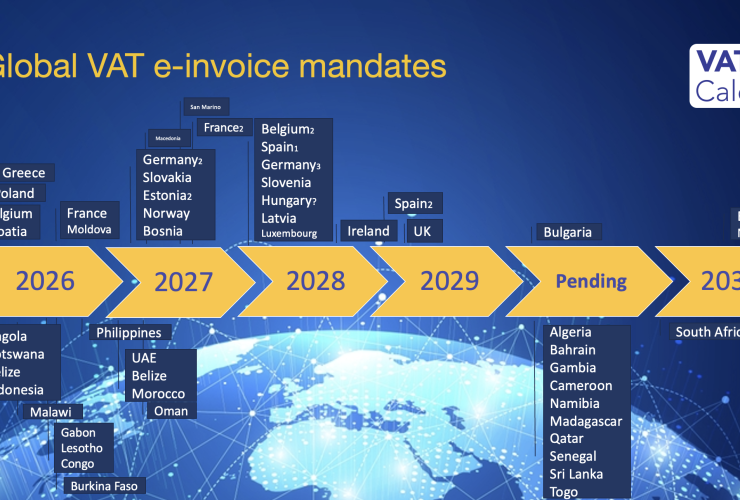
- Real-time e-invoicing and digital reporting mandates under the EU’s VAT in the Digital Age (ViDA) reforms
- Cross-border supply chain complexity driven by marketplace, drop-shipment and fulfilment models
- Demand for automation across Accounts Payable, Accounts Receivable and shared service centres
Instead of replicating yesterday’s tax logic into tomorrow’s ERP, leading CFOs are using the S/4HANA migration to reset their indirect tax architecture entirely.
The case for a full tax engine
A modern tax engine replaces fragmented, manual and country-specific configurations with a single source of tax truth that connects seamlessly to your ERP, billing, e-invoicing and reporting systems.
The right engine should deliver:
- Automated VAT determination based on codified legislation, not manual rules
- Real-time compliance for continuous transaction controls and digital reporting
- Centralised configuration for consistent logic across all systems and geographies
- Audit-ready visibility for every transaction and tax decision
In other words: no more maintaining hundreds of localised VAT conditions or reacting to rate and rule changes by emergency transport requests.
Where legacy engines fall short
For years, global businesses have relied on traditional vendors calculate VAT. These systems were designed in an era of periodic VAT returns, not real-time digital reporting. This includes Vertex, Sovos, TR and Avalara.
They depend heavily on:
- Manually scripted rules maintained by implementation partners
- Multiple integrations between separate determination, e-invoicing and reporting products
- Slow update cycles whenever legislation or invoice formats change
- Complex reconciliations between calculated VAT and reported data
As governments move to live, data-driven VAT oversight, these multi-vendor, batch-based solutions increasingly create risk and delay. Each additional interface introduces potential mismatches, data latency and additional maintenance cost.
Migrating such legacy engines into S/4HANA simply reproduces the complexity that businesses are trying to eliminate.
VATCalc: Built for the next era of SAP tax
VATCalc was designed for this moment. While others retrofit their systems to meet new reporting models, VATCalc was built from the ground up as a single, cloud-based tax engine and reporting platform for real-time digital compliance.
What sets VATCalc apart:
-
Legislation-codified logic — not black-box rules
Every VAT rule, exemption, reverse charge and reporting obligation is directly codified from primary law and guidance. Determination is instant and transparent — not dependent on user-defined conditions or opaque rule sets.
-
Single platform for tax and reporting
VATCalc uniquely unites tax calculation and reporting in one application. No need for separate integrations between different vendors for e-invoicing, SAF-T or return submission — ensuring a single data model, lower cost and no reconciliation gaps.
-
Live e-invoicing and ViDA-ready digital reporting
With Peppol tax code and national CTC mappings built in, VATCalc supports current live regimes (France, Poland, Italy, Saudi Arabia, etc.) and future EU ViDA requirements — automatically validating transactions in real time.
-
Serverless microservice architecture
Designed for scalability and speed, VATCalc deploys seamlessly alongside SAP S/4HANA, whether on-premise, private or public cloud. Updates are instantaneous — no downtime, no upgrade windows.
-
Guarantor of Tax – human intelligence in the loop
While competitors experiment with unsupervised AI, VATCalc’s human-verified content ensures absolute accuracy and accountability. Every update is reviewed by expert tax technologists, not left to inference or training data.
Beyond compliance: measurable business value
Businesses adopting VATCalc during their S/4HANA migration report major efficiencies:
- 50–70% reduction in manual VAT reconciliations and exception handling
- Faster close cycles thanks to aligned determination and reporting data
- One vendor, one platform for global tax logic and returns
- Future-proof compliance across CTC, SAF-T and ViDA reporting regimes
With VATCalc, tax becomes a native digital control within S/4HANA — a strategic enabler of transparency and automation, not an afterthought patched together from multiple tools.