
One of the biggest costs in implementing VAT automation isn’t configuring tax rules. It’s mapping customer transaction data.
Mapping translates each customer’s unique ERP export into the standard data structure needed for automated VAT determination and reporting.
Many software vendors and advisory firms, including the Big Four, are introducing AI-powered mapping tools. But most stop once the data has been mapped.
VATCalc takes a different approach
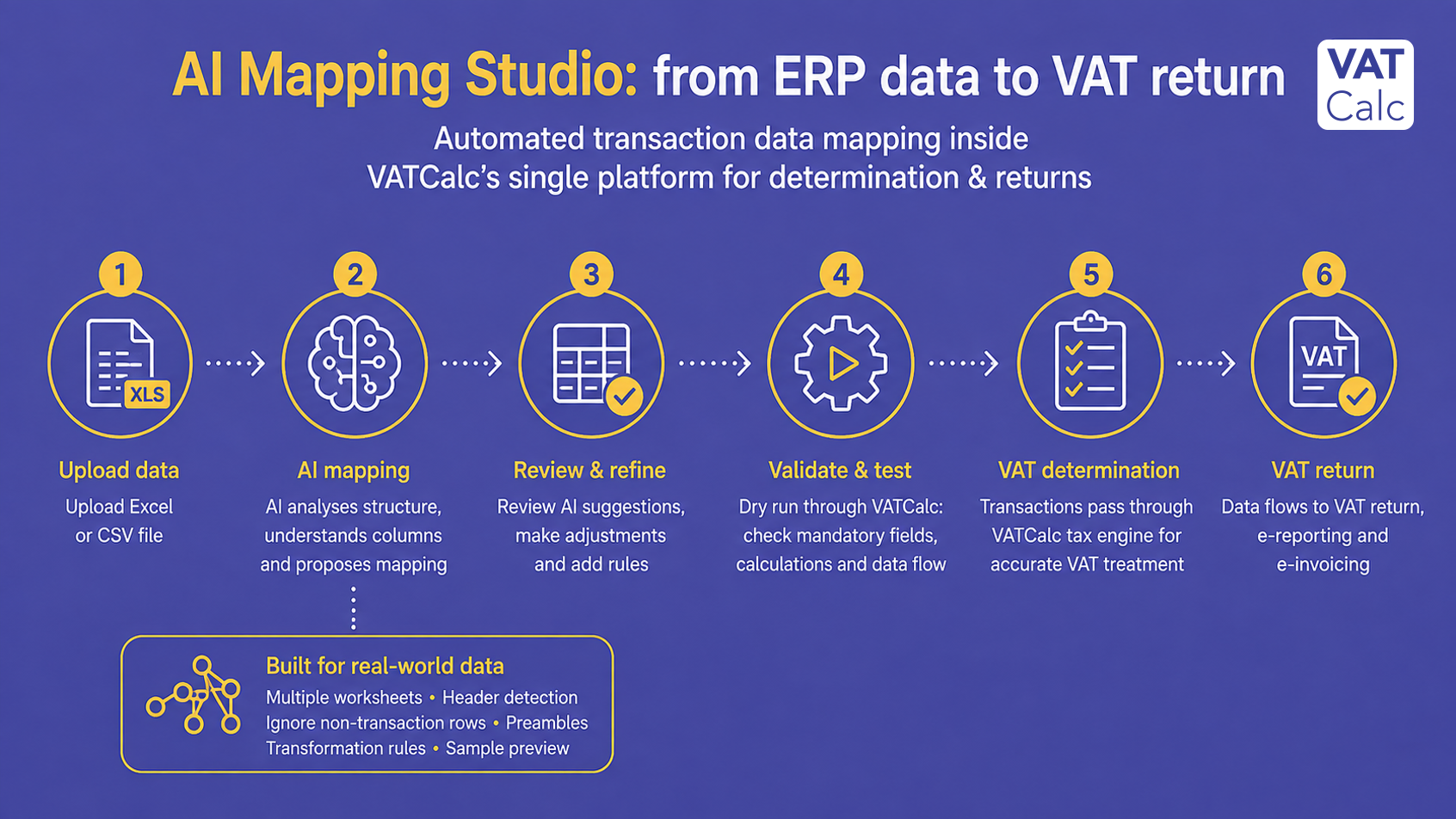
Our AI Mapping Studio is built directly into our VAT determination and reporting platform. Customers upload a transaction file, AI proposes the mapping, VATCalc validates it, determines the correct VAT treatment and prepares the VAT return, all within the same application, interface and audit trail.
There are no disconnected tools or multiple vendors to manage.
From upload to VAT return
Upload an Excel or CSV file and Mapping Studio immediately:
- identifies worksheets, headers and transaction data
- understands column names and accounting terminology
- proposes mappings into the VATCalc data model
- explains the reasoning behind each suggestion
- flags missing or uncertain fields
Unlike standalone mapping tools, Mapping Studio immediately performs a dry run through VATCalc.
Users can see whether transactions successfully pass VAT determination and populate the VAT return, highlighting missing mandatory fields or calculations before implementation begins.
Instead of simply mapping data, AI Mapping Studio proves that the mapping works.
It also handles the messy reality of finance data, including multiple worksheets, introductory text, inconsistent layouts and reusable transformation rules for more complex scenarios.
AI where it delivers the greatest value
AI Mapping Studio reflects VATCalc’s broader AI strategy.
Rather than asking AI to determine VAT, we use it where it performs best: understanding spreadsheets, recognising accounting patterns and removing manual implementation effort.
Once the data has been prepared, VATCalc’s legislative-coded tax engine determines the VAT treatment, while the same platform prepares VAT returns, e-reporting submissions and e-invoices.
AI prepares the data. VATCalc determines the tax. VATCalc reports the result.
By deploying AI around the core tax engine, rather than replacing it, we combine the productivity of AI with consistent, explainable and auditable VAT compliance.

How VATCalc has been using AI for years for tax determination
See how else VATCalc is applying Artificial Intelligence since 2022 to enhance VAT determination and reporting:
- AI and item classification in VAT determination;
- Tax advice generated by AI from our VAT expert-maintained tax engine
- Tax code mapping with AI to reduce significantly tax engine implementations and testing
Contact us for a FREE trial
AI that accelerates entity onboarding and keeps your teams free for high value added tasks