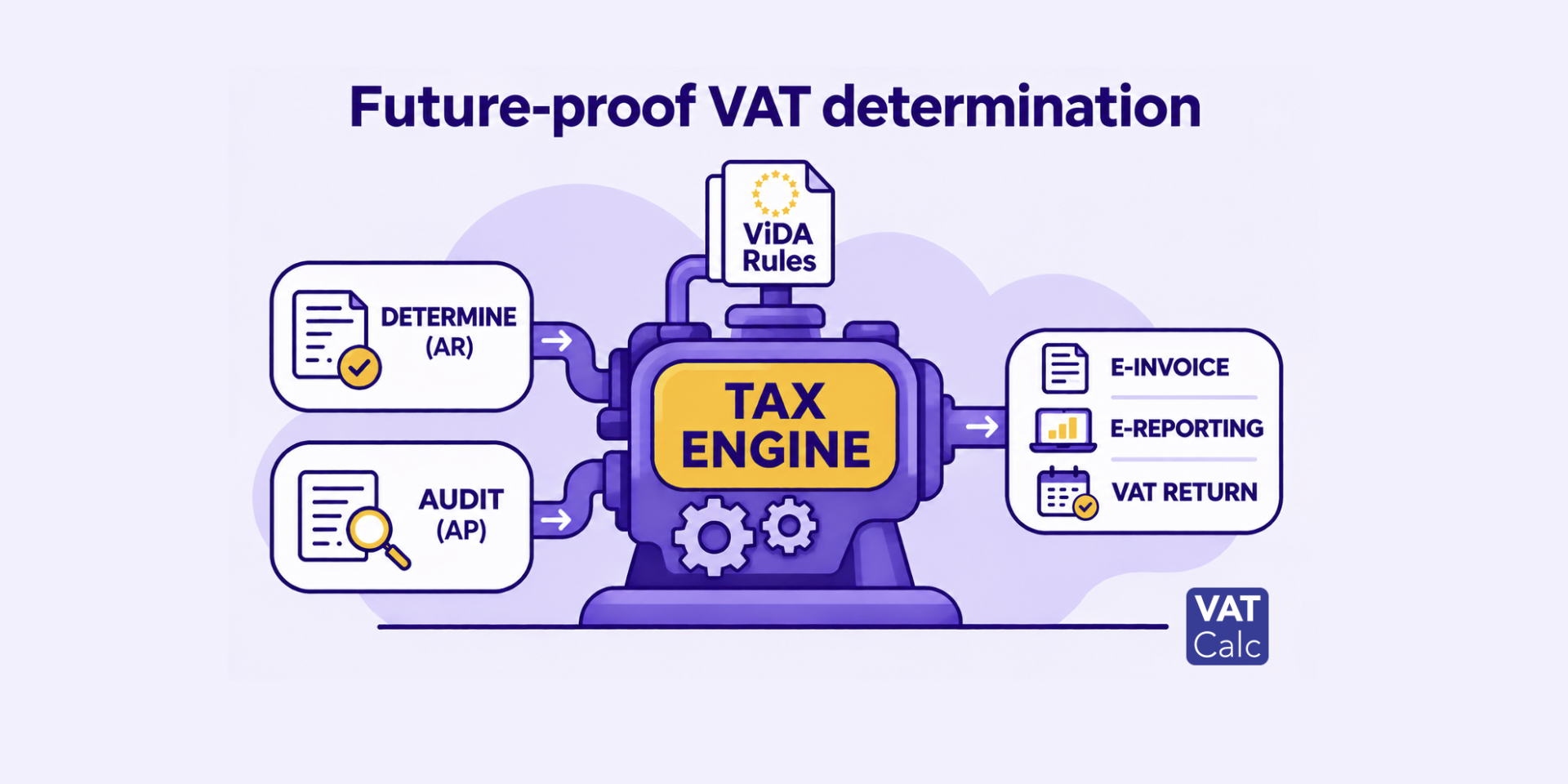
A VAT tax engine automatically determines the correct VAT or GST treatment of transactions.
As ViDA, mandatory e-invoicing and digital reporting transform tax compliance, businesses increasingly need real-time determination, independent auditing and reconciliation.
VATCalc delivers these capabilities through one modern, affordable platform, without traditional enterprise implementation costs.
Read more about our integrations with: SAP S/4HANA and ECC; SAP Public Cloud; Oracle NetSuite; or Oracle JD Edwards
What is a VAT/GST tax engine?
A tax engine is specialist software that automatically determines and calculates the correct VAT, GST or sales tax on business transactions. It typically integrates with ERP, accounting, e-commerce and invoicing systems through an API.
However, there is an important distinction between calculating VAT and determining its correct legislative treatment.
Calculating 20% VAT on a domestic sale is straightforward. Establishing whether VAT should be charged, in which country, at what rate and by which party is considerably more complicated.
A comprehensive global VAT engine must consider place-of-supply rules, customer status, exemptions, reverse charges, cross-border movements and the classification of goods and services.
Complex transactions, including triangulation, international chain supplies and composite supplies, require more than a database of VAT rates.
A genuine VAT tax engine determines not just how much tax is due, but why, where and by whom.
Why do businesses need a VAT tax engine?
Traditionally, businesses have used tax engines to automate complex VAT calculations that standard ERP tax codes struggle to manage. This reduces the need for internal IT teams and expensive external consultants to maintain tax rules across multiple countries and systems.
But mandatory e-invoicing and digital reporting are fundamentally changing the requirement.
Under the EU’s VAT in the Digital Age (ViDA) reforms, structured e-invoicing and near-real-time reporting become mandatory for relevant intra-EU B2B transactions from 1 July 2030. Meanwhile, countries are introducing domestic e-invoicing and e-reporting mandates on their own timetables.
This creates three important requirements:
- Real-time determination: Calculate the correct VAT treatment before issuing customer invoices.
- Independent auditing: Verify supplier invoices and existing ERP tax decisions against legislation and check for deductibility in real-time
- Reporting reconciliation: Ensure VAT decisions agree with e-invoices, digital reporting and statutory VAT returns.
ViDA does not require businesses to purchase a dedicated tax engine. However, it strengthens the case for automated legislative determination as tax authorities receive transaction data earlier.
For businesses preparing for ViDA or migrating to SAP S/4HANA, a tax engine is increasingly a future-proofing investment, rather than simply another calculation application.
Why VATCalc’s global tax engine is different
Our VAT Calculator combines comprehensive legislative determination with a modern architecture designed to eliminate much of the complexity and cost of traditional enterprise tax engines.
1. Legislative determination, not customised tax rules
VATCalc’s global tax engine is built directly on codified national VAT legislation and the EU VAT Directive.
Rather than relying on consultants to create and maintain bespoke transaction use cases, it determines the appropriate tax treatment from the underlying transaction facts and applicable legislation.
Each determination can include supporting legislative references, helping businesses defend their VAT treatment during customer challenges or tax authority audits.
VATCalc’s proprietary VAT Script also allows businesses to adapt particular assumptions and tax interpretations where necessary, without extensive ERP customisation.
2. Implementation in days, not months
Traditional enterprise tax engine implementations can require months of workshops, transaction mapping, custom rule development and specialist consultancy.
VATCalc reverses this approach.
Its legislative engine and auditing capabilities establish how transactions should be treated, substantially reducing the need to develop bespoke tax rules for individual business scenarios.
Implementation therefore focuses on connecting transaction data through an API and validating the results.
For suitable deployments, this reduces implementation times from months to days, together with significant savings in consultancy and ongoing maintenance costs.
3. Modern technology at an affordable cost
Sophisticated global tax determination has historically been the preserve of major multinationals with substantial technology budgets.
VATCalc’s cloud-native, serverless architecture and lower operating costs make enterprise-grade VAT determination accessible to the mid-market.
Its API-first design supports SAP S/4HANA, other ERP environments, accounting applications and e-invoicing platforms. Software vendors can also embed VATCalc directly into their own products.
Businesses therefore gain sophisticated international VAT capabilities without the expense and complexity traditionally associated with enterprise tax engines.
4. Independent VAT auditing
Our VAT Auditor uses the same legislative engine to independently verify VAT treatments applied by existing ERPs, tax engines or suppliers.
It identifies incorrect VAT charges, exemptions and reverse-charge treatments, providing supporting legislative explanations and proposed corrections.
Businesses can use VAT Auditor to check accounts payable invoices, validate existing ERP configurations or review large transaction populations without replacing their current tax engine.
5. One platform for determination and reporting
VATCalc combines Calculator, Auditor and VAT Filer within a single platform, using one underlying legislative engine.
Businesses can deploy determination independently or add statutory VAT returns, SAF-T, Intrastat and other reporting requirements without introducing a separate compliance platform.
The same architecture supports reconciliation between VAT calculations, e-invoices, digital reporting and VAT returns, reducing the risks created by disconnected systems.
VATCalc does not simply calculate VAT. It determines, audits and reports it through one platform.
Built for ViDA and future-proof VAT compliance
Businesses preparing for ViDA, national e-invoicing mandates or SAP S/4HANA migrations increasingly demand future-proof tax engines that can adapt to changing legislation and reporting requirements without costly reimplementation.
This is particularly important for mid-sized businesses, which face growing digital VAT compliance obligations but lack the budgets for traditional enterprise tax engines.
VATCalc’s affordable architecture, rapid implementation and integrated reporting options provide a practical route to meeting these obligations as they evolve.
Rather than rebuilding VAT logic for each new mandate, businesses can maintain a central determination capability that supports future regulatory changes.
From e-invoicing to VAT return reconciliation
One of the biggest emerging requirements for tax engines is the ability to connect the original VAT decision with subsequent digital reporting.
- Accounts receivable: the engine must determine the VAT treatment used to issue an invoice.
- Accounts payable, businesses need to verify the tax treatment on supplier invoices.
But correct calculations alone are insufficient.
The VAT reported in structured e-invoices must reconcile with digital submissions to tax authorities, subsequent corrections and the final VAT return. Discrepancies can create compliance risks even where the original calculation was correct.
This is particularly important as tax authorities move towards continuous reporting and pre-filled VAT returns.
VATCalc’s single-platform approach provides a consistent legislative basis for determination, auditing, e-invoicing reconciliation and statutory reporting.
The future of VAT tax engines
VAT determination is moving from an expensive enterprise specialism towards an essential component of digital tax compliance.
ViDA, national e-invoicing mandates and ERP modernisation are accelerating that transition. Businesses of all sizes increasingly need technology that determines VAT correctly, verifies supplier invoices and connects tax decisions to statutory reporting.
VATCalc brings these capabilities together through a modern, affordable platform, with implementations measured in days rather than months.
The future of VAT determination is not simply calculating tax faster.
It is getting the tax right, proving why it is right and reconciling it through to the final VAT return.