
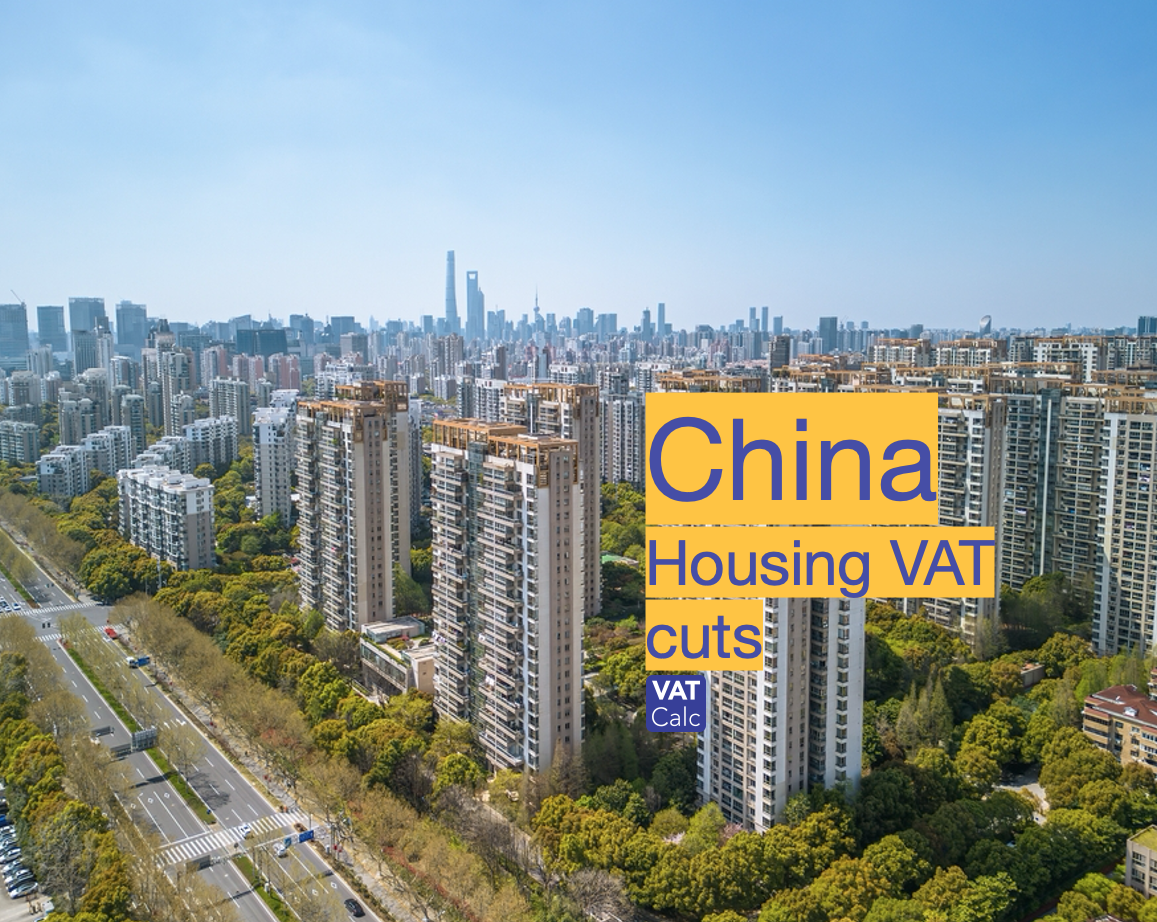
China reduces VAT on short-term residential resales from January 2026
From 1 January 2026, China will apply a reduced value-added tax (VAT) rate to certain residential property resales by individuals, lowering the tax burden on short-term disposals while preserving the long-standing exemption for longer-held properties. The measure forms part of a broader, incremental approach to stabilising the property sector, although market participants caution that tax relief alone is unlikely to generate a rapid demand-side recovery.
China’s VAT law, adopted by the Standing Committee of the National People’s Congress in December 2025, will take effect on 1st January 2026.
Policy overview and legal basis
Under a joint announcement issued by the Ministry of Finance and the State Taxation Administration, the VAT treatment of individual housing sales will be adjusted as follows:
-
Housing held for less than two years
VAT will apply at a reduced rate of 3%, down from the previous 5%.
-
Housing held for two years or more
Sales will remain fully exempt from VAT, maintaining continuity with the existing framework.
The revised rules also include a transitional provision allowing the new 3% rate to be applied to qualifying transactions where VAT has not yet been declared or paid before 1 January 2026.
Technical VAT implications
From a VAT mechanics perspective, the change primarily affects the effective transaction cost for individuals engaging in short-term property resales:
-
The reduction from 5% to 3% directly lowers the tax friction on resale transactions, improving post-tax proceeds for sellers.
-
The policy preserves a clear holding-period distinction, reinforcing behavioural incentives to discourage speculative short-term trading while avoiding additional tax burdens on longer-term ownership.
-
Administrative simplicity is maintained, as the measure does not introduce new valuation bases or reporting obligations, instead adjusting the applicable rate within an existing framework.
Notably, the exemption for properties held for two years or more continues to function as a de facto structural relief, limiting VAT exposure for the majority of owner-occupiers rather than professional or speculative sellers.
What this means in practice
-
Individuals selling residential property held for less than two years should factor the reduced 3% VAT rate into pricing and completion planning from 2026 onward.
-
Sellers of properties held for two years or more continue to benefit from a full VAT exemption, with no change to existing treatment.
-
While helpful at the margin, the reform should be viewed as a cost-reduction measure, not a substitute for broader demand-side recovery in China’s housing market.

