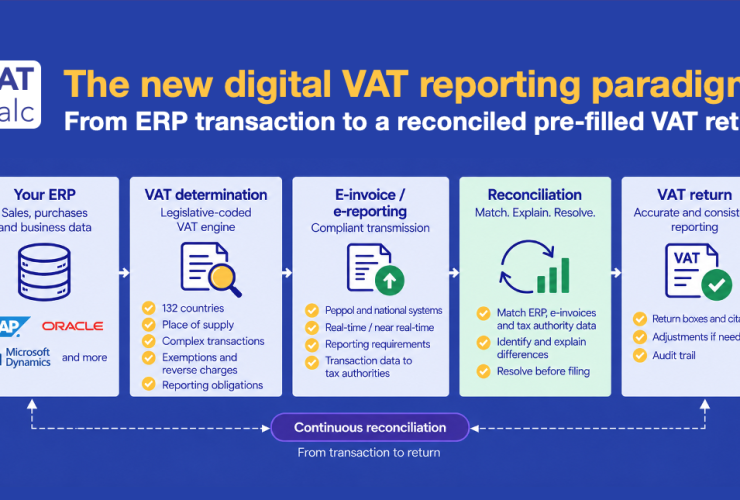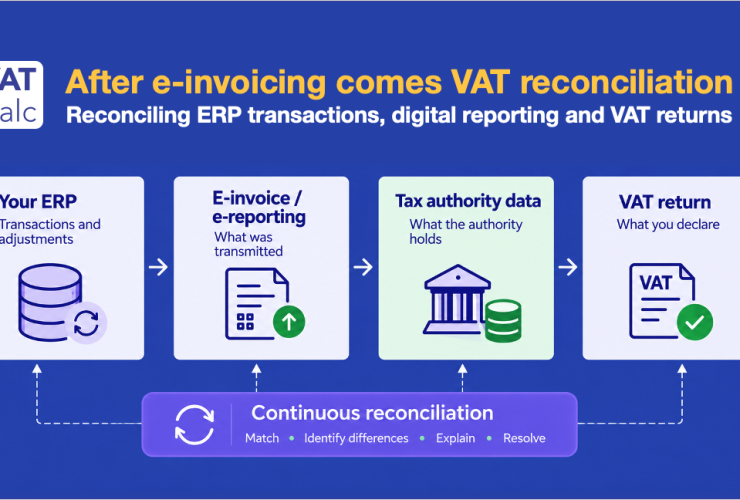
VATCalc automatically reconciles e-invoicing, e-reporting and VAT returns because it determines all three from the same tax engine
The e-invoicing market has spent years solving transmission, but is overlooking the bigger compliance challenge.

Today, most businesses can successfully send invoice and reporting data to tax authorities through their ERP, a service provider or a Peppol network. But many are overlooking much bigger challenges:
- How do you know every transaction was reported correctly as we face national and ViDA Digital Reporting mandates?
- How do you know an invoice was accepted rather than rejected?
- How do you know the data reported to the tax authority matches the VAT return that will eventually be filed?
- How to pivot to pre-filed VAT returns as they become the preferred model?
For many businesses, the answer is still the same: run reports, compare spreadsheets and manually investigate discrepancies.
That is the e-invoicing mistake.
Transmission is not VAT compliance
Most e-invoicing projects focus on getting data from A to B. Yet tax authorities increasingly use e-invoice and e-reporting data to validate VAT returns, generate pre-filled returns and monitor transactions in near real time.
As a result, businesses need more than proof that an invoice was sent. They need visibility of what happened afterwards.
- Was the invoice accepted?
- Was it rejected?
- Was the reporting obligation fulfilled?
- Does the reported data reconcile with the VAT return?
These questions are becoming central to VAT compliance, but many organisations still answer them through manual reporting and investigation.
Why Reconciliation Is Becoming the Real Challenge
Most e-invoicing providers are designed to transmit data. Most ERP systems are designed to process transactions.
Neither is typically designed to continuously reconcile transaction data, reporting obligations, tax authority responses and VAT returns.
This creates a growing compliance gap. The system can tell you what was sent.
It cannot always tell you whether the right thing was sent, whether it was accepted, or whether it ultimately matches the VAT return.
As digital reporting obligations expand across Europe and beyond, this gap will only become more significant.
How VATCalc solved the e-invoicing to return blocker
VATCalc was built around a simple principle: the same engine that determines VAT should also determine e-invoicing and e-reporting obligations.
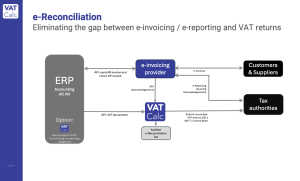
For every transaction, VATCalc understands:
- The correct VAT treatment
- Whether e-invoicing is required
- Whether e-reporting is required
- Where the transaction should be reported
- What acknowledgements and responses should be received
Because the same legislative engine drives all of these decisions, VATCalc knows both what should happen and what actually happened.
This enables automatic e-reconciliation.
Transactions, e-invoicing submissions, e-reporting messages, acknowledgements and VAT returns are continuously compared within a single platform. Acceptance messages, rejection notices and tax authority responses are linked directly to the underlying transaction.
Any discrepancy can be identified automatically without relying on report extraction, spreadsheet analysis or manual review.
The same platform can then audit both the VAT treatment and the associated reporting compliance.
The next phase of e-Invoicing – automated reconciliation to return reporting
The first generation of e-invoicing focused on transmission. The next generation will focus on reconciliation and audit.
Businesses need more than confirmation that an invoice was sent. They need confidence that it was taxed correctly, reported correctly, accepted by the tax authority and reflected accurately in the VAT return.
Most providers can transmit.
VATCalc can determine, report, reconcile and audit.
That is how businesses can avoid the e-invoicing mistake everyone is making.