
The tax technology industry is investing heavily in artificial intelligence. Avalara’s recent launch of its Intelligent Tax Classification platform, trained on more than 3 billion products, is the latest example.
AI promises to eliminate laborious product tax coding, improve accuracy and reduce manual intervention. These are worthwhile advances. But are providers using AI to improve yesterday’s compliance processes rather than rethinking how tax should be managed?
Automating the catalogue, not the transaction
Traditional tax determination relies heavily on product tax codes assigned in advance. AI can accelerate this process by classifying large catalogues and recommending codes for approval, but classification remains a separate activity preceding tax calculation.
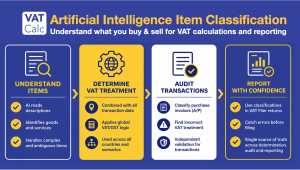
VATCalc takes a different approach. Its AI Item Classification combines product descriptions with vendor information to classify goods and services dynamically within a live VAT engine call.
Businesses can also classify products during initial setup where appropriate.
This is particularly valuable for accounts payable, where businesses receive invoices containing unfamiliar goods and services from numerous suppliers. Maintaining advance classifications for every possible purchase is impractical.
A product code does not determine VAT
Correctly identifying a product is only one element of VAT determination. Tax treatment also depends on the supplier, customer, location, transaction type and applicable exemptions.
The greater opportunity is to combine AI classification with a rules-based tax engine that evaluates the full transaction context. This becomes increasingly important for international businesses managing different tax rules and exemptions across jurisdictions.
Making fragmented systems smarter doesn’t make them simpler
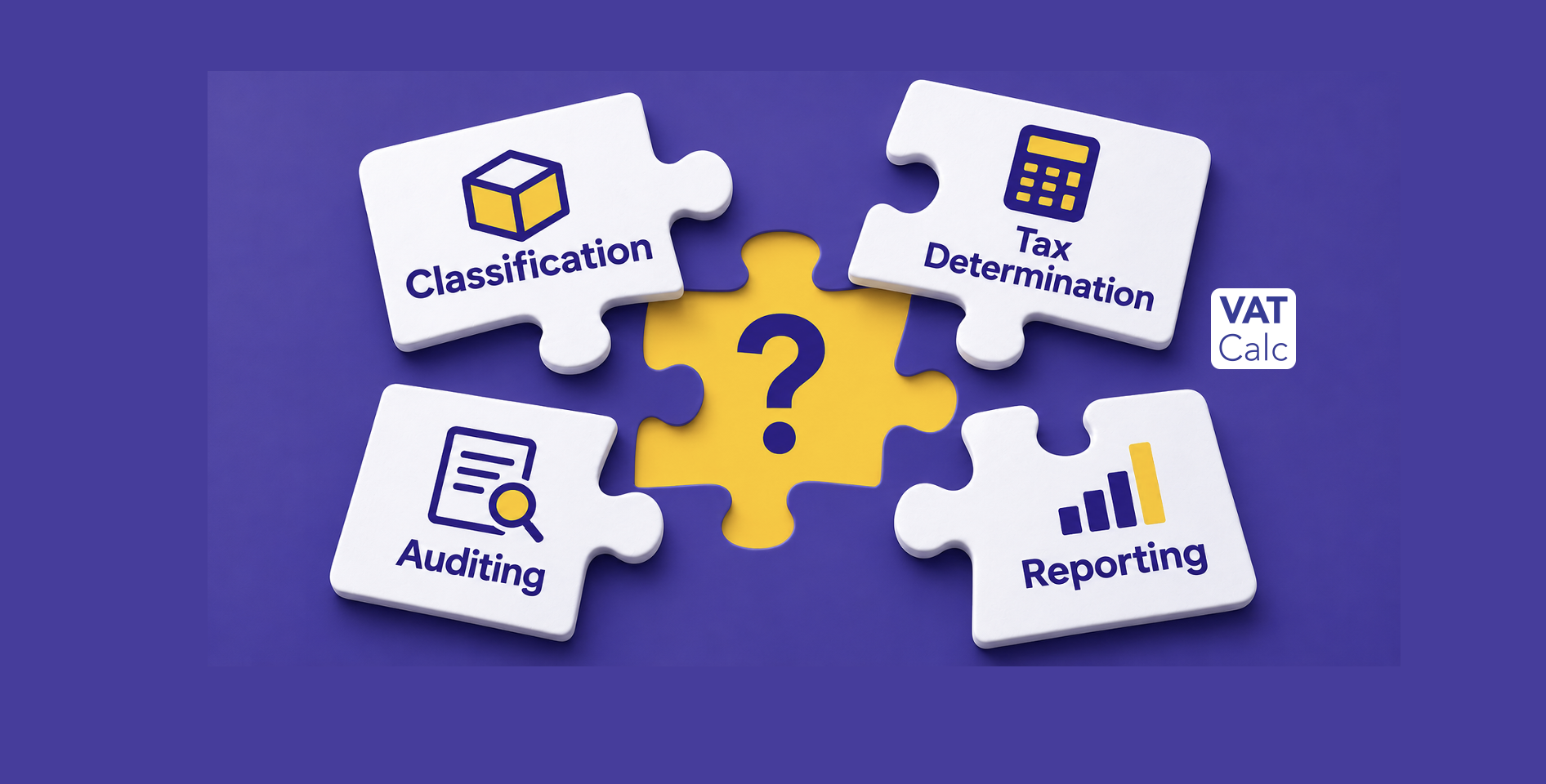
Tax technology has evolved through separate applications for classification, determination, auditing, e-invoicing and VAT reporting. Integrations connect these functions, but businesses must still manage the interfaces, data flows and reconciliation between them.
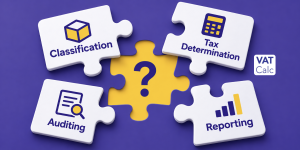
VATCalc was designed around a different model: a single application combining AI classification, tax determination, transaction auditing and VAT reporting. The tax treatment established during a transaction can flow through to auditing and reporting without relying on separate compliance applications.
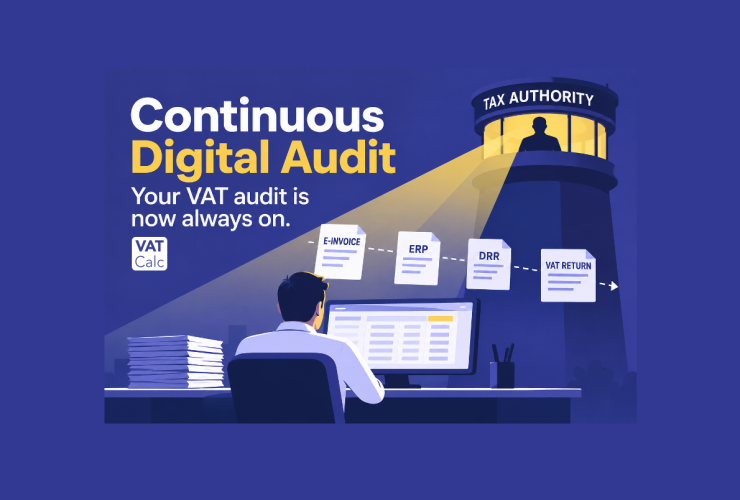
As e-invoicing and continuous digital reporting expand, maintaining consistency between the original tax decision and the amounts reported to authorities becomes increasingly important.
Rethinking tax technology for the AI era
The next generation of tax technology should do more than automate manual tasks inherited from traditional compliance systems.
The industry risks using AI to make fragmented compliance systems more efficient, rather than questioning why they remain fragmented in the first place.
The opportunity is to change the architecture of tax compliance, not simply accelerate the processes built around it.