B2B Peppol e-invoicing & B2C e-reporting mandated Sept 2026; SME’s Sept 2027
From 1 September 2026, large and intermediate-sized businesses must issue electronic invoices and submit transaction data through the new e-reporting regime, with SMEs following a year later.
DGFiP has confirmed limited enforcement until 2027 of French e-invoicing penalties if best efforts to comply with the new regime are followed.

Sept 2026-27 B2B e-invoicing & B2C e-reporting
France is implementing a 12-month phased mandate based on enterprise size:
- 1 September 2026: large companies (more than 250 employees; and exceeding either of following: €50 million turnover; or €43 million balance sheet) and ETIs begin issuing e-invoices and submit e-reporting to DGFiP (Direction Générale des Finances Publiques) but only on transactions where VAT actually collected.
- 1 September 2026: all taxpayers, regardless of size, must be able to receive B2B e-invoices.
- 1 September 2027: SMEs and micro-enterprises begin issuing e-invoices and meeting e-reporting obligations. E-reporting starts for transactions where French VAT due, but collected via other means such as intra-community or Articles 194 & 194 VAT Directive reverse charge.
E-invoicing applies to:
- Domestic B2B invoices where both supplier and customer are established in France and the transaction is within French VAT invoicing scope.
E-reporting applies to:
- B2C sales (reporting transaction data rather than delivering a platform e-invoice to the consumer).
- Cross-border B2B flows (intra-EU and extra-EU sales/purchases), where France still requires structured disclosure of the VAT-relevant data.
- Certain payment data requirements for relevant transactions, supporting VAT chargeability monitoring.
Non-established businesses obligations
- Foreign companies without a permanent establishment in France are generally outside the domestic e-invoicing obligation because the domestic B2B mandate targets transactions between VAT-taxable persons established in France.
- However, foreign businesses with French VAT obligations still face e-reporting duties . However, this is phased in with only ‘Large Enterprises’ initial subject between Sept 2026 and Sept 2027. After this, all non-residents are subject to e-reporting requirements.
e-invoicing formats and mandatory data
Traditional, unstructured formats (paper, basic PDF, email attachments) are no longer sufficient for mandated B2B flows. France recognises specific structured formats, including:
- Peppol
- Factur-X (hybrid PDF with embedded structured data)
- UBL 2.1
- UN/CEFACT CII
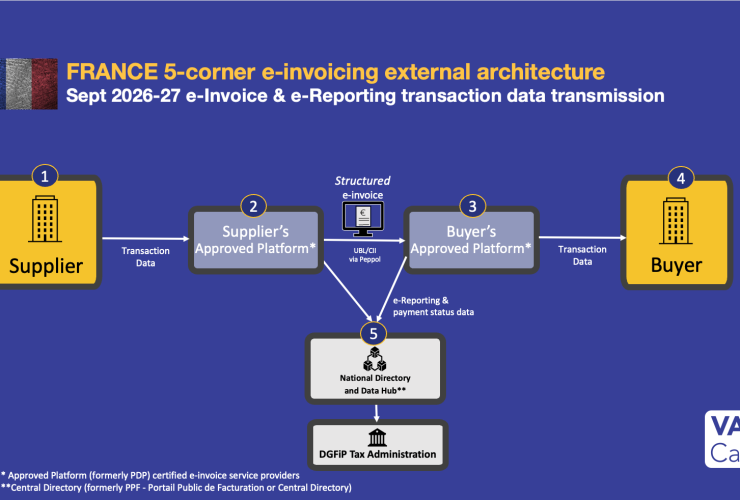
How France’s platform model works: PA’s; Central Directory
France is building a federated platform architecture:
- Taxpayers appoint agents, “Approved Platforms“, Plateforme agréée ‘PA’ (accredited e-invoicing service providers – formerly called PDP Partner Dematerialisation Platform)
- PA’s submit and receive e-invoicing on a new Central Directory (previously PPF Portail Public de Facturation). Directory is now officially launched with some 8,000 companies already registered.
DGFiP is now France’s Peppol authority, paving the way for integrating the international network’s standard in the 2026 launch of mandatory e-invoicing and e-reporting. AFNOR is the French Association for Standardisation, and has been appointed to over see the development of standard e-invoicing in France.
e-Reporting – tri-monthly reporting B2C & cross-border B2B transactions
For transactions outside of the scope of e-invoicing, there is a separate e-reporting to DGFiP. But the introduction is phased – initial only transactions where VAT actually collected (B2C); then extended Sept 202to where VAT is due but collected via reverse charge.
In scope:
-
Sept 2026 B2C (Business → Consumer / final person) transactions
Even though consumers don’t receive structured e-invoices, the supplier (or seller) must report data about those transactions. Depending on how the seller’s IT setup is arranged, there are three scenarios:
-
- If the seller uses Point of Sale (POS) software: report a daily “Z ticket” summary (all the receipts/tickets)
- If the seller already issues e-invoices: transmit invoice data through the same channel used in the B2B e-invoicing path (i.e., via PDP / PPF, etc.) without having to send the e-invoice version to the consumer
- If the seller lacks an IT / invoicing system: send a summary of all operations over a reporting period (every 10 days, or monthly)
-
Sept 2027 Cross-border B2B / international B2B; Reverse charge
Transactions where at least one party is outside France (or outside the EU) but the VAT burden is French, or intra-community flows, must be reported. These include:
-
- Intra-community deliveries (goods or services) to another EU country
- Exports (sales to companies outside the EU)
- Operations to overseas territories / French overseas communities
- Intra-community acquisitions (goods bought from another EU country, for use / resale)
- Reverse charge Article 194 and 199 of the VAT Directive
Penalties following initial four months soft landing
France’s penalty model is designed to be scalable and routine:
- E-invoice errors fine €50 (previously €15);
- E-reporting errors fine €500 per transaction (previously €250)
- Failure to appoint AP agent graduated fines €500 to €1,000 per month