July 2028 OSS return extension and revised reverse charge rules
Major new real-time compliance options, complexities & risks
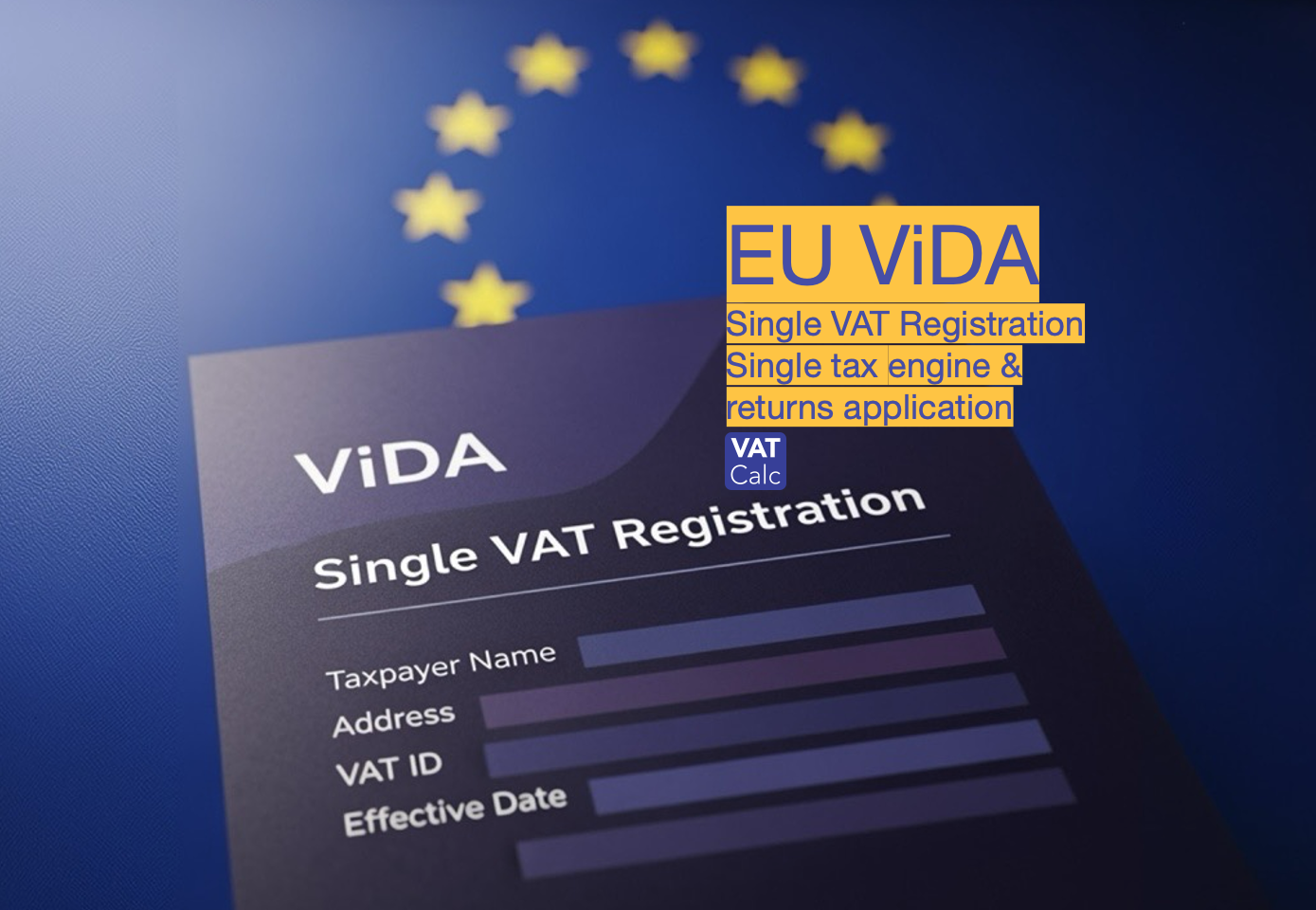
The July 2028 Single VAT Registration pillar of the EU ViDA reforms are set to offer simpler compliance for businesses and marketplaces – but created a new imperative for live identification of calculations and VAT return options.
Existing manual processes and disconnected legacy tech won’t cut it.

VATCalc is the world’s only single tax engine Calculator tax engine & Filer application uniquely built for the huge changes of the Single VAT Registration (SVR) reforms. And, VATCalc’s single app will be ready for the Pillar 1, Digital Reporting Requirements which are set for July 2030 – so no further tech required and costs controlled. Ignore what you have read elsewhere, VATCalc is the disruptive tax tech for ViDA.
ViDA - Single VAT Registration challenges
| ViDA challenge | VATCalc response | |
| 1. One Stop-Shop extension | ||
| Businesses transferring their own stocks, including for e-commerce, can adopt the single EU OSS return to limit the number of foreign registrations they need. | VATCalc’s tax engine, Calculator, is unique in with calculating the correct invoice VAT, it also determines the correct VAT returns to post transactions. | |
| But as OSS does not allow for VAT deductibility, many businesses will continue with a mix of local and OSS returns | VATCalc also produces the accurate regular or OSS VAT returns for filing. | |
| This must be determined with the issuance of invoices, including the calculation of the VAT and invoice disclosures (‘mentioning’). No accounting, ERP or non-tax law based tax engine will be able to manage this – putting shipments and VAT obligations at risk. | No other VAT tech does this. | |
| 2. 27 variations in country returns and OSS | ||
| The EU member states have retained full scope to set their own standards and processes for collecting transaction details in regular and OSS returns. Which means businesses will have to monitor, build and support as many different returns. | VATCalc supports all VAT return and OSS formats across the EU. This includes local filings: SAF-T; ESL; Intrastat; Control Statements; Ledgers and more. | |
| This major miss on harmonisation represents a huge resource ask for taxpayers; potentially putting a question over business models and smaller jurisdictions. | ||
| 3. Partial reverse charge harmonisation | ||
| The scope of methodologies for member states to mandate the reverse charge is being partially harmonised. | VATCalc has already codified the existing hyper-complex reverse charge rules by country. | |
| But this still requires taxpayers to understand x27 national variations and comprehend the conditions for applying VAT between the seller and acquirer. | We will be updating them in our content model as countries select their post-July 2028 models. So there will be no requirement for you to track or understand the differences. | |
| Failure to get this right – even if you are the customer – means you are directly liable still for VAT. | With VATCalc, it is all taken care of for your invoices and returns. | |
| 4. 2030 e-invoicing and e-reporting | ||
| ViDA also brings July 2030 mandate on e-invoicing between businesses and e-reporting to governments on own stock movements. | VATCalc also includes within its single app the ability to calculate VAT on e-invoiced or validate it on purchase invoice in real-time to meet this ViDA obligation. | |
| The adds a further layer of invoice calculation and e-reporting obligations which must tie to regular and OSS returns to avoid triggering audits | And since the e-invoices are then used as the source data for returns and OSS, there are no lengthy manual reconciliations or discrepancies for the authorities. |
Contact us for a FREE trial
The world’s first and only single VAT / GST tax engine and reporting application that simplifies your international VAT determination, invoicing and reporting for ViDA