From CNC to Cloud: integrating JD Edwards ERP with modern VAT engines
How VAT helps JDE enterprises achieve real-time VAT automation without leaving EnterpriseOne
Oracle’s JD Edwards (JDE) remains the quiet workhorse of European and global mid-market ERP — still powering thousands of manufacturing, logistics, and engineering businesses across complex multi-jurisdictional VAT footprints.

Yet, as Europe shifts towards real-time digital reporting and mandatory e-invoicing, many JDE environments are discovering that their batch-driven tax architecture is no longer enough.
The challenge: legacy VAT logic in a real-time world
JDE’s tax processing was built for a periodic world: transactions post to the General Ledger, and VAT reports are generated via UBEs (Universal Batch Engines). That model worked well under traditional return-based regimes.
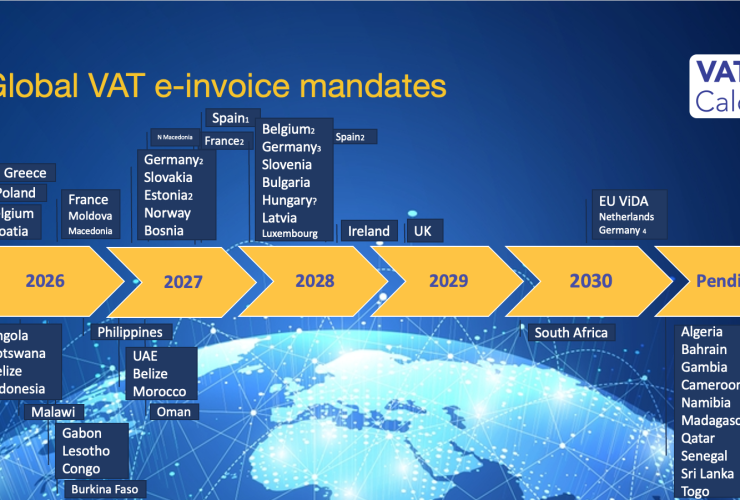
But the new generation of mandates — France PDP 2026, Belgium 2026, Poland KSeF 2026, Germany 2025-28 — require invoice-level validation and instant transmission to government or Peppol platforms.
These frameworks depend on:
- Real-time VAT determination (before invoice issue)
- EN 16931 tax code mapping and XML validation
- Clearance and acknowledgement status synchronisation
Native JDE functionality cannot provide these directly. Customisations or on-premise middleware can partially bridge the gap — but they add cost, latency, and risk when tax rules change.
From CNC to Cloud: the modern VAT integration model
VATCalc’s single tax engine allows JDE users to externalise VAT logic to a modern, serverless architecture — while keeping EnterpriseOne as the system of record. The approach decouples compliance complexity from ERP configuration.
VATCalc is already certified by Oracle NetSuite for global VAT returns.
Three practical integration patterns are typically used:
-
File-based orchestration
- JDE UBE exports AR/AP XML or CSV files to cloud storage (e.g. AWS S3 or Google Cloud Storage).
- VATCalc automatically ingests, determines, validates, and returns VAT-enriched data for posting and reporting.
- Minimal IT footprint, ideal for hybrid JDE World or EnterpriseOne setups.
-
Direct API integration via AIS Server
- Using JDE’s Application Interface Services (AIS), VATCalc REST APIs can be called during invoice creation or posting.
- The VAT engine returns compliant tax results, invoice status, and Peppol mappings in milliseconds — enabling near real-time e-invoicing without disrupting CNC layers.
-
Orchestrator Studio flows
- For users modernising their automation, VATCalc integrates directly into Orchestrator workflows.
- This allows visual low-code orchestration of VAT checks, e-invoice validation, and SAF-T preparation.
Each model enables cloud-native VAT automation without migration to Oracle Cloud ERP — the “CNC to Cloud” bridge.
Why this matters for compliance and scale
JDE customers operate across high-volume supply chains and multi-VAT registrations, where tax logic must reflect national law, not hard-coded setups.
VATCalc codifies the EU VAT Directive, national legislation, and Peppol BIS 3.0 mappings as legislative logic — ensuring accurate determination, validation, and reporting in every jurisdiction.
The benefits extend beyond compliance:
- Reduce tax and IT maintenance by removing local customisations
- Gain live visibility into e-invoicing and SAF-T data
- Prepare instantly for upcoming ViDA and EU Customs Reform integrations
Compliance without re-implementation
JD Edwards may pre-date Europe’s digital reporting era — but it doesn’t have to be left behind.
By externalising VAT logic to a serverless, real-time engine, enterprises can retain their trusted JDE landscape while meeting every new mandate from Brussels to Bucharest.
VATCalc’s single tax engine and Filer application are designed for exactly this: determination, validation, and reporting — in one cloud-native layer, no re-implementation required.
Would you like me to create a short version (≈ 300 words) for use as a LinkedIn post or landing-page teaser of this blog next?