A new IOTA paper: how ViDA-era invoice data could be automatically reconciled against VAT returns
Moving tax authorities from detection towards automated correction and enforcement
The next stage of VAT digitisation may not be e-invoicing. It could be automated reconciliation of e-invoices and digital reporting data against VAT returns.

A new paper published by the Intra-European Organisation of Tax Administrations (IOTA) proposes a Data Reconciliation Procedure (DRP) for the EU’s VAT in the Digital Age (ViDA) era.
The paper, written by Ferenc Vágujhelyi, former Commissioner of Hungary’s National Tax and Customs Administration, addresses a growing problem for tax authorities: transaction-level reporting increasingly allows them to identify VAT discrepancies automatically, but correcting them still often requires traditional intervention or audit
From detecting VAT errors to correcting them
ViDA and national digital reporting regimes fundamentally change the information available to tax authorities.
Instead of relying primarily on the periodic VAT return, administrations increasingly receive invoice-level transactional data. This allows them to calculate, or at least estimate, the VAT position that should appear on a taxpayer’s return.
The IOTA paper argues that the challenge therefore shifts from finding discrepancies to deciding what happens when a taxpayer does not correct them.
This is already emerging across Europe.
Hungary’s eVAT can prepare draft VAT returns from transactional information. Italy uses transactional data for precompiled VAT compliance records. Romania’s RO e-TVA creates a pre-filled VAT position which can be automatically compared with the taxpayer’s submitted VAT return. Significant discrepancies may generate an electronic compliance notice.
A new Data Reconciliation Procedure
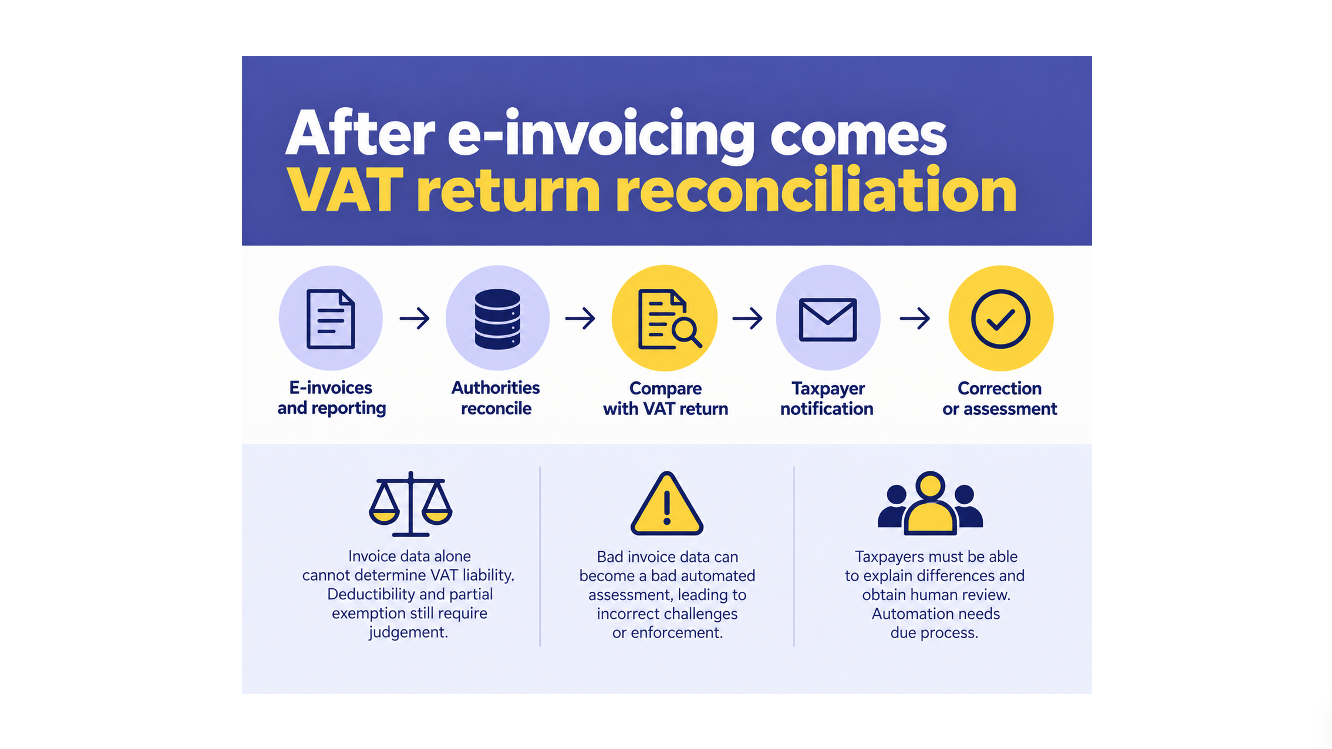
The paper proposes taking this further through an Automated Data Reconciliation with Due Process (DRP).
The tax authority would calculate a Data-Determined VAT Position (DDVP) using invoice and credit-note data.
This would then be compared with the taxpayer’s VAT return.
Where a sufficiently material and objectively identifiable difference exists, the authority could issue an Automated Reconciliation Notice identifying the transactions behind the discrepancy.
The taxpayer could then:
- accept the calculated position and submit an automatically generated correction;
- correct the underlying invoice data;
- explain a legitimate difference, such as non-deductible expenditure or partial exemption; or
- request human review where more complex VAT interpretation is required.
Importantly, the proposal is limited to discrepancies that can be established from transactional data. Complex questions of VAT deductibility and legal interpretation would remain outside automated assessment.
From VAT notice to automated assessment
The more significant proposal concerns what happens if the taxpayer does nothing.
Under DRP, an unresolved discrepancy could ultimately produce an Automated Assessment of the Delta (AAD). This would be enforceable as a normal tax assessment, while remaining subject to the taxpayer’s normal appeal rights.
This would move digital VAT compliance beyond simply identifying anomalies.
Tax authorities could potentially progress from:
e-invoice → digital reporting → VAT return → discrepancy detection
towards:
e-invoice → digital reporting → VAT return reconciliation → correction → assessment
ViDA changes the VAT return
This is particularly relevant as the EU implements ViDA.
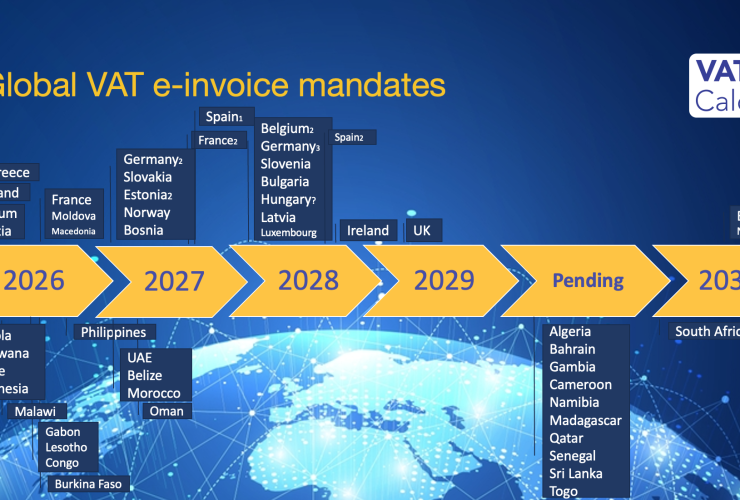
ViDA introduces harmonised Digital Reporting Requirements for intra-EU transactions and provides the framework for increasing alignment of domestic digital reporting systems.
As transaction-level data becomes more widely available, the traditional VAT return increasingly becomes the reconciliation point for data already held by the tax authority, rather than an isolated declaration of aggregated VAT figures.
The IOTA paper describes the potential transition as moving from “detect-and-chase” towards “prepare-and-confirm”, including draft VAT returns generated from transactional data.
Businesses will need to reconcile first
This development has an important consequence for taxpayers.
If tax authorities are going to reconcile VAT returns against e-invoices and digital reporting data automatically, businesses will increasingly need to perform the same reconciliation before submitting the return.
An invoice reported through an e-invoicing or DRR system cannot comfortably say one thing while the VAT return says another.
That increases the importance of connecting VAT determination, e-invoicing, digital reporting and VAT returns rather than treating them as separate compliance processes.
The direction of travel is becoming clearer:
Determine → Invoice → Report → Reconcile → VAT return
ViDA is therefore about considerably more than electronic invoices. It is helping create a transaction-level VAT compliance environment in which the tax authority can increasingly reconstruct, compare and challenge a taxpayer’s VAT position automatically.
The IOTA DRP remains a proposal, not an adopted EU procedure. But it provides a useful indication of what could follow once Europe’s tax authorities have the transaction-level data created by e-invoicing and digital reporting.