EU real-time VAT reporting: why live determination and VAT returns must be re-engineered together
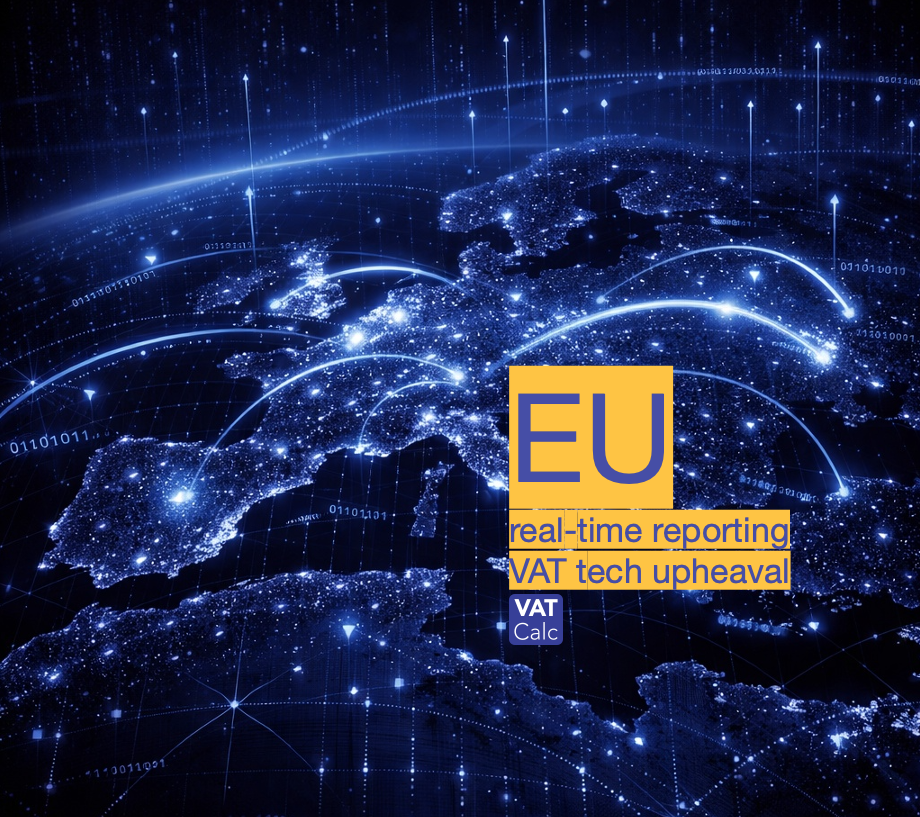
The EU’s move toward real-time VAT reporting marks the most fundamental recalibration of the VAT system since its creation. What began as national domestic e-reporting and e-invoicing mandates is now being consolidated under the EU’s VAT in the Digital Age (ViDA) framework, extending transaction-level digital reporting to intra-Community supplies.

Together, domestic e-reporting and ViDA intra-EU reporting represent a decisive break from periodic, summary-based VAT compliance. Tax authorities are no longer prepared to infer VAT outcomes weeks or months after the event. Instead, they expect VAT to be determined, reported and auditable at the point of transaction—using data structures and validations they control.
This shift forces businesses to rethink not only reporting, but the very foundations of VAT determination and VAT returns.
From periodic VAT returns to continuous compliance
Under traditional VAT models:
- VAT is calculated at invoice level, often using configurable ERP rules
- Transaction data is aggregated, reconciled and adjusted post-fact
- VAT returns are compiled as periodic summaries, detached from determination logic
Real-time reporting dismantles this separation.
Domestic e-reporting regimes already require transaction-level data to be transmitted to tax authorities in near real time. ViDA extends this logic to intra-Community supplies, introducing a harmonised EU framework but allowing Member States discretion over format, validation rules, timing and enforcement.
The result is not a single reporting model, but a matrix of national and EU-level variations that tax authorities will continuously refine.
Why real-time reporting demands live VAT determination
Real-time reporting is not simply a data transmission exercise. Tax authorities are increasingly using reported data to:
- Validate VAT treatment at source
- Cross-check buyer and seller reporting
- Identify misclassification, incorrect exemptions and fraud patterns
- Reconstruct VAT returns directly from transaction data
This creates a critical dependency: if VAT determination is not aligned in real time with reporting logic, errors are exposed immediately.
Legacy tax engines struggle here. Rules-based determination was designed for retrospective correction. In a real-time world, there is no tolerance for “fixing it in the return”.
VAT must be correct when reported—because that data becomes the tax authority’s system of record.
VAT returns are no longer static forms
ViDA and domestic e-reporting also fundamentally change the role of the VAT return.
Rather than being a primary declaration, VAT returns increasingly become:
- A control layer over transaction-level data
- A reconciliation mechanism for adjustments, corrections and special cases
- A legal artefact derived from reported transactions, not built independently
Crucially, tax authorities are expected to “slice” VAT data differently across Member States—adjusting reporting scope, aggregation rules and validations as domestic interpretations of ViDA evolve.
This makes static, country-specific VAT return solutions obsolete.
The structural failure of legacy tax technology
Most existing ERP tax engines and add-ons were built on three assumptions:
- VAT determination is rules-based and configurable
- Reporting is periodic and downstream
- National variation is handled via local products or extensions
Real-time reporting breaks all three.
To support domestic and intra-EU e-reporting, legacy platforms typically require:
- New determination layers for reporting-specific logic
- Parallel systems to format and transmit data
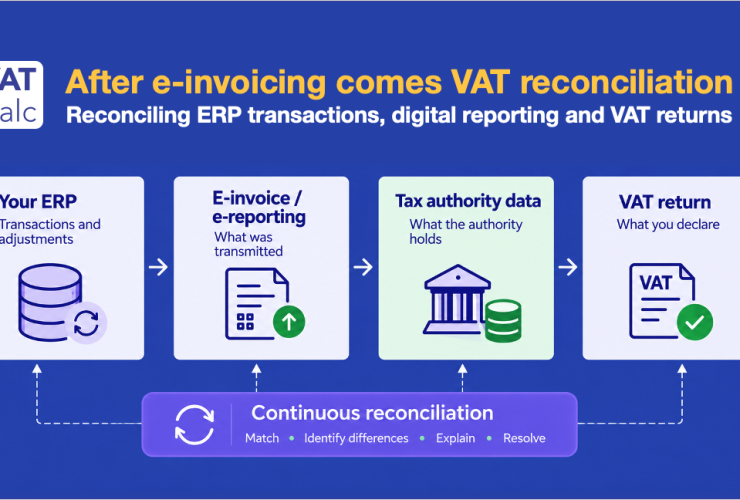
- Separate VAT return tools to reconcile reported vs declared figures
Each new national variation triggers further investment, duplication and risk.
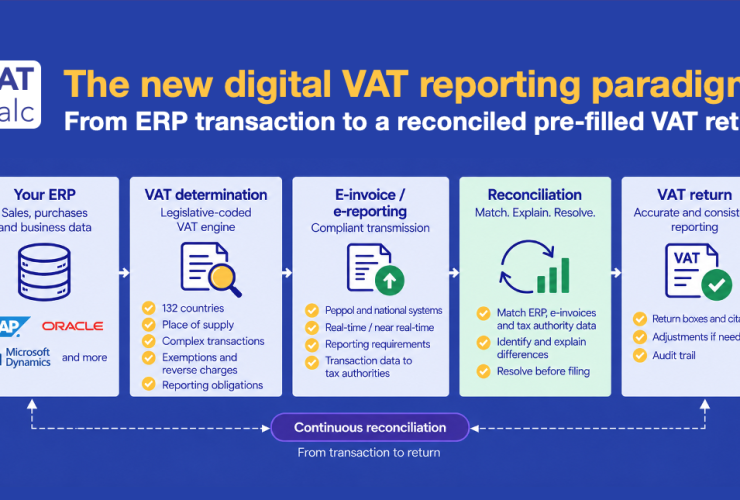
A single engine for determination, reporting and returns
This is where VATCalc is structurally different. VATCalc operates a single, live tax engine that underpins:
- Real-time VAT determination
- Domestic and intra-EU digital reporting
- VAT returns and OSS / IOSS filings
There is no handoff between systems, no re-interpretation of VAT logic, and no post-hoc reconciliation between determination and reporting.
The same legislatively-coded logic drives every outcome.
Legislatively-coded VAT for a variable reporting world
ViDA explicitly allows Member States to adopt variations in scope, timing and technical implementation. Tax authorities are expected to refine these rules iteratively.
VATCalc is designed for this reality. VAT logic is coded directly from legislation and official guidance, not inferred from configurable rules. When a Member State introduces a reporting nuance, it is absorbed as a legislative variation—not as a bespoke product or workaround.
This enables:
- Rapid adoption of national deviations
- A clear legal audit trail explaining VAT outcomes
- Consistency across invoices, e-reports and VAT returns
For tax authorities, this consistency is exactly what real-time reporting is designed to enforce.
VAT returns as a dynamic compliance layer
Because VATCalc integrates VAT returns within the same application:
- Returns are generated directly from reported transactions
- Adjustments are tracked with full legislative context
- Different reporting “views” can be produced without rebuilding logic
As tax authorities increasingly reshape VAT returns to reflect real-time data, VATCalc can adapt without introducing parallel systems or manual reconciliation.
Recalibrating VAT for the next decade
The imposition of domestic and ViDA intra-Community real-time reporting is not an incremental compliance change. It is a recalibration of VAT itself—from a retrospective tax to a continuous control system.
In that environment:
- Live VAT determination is non-negotiable
- VAT returns must be flexible, derivative and audit-ready
- Technology must absorb variation without constant reinvestment
Only platforms built as single, live VAT engines—spanning determination, reporting and returns—can meet these demands sustainably.
EU real-time VAT reporting will not tolerate fragmented tax technology stacks. The separation between determination, reporting and VAT returns is being dismantled by design.
With a single legislatively-coded tax engine and integrated VAT returns application, VATCalc is uniquely positioned for this new compliance reality—ready not just to comply with ViDA, but to adapt as tax authorities continue to reshape how VAT is determined, reported and enforced across Europe.