Why business ‘Use Cases’ will decide your September 2026 readiness
With less than two months until France’s mandatory e-invoicing regime begins on 1 September 2026, many businesses believe their biggest challenge is selecting an Approved Platform (AP) who are struggling to meet the launch.
It isn’t.

44 official businesses cases that almost nobody has mastered
The real challenge is ensuring every way your business invoices customers can be represented correctly within France’s new structured e-invoicing standards.
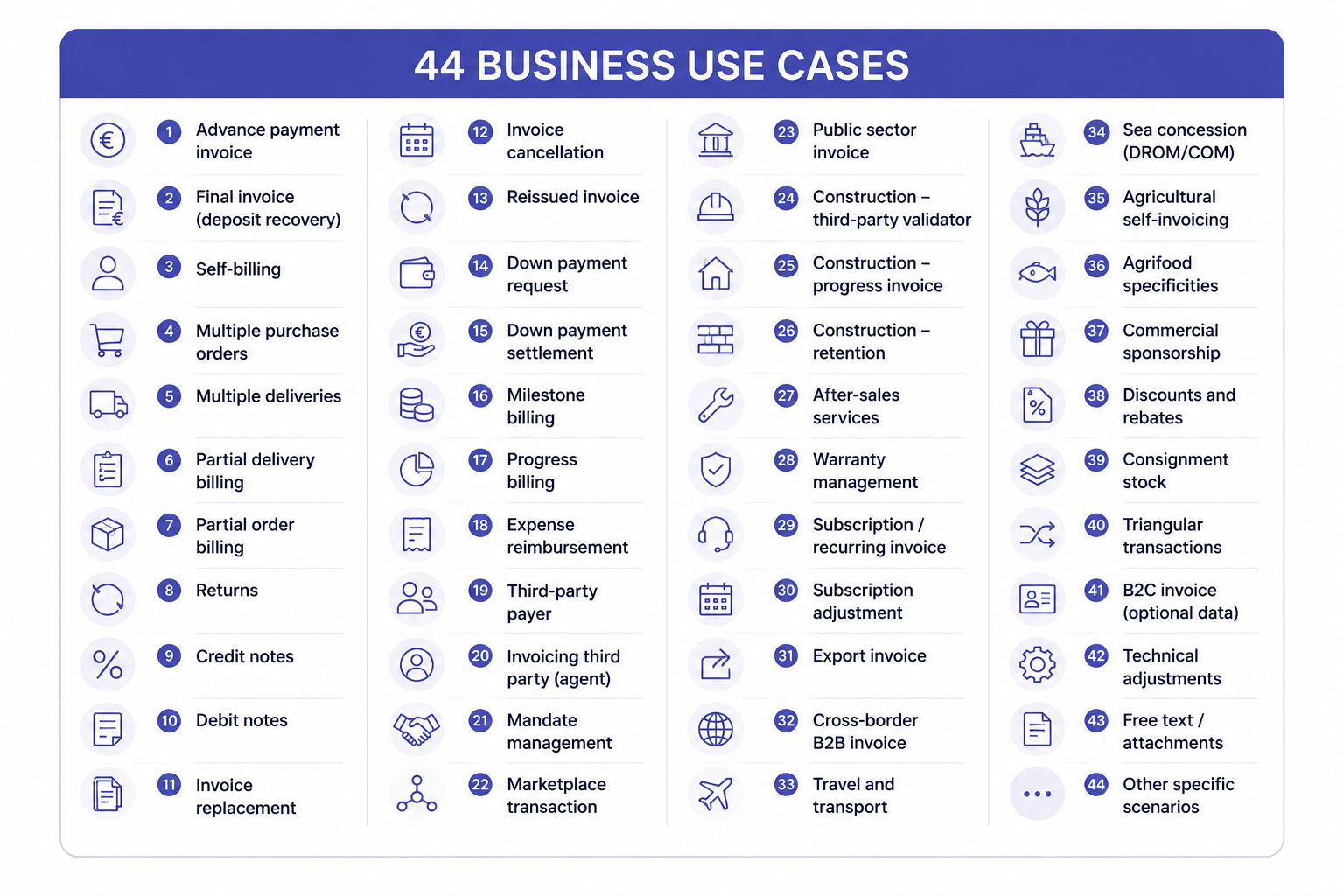
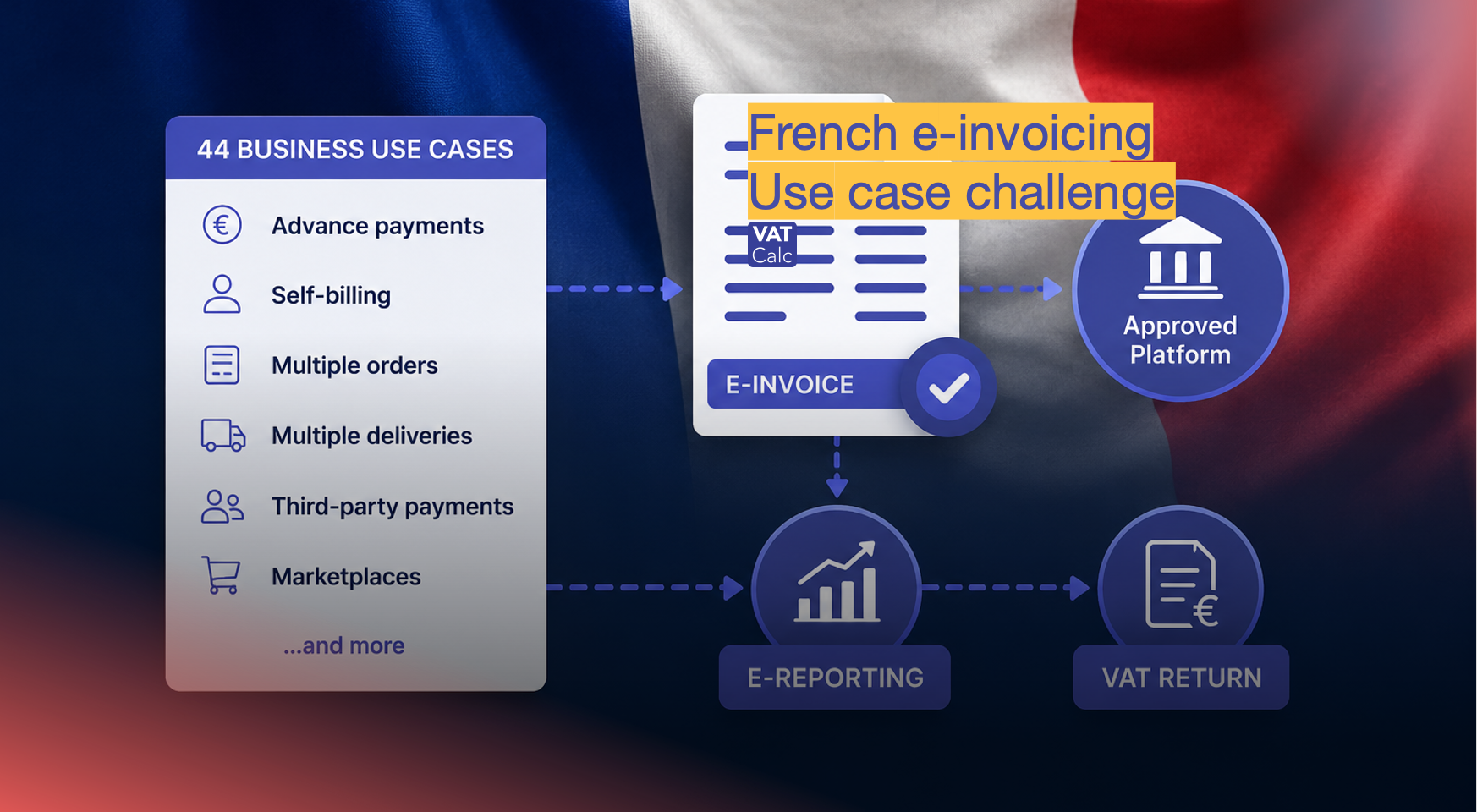
AFNOR’s latest XP Z12-014 standard identifies 44 recognised business use cases, covering everything from advance payment invoices and self-billing to multi-delivery orders, third-party payments and marketplace transactions.
For finance teams, the countdown is no longer about understanding the legislation. It is about understanding their own business processes.
The AFNOR standard now documents dozens of common commercial scenarios, including:
- Advance payment invoices and final invoices
- Self-billing arrangements
- Multiple purchase orders
- Multiple deliveries
- Expense reimbursements
- Third-party payers
- Marketplace transactions
- Construction industry validation workflows
- Agricultural self-invoicing
- Overseas territory specific requirements
Many organisations use several of these scenarios every day without recognising that they require specific structured data under the French mandate.
Approved does not necessarily mean complete
One important point often overlooked is that DGFiP approval confirms an Approved Platform satisfies the mandatory tax requirements.
It does not automatically mean the platform supports every AFNOR use case.
Businesses should therefore map their invoicing processes before selecting or configuring their platform, asking practical questions such as:
- Which of the 44 use cases are supported?
- Which require configuration?
- Which require custom development?
- How are future standards updates managed?
- How are complex invoice chains handled?
Understanding these answers before September is likely to avoid costly surprises later.
Don’t forget the VAT return
The invoice itself is only part of the compliance journey.
Every electronic invoice ultimately contributes to the company’s VAT position.
Consider an advance payment invoice.
The structured invoice must correctly represent the deposit, the final invoice must recover that deposit appropriately, and the VAT treatment must remain consistent throughout the transaction lifecycle.
Finally, those transactions must reconcile accurately to the VAT return.
If any stage differs, finance teams can face reconciliation problems between:
- ERP transactions
- Electronic invoices
- E-reporting submissions
- VAT returns
- General ledger balances
As governments increasingly use transaction-level data to pre-populate VAT returns and perform automated risk analysis, these reconciliations become critical.
Tax determination and e-invoicing are converging
France illustrates a wider international trend.
Electronic invoicing is no longer simply about transmitting invoices electronically.
It is becoming the structured representation of tax transactions.
That means VAT determination, invoice generation, digital reporting and VAT return preparation can no longer be treated as separate processes.
Each must agree with the others.
How VATCalc approaches the e-invoicing challenge
VATCalc’s legislative-coded tax engine sits between ERP transaction data and statutory reporting, helping businesses ensure that tax determination, structured invoice data and VAT reporting remain aligned.
Our e-invoicing capabilities are designed not simply to generate compliant electronic invoices, but to ensure that those transactions reconcile through to VAT returns and digital reporting obligations, providing a complete audit trail from source transaction to tax authority submission.
As France’s reforms demonstrate, successful e-invoicing projects are no longer judged simply by whether an invoice is accepted by an Approved Platform.
The real measure of success is whether every business scenario, every VAT treatment and every reported transaction remains consistent throughout the entire compliance process.