July 2030: should the EU harmonise invoice data, not the format?
Challenges to ViDA’s exclusion of EDIFACT as businesses warn billions in costs to changing established invoicing formats
The EU has a strong reason for harmonising electronic invoicing – but the focus has been on e-invoicing semantics

Today, businesses trading across Europe face a growing collection of national e-invoicing and digital reporting regimes. Different formats, platforms and reporting rules risk replacing the complexity of traditional VAT compliance with a new form of digital fragmentation.
ViDA is intended to stop that.
From 1 July 2030, the EU will introduce harmonised Digital Reporting Requirements for intra-EU B2B transactions, supported by structured electronic invoices. The objective is straightforward: create a common set of invoice data which businesses can exchange electronically and tax authorities can use for near-real-time VAT control.
But an unexpected argument is developing over how far that harmonisation needs to go.
Should the EU harmonise the data contained in an invoice, or also dictate the technical format businesses use to exchange that data?
Or, more simply: harmonise the data, not necessarily the transport syntax.
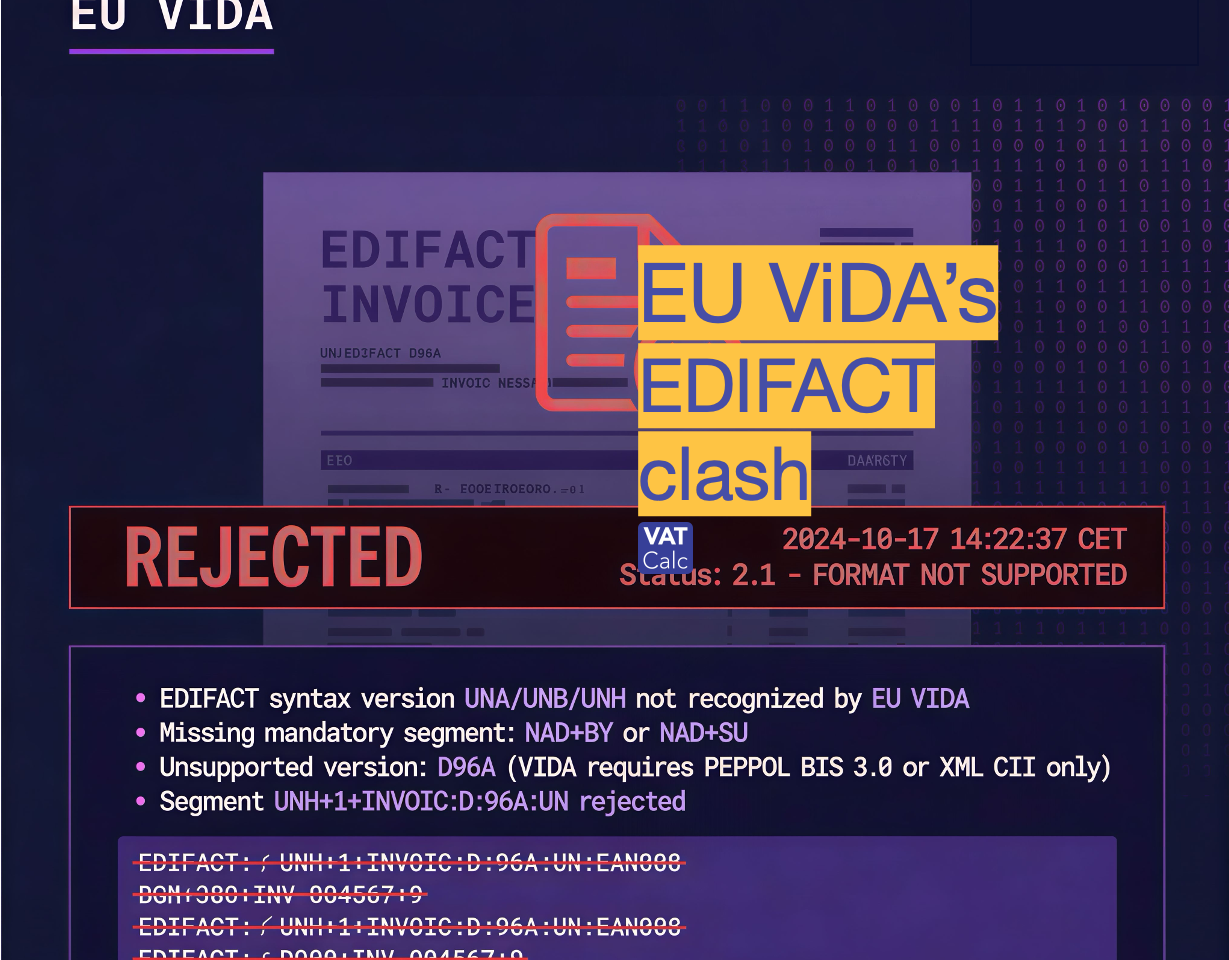
That distinction matters because one of Europe’s most established B2B electronic invoicing formats, EDIFACT, currently sits outside the two principal syntaxes recognised for the European e-invoicing standard.
ViDA points businesses towards UBL and CII
ViDA builds its new cross-border e-invoicing regime around the European standard EN 16931 and the list of syntaxes established under the EU’s existing public-procurement e-invoicing framework.
There are currently two mandatory syntaxes on that list:
- UBL 2.1; and
- UN/CEFACT Cross Industry Invoice (CII) D16B.
EDIFACT is not included.
That might sound like an obscure technical standards issue. For some of Europe’s largest supply chains, it is anything but EDIFACT has been used for decades to automate B2B transactions, particularly in automotive, retail, manufacturing and logistics.
BusinessEurope has now asked the European Commission to reconsider its treatment.
In a 1 June 2026 letter to DG GROW, it argues that businesses should continue to be permitted to exchange EDIFACT invoices rather than being forced to migrate established B2B processes to another syntax.
Why was EDIFACT excluded in the first place?
There is an historical wrinkle. EDIFACT was not rejected because it is incapable of carrying the EN 16931 invoice data.
EN 16931 actually has a specific syntax binding for UN/EDIFACT INVOIC D16B, CEN/TS 16931-3-4.
The reason EDIFACT did not make the mandatory syntax list lies in the origins of the European standard.
EN 16931 was developed principally to support electronic invoicing in public procurement. The Commission explains that EDIFACT was not included on the mandatory compliant list because it was not commonly used by public-sector entities. Public authorities were therefore required to support UBL and CII, but not EDIFACT.
That was understandable for B2G invoicing.
ViDA has now given that decision much greater significance. A syntax choice originally made around what government procurement bodies could reasonably be expected to receive is potentially determining how Europe’s private-sector businesses exchange invoices with each other from 2030.
That is what BusinessEurope is challenging.
Automotive asks: why change a B2B system that already works?
Automotive provides perhaps the clearest example.
EDIFACT is not simply the format used to create an invoice at the end of a transaction.
It can form part of an integrated electronic chain covering orders, forecasts, just-in-time delivery instructions, despatch notifications, receipt confirmations, invoices, remittance information and other messages.
Odette International describes its EDIFACT standards as covering the automotive industry’s wider Buy-Ship-Payprocess.
The invoice is therefore one message within a much larger automated B2B conversation.
And this infrastructure is still being actively maintained.
VDA, the German automotive industry association, released version 3.1 of its Global INVOIC implementation guideline in September 2025. Odette followed in February 2026 with an updated Joint Automotive Invoice Message based on EDIFACT.
ViDA could therefore require businesses to change an invoicing architecture that industry was still actively developing immediately before the new EU regime.
Automotive industry cites €12.5 billion cost
That potentially has a substantial price tag.
Automotive industry representatives have cited a VDA estimate of approximately €12.5 billion for the cost of changing technical B2B invoicing formats across the European automotive industry. Separately, Odette has cited an estimate of around €1 billion for German vehicle manufacturers alone to adapt their existing systems to the proposed requirements.
The underlying problem is clear: replacing EDIFACT is not necessarily a simple file-conversion exercise. Businesses may have ERP integrations, customer and supplier mappings, validation processes and EDI workflows built around it across thousands of trading relationships.
Harmonise the data, not necessarily the transport syntax?
There is a good argument for what the EU is trying to achieve. A genuinely harmonised European e-invoicing standard should prevent businesses having to accommodate a different technical system every time they trade across another EU border.
ViDA should be a force for simplification, not another layer of fragmentation – the problems of e-invoicing disharmonisation are well known. A common semantic invoice model is therefore important.
The question is whether achieving that requires every business to exchange the underlying commercial invoice using the same limited set of technical syntaxes.
The automotive industry’s answer is “no”.
Its alternative is conceptually simple:
- Supplier → Customer: continue exchanging the established EDIFACT invoice.
- Business → ViDA reporting: extract and map the required invoice data into the harmonised structure required by the tax authorities.
The tax authority still receives the same standardised VAT information.
What does not need to change is the established technical conversation between supplier and customer.
This is not an argument against ViDA harmonisation
That distinction is important. Allowing EDIFACT need not mean abandoning the EU’s attempt to create a common e-invoicing environment. Quite the opposite.
Europe can harmonise what an electronic invoice means without necessarily requiring every industry to communicate it in exactly the same way.
- The semantic layer tells businesses which information an invoice must contain and what each data field means.
- The syntax is how systems package and transport that information.
For VAT control, it is the harmonised and machine-readable data that ultimately matters. Indeed, the existence of an EN 16931 EDIFACT syntax binding demonstrates that EDIFACT and the European semantic model are not inherently incompatible.
ViDA has an opportunity to get both right
BusinessEurope is raising the issue while the EU’s wider e-invoicing framework is itself under review.
That gives the Commission an opportunity to consider whether the original B2G syntax restriction remains appropriate when EN 16931 becomes part of Europe’s much larger B2B VAT architecture. The goal of ViDA should remain ambitious: one increasingly harmonised European VAT data environment instead of 27 diverging digital reporting regimes.
But achieving that does not necessarily require Europe to discard functioning B2B infrastructure developed over decades.
The more proportionate answer may be much simpler: Harmonise the invoice data. Require interoperability. But do not necessarily harmonise the transport syntax.