France has exposed data and interoperability problems. But Poland shows how e-invoicing reaches deep into access, ERP and accounting processes
Eight months after Poland launched mandatory KSeF e-invoicing, evidence is emerging on where businesses are encountering problems.

It provides an interesting contrast with France. France’s first weeks highlighted data quality, identifiers and interoperability across its decentralised platform model. Poland’s centralised KSeF system is exposing different pressure points.
657 million invoices – and 319,000 calls for help
By 2 September 2026, KSeF had processed 657.4 million invoices from 2.37 million issuers.
Yet by 7 September, the Polish tax administration helpline had received almost 319,000 KSeF-related calls.
The Ministry of Finance says recurring questions concern permissions, authentication, qualified electronic signatures, system access and issuing and receiving invoices.
Moving invoices onto a central government platform has effectively made digital identity and authorisation part of everyday VAT compliance.
The problems go beyond access
Practical experience also shows how structured e-invoicing reaches into existing accounting processes.
MDDP identifies problems including:
- incorrect buyer VAT IDs, which can require an invoice to be corrected to zero and reissued;
- final invoices following advance payments, including incorrect VAT and links to earlier invoices;
- bulk corrections requiring traceability back to the underlying invoices; and
- employee purchases arriving centrally in KSeF without necessarily identifying which employee incurred the expense.
Earlier analysis also found errors in 18% of corrective invoices and incomplete information in around 10% of invoice XML files.
Businesses therefore need more than a working KSeF connection. They need their master data, ERP configuration and accounting processes to work with the new structured invoice model.
ERP to XML to VAT reporting
There is another important reconciliation issue.
The structured XML submitted to KSeF is the authoritative invoice. MDDP warns of the potential for differences between ERP data, that XML and the human-readable invoice visualisation.
This creates a new compliance chain:
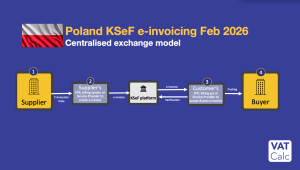
ERP → structured invoice → KSeF → accounting → VAT reporting
Errors or inconsistencies at one stage can flow into the next.
France and Poland: different systems, similar lesson
France has so far particularly highlighted data quality and interoperability. Poland highlights access, permissions and the redesign of internal invoice processes.
Different e-invoicing architectures are exposing different weaknesses.
But the broader lesson is similar: mandatory e-invoicing is no longer simply an invoice-format project.
As e-invoicing and digital reporting spread across Europe, businesses will increasingly need to ensure the whole digital VAT compliance chain reconciles – not simply that an electronic invoice can be transmitted.