New B2B e-invoicing will sit alongside SII reporting and pre-filled VAT returns, creating a growing reconciliation challenge
Is Spain creating Europe’s most complex digital reporting regime — and a reconciliation nightmare for taxpayers?

Its Crea y Crece B2B e-invoicing mandate adds another layer to an already crowded landscape of SII, VERI*FACTU and potentially pre-filled Form 303 VAT returns.
SII, VERI*FACTU and now 2028 Crea y Crece e-invoicing
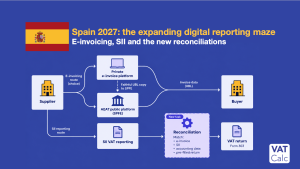
SII has operated since 2017 and requires qualifying businesses, including large companies and VAT groups, to transmit detailed VAT invoice-book information to AEAT, generally within four days.
VERI*FACTU introduces controls over invoicing software, including invoice integrity, traceability and record preservation. SII taxpayers are generally outside VERI*FACTU, so businesses will not normally face both regimes.
But Crea y Crece sits across this existing landscape.
From 6 October 2027, businesses with turnover above €8 million must issue and receive structured B2B electronic invoices. Other businesses follow from 6 October 2028.
More than e-invoicing
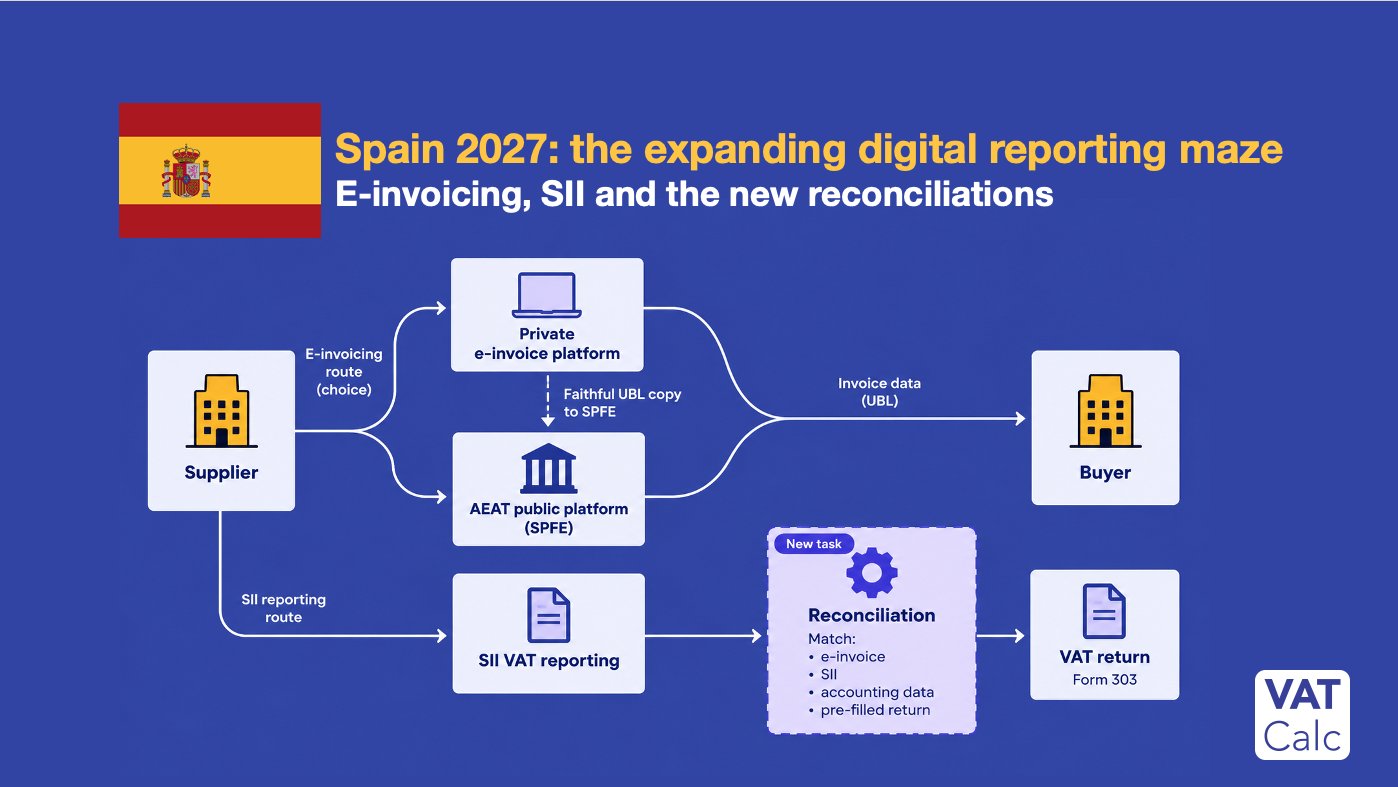
Spain has chosen a hybrid model. Businesses can use private e-invoicing platforms or AEAT’s public SPFE solution.
However, invoices exchanged privately do not remain outside the government system. An immediate faithful copy in UBL format must also be transmitted to SPFE, which acts as both an invoice exchange option and central repository.
Spain goes further by requiring invoice status and payment information. The October 2026 technical rules also establish validation and rejection procedures and a unique invoice identifier based on the supplier NIF, invoice number, series and issue date.
And potentially a pre-filled VAT return
Spain is also developing the use of pre-filled Form 303 VAT returns, using information already held by AEAT.
This potentially adds another dataset to the compliance process. Rather than preparing a VAT return solely from its own accounting records, a business may also need to compare its calculation with the return information pre-populated by the tax authority.
The objective is simplification. But where the underlying datasets do not agree, pre-filling can create another reconciliation exercise rather than eliminate one.
One transaction, multiple versions of the truth
This is where Spain’s complexity becomes apparent.
The same transaction may now be represented in:
- the structured electronic invoice and SPFE;
- SII VAT reporting;
- the business’s accounting and VAT records; and
- potentially AEAT’s pre-filled Form 303.
Timing differences, corrections, rejected invoices or incomplete source data can create discrepancies between them.
This illustrates a wider problem with tax digitalisation: more reporting does not necessarily mean less compliance work. Greater tax-authority visibility can also create more exception management for tax teams when different digital representations of the same transaction do not reconcile.
And ViDA is still to come in 2030
Spain must also accommodate the EU’s ViDA Digital Reporting Requirements for intra-EU B2B transactions from 1 July 2030.
The challenge is therefore increasingly one of integration rather than simply digitalisation.
This is why VATCalc treats VAT determination, e-invoicing, e-reporting and VAT returns as parts of the same transaction lifecycle. A common tax engine and data model can reconcile e-invoice, SII, accounting and pre-filled return data, identify discrepancies and reconcile the final VAT return.
Spain may have digitised its invoices. It has yet to simplify its reporting.