Flávio Bolsonaro is considering constitutional changes to Brazil’s new dual VAT system, including its estimated 28% rate and split-payment regime
Brazil’s 2026-33 VAT implementation faces fresh uncertainty after presidential candidate Flávio Bolsonaro pledged a review of the new consumption tax system ahead of the 25 October presidential runoff against incumbent Luiz Inácio Lula da Silva.
Bolsonaro, who finished first in the 4 October opening round, has said that several constitutional amendments are under consideration, including changes to the tax reform approved under Lula’s government.
A particular target is the expected combined rate of Brazil’s new federal and subnational VATs. The government originally estimated this at 26.5%, although subsequent estimates have suggested it could approach 28%.
The final effective rate has not yet been established. The 2023 constitutional reform instead requires the new system to be broadly revenue neutral compared with the five consumption taxes it replaces.
Could Brazil’s VAT implementation change or be delayed?
More significantly, Bolsonaro stated in June 2026 that, if elected, he would suspend implementation of the reform for at least one year while his administration developed revised legislation.
His economic team is also targeting one of the reform’s most significant compliance innovations: VAT split payment.
Under the planned mechanism, the VAT element of a transaction would be separated when payment is settled rather than passing entirely through the supplier. The government argues this should substantially reduce VAT fraud and the tax gap, potentially supporting a lower overall VAT rate.
However, Bolsonaro’s economic adviser Daniella Marques has said a new administration would seek to end split payment, arguing that it could damage businesses’ working capital.
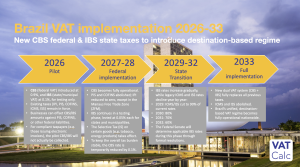
Voluntary B2B split payment is currently scheduled to begin in 2027, ahead of later mandatory implementation.
What does this mean for businesses?
Brazil’s reform replaces the existing fragmented consumption tax system with a federal CBS, state and municipal IBS, together with a separate Selective Tax on products considered harmful to health or the environment.
The transition is scheduled to accelerate from 2027, with the existing taxes progressively replaced and the new system fully implemented by 2033.
Changes to the timetable, VAT structure or split-payment mechanism could therefore have significant implications for businesses already preparing their ERP, tax determination, invoicing and reporting systems.
For now, however, Brazil’s legislated VAT transition remains unchanged. Businesses should continue preparations while monitoring the election and any subsequent constitutional or legislative proposals.