Brazil tax reform 2026 to 2032 – Federal Revenue Service issues compliance warning
- From 1 January 2026, Brazil’s indirect tax reform moves into its pilot implementation phase, embedding the new CBS (federal) and IBS (state/municipal) consumption taxes directly into electronic invoicing and day-to-day compliance.
- A 3-month penalty-free testing period will apply once CBS and IBS regulations are published in 2026, but after this window closes, incomplete or incorrect invoice reporting may trigger fines, loss of credits and operational disruption.
- The reform begins with testing and symbolic rates in 2026, expanding to split payment and full CBS operation from 2027, and concluding with the gradual transition from ICMS and ISS to IBS through 2029–2032.

Federal Revenue Service issues guidance on compliance
Brazil’s indirect tax overhaul is moving decisively from legislation to execution. Guidance released on 23 December 2025 by the Brazil Federal Revenue Service, together with the national management committee for states and municipalities, confirms that the implementation phase of the new consumption tax system will formally begin on 1 January 2026.
While 2026 is positioned as an “educational year”, the message to businesses is unambiguous: errors in the reporting of the new CBS (federal) and IBS (state and municipal) taxes will no longer be tolerated once the initial testing window closes, exposing taxpayers to penalties, loss of credits and potential operational disruption.
The reforms include imposing Brazilian VAT on digital services and updates to the Brazilian e-invoicingregime.
New CBS and IBS indirect taxes to simplify most complex regime in world
Brazil’s reform replaces a fragmented indirect tax landscape with a VAT-style model built around two new levies:
- CBS (Contribuição sobre Bens e Serviços) at the federal level, and
- IBS (Imposto sobre Bens e Serviços) at state and municipal level, gradually substituting ICMS and ISS.
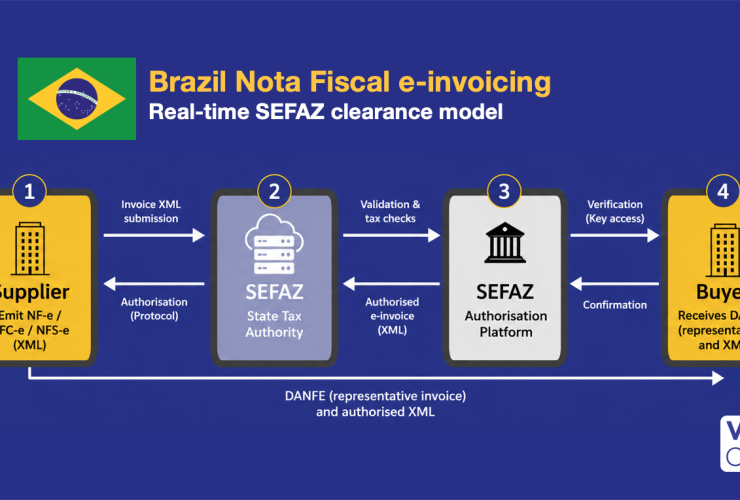
The newly issued guidance focuses less on policy intent and more on execution. It confirms that CBS and IBS will become embedded into the country’s electronic invoicing framework, making the invoice the primary compliance vehicle for determining, reporting and ultimately collecting consumption taxes.
Although invoice layouts will broadly resemble existing formats, new mandatory data fields for CBS and IBS must be completed accurately. Once enforcement begins, incomplete or incorrect invoices will no longer be a technical issue—they will be a tax risk.
2026 Three-month testing period once regulations published
To support the transition, the authorities have confirmed a three-month penalty-free testing phase. This window begins only after the detailed CBS and IBS regulations are formally published in 2026.
During this period:
- Businesses must populate CBS and IBS fields on invoices,
- No actual tax will be collected, and
- Errors will not trigger fines or automatic invoice rejection.
The timing matters. If regulations are issued in January 2026, mandatory accuracy would apply from 1 May 2026. A February publication would push that date to 1 June 2026. After that point, the tolerance ends.
The Revenue Service has stressed that this period is intended for system calibration and learning—by both taxpayers and tax authorities—not as a deferral of compliance.
Phased introduction between 2026 and 2032
The guidance also reiterates that Brazil’s consumption tax reform is underpinned by a new, centralised technology platform designed to process transaction volumes on an unprecedented scale.
In 2026, the system will operate with a symbolic 1% rate, offset against existing taxes to avoid an immediate cash impact. This allows authorities to validate data flows, reporting logic and settlement mechanics before full financial consequences apply.
From 2027, the reform accelerates:
- Federal PIS and Cofins are eliminated,
- CBS becomes fully operational for B2B transactions, and
- A split-payment mechanism begins to apply, redirecting part of the tax directly to the authorities.
Between 2029 and 2032, ICMS and ISS are phased out as IBS rates progressively increase, completing the transition to the new model.
Revenue Service targets invoice determination
According to the Revenue Service, invoice complexity is not increasing in form—but it is increasing in consequence. Once the testing phase ends, mistakes in CBS or IBS fields may lead to:
- Fines and administrative penalties,
- Rejected or delayed transactions,
- Denial of input tax credits, and
- Cash-flow pressure caused by unrecoverable VAT-style credits.
Incorrect product classification or incomplete parameterisation could prevent buyers from claiming credits, creating downstream commercial disputes and payment delays. In extreme cases, documentation errors may even block the movement of goods.
2026: the decisive preparation year
The official timeline makes one point clear: 2026 is not a soft launch—it is the final rehearsal. Businesses that wait until enforcement begins risk discovering system weaknesses when penalties are already in play.
Practical steps to take now include:
- Monitoring the publication of CBS and IBS regulations;
- Mapping how the new taxes apply to different transaction types;
- Updating ERP and billing systems to support new invoice fields;
- Testing data accuracy during the penalty-free window; and
- Training tax, finance and billing teams on the new logic.
The Federal Revenue Service’s guidance positions the invoice as an immediate compliance checkpoint under the new regime. From mid-2026 onwards, accurate CBS and IBS reporting will determine whether a business can trade smoothly—or face financial and operational consequences.
In short, Brazil’s indirect tax reform has moved beyond theory. From 2026, compliance will be tested transaction by transaction, invoice by invoice.