Brazil sets implementation timetable for IBS/CBS e-invoicing reforms
6 August 2026 update: the implementation timetable for the new IBS/CBS e-invoicing regime was published. This covers the 2026-32 Brazil VAT implementation.
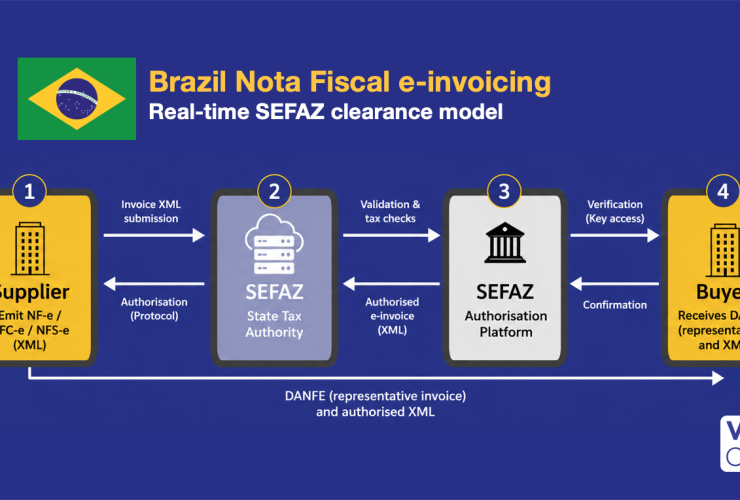
Brazil Nota Fiscal framework requires businesses to issue, validate and archive electronic fiscal documents through federal, state or municipal tax authority platforms before goods or services may be supplied.
2026 rollout timetable
The phased rollout began on 3 August 2026 with the core electronic invoice and transport document models, before extending to service invoices, digital platform reporting and other specialist fiscal documents through to 1 January 2027.
3 Aug 2026 – Core fiscal documents (NF-e, NFC-e, CT-e and others) begin supporting IBS/CBS
1 Oct 2026 – Services invoices (NFS-e), telecoms and import documents
1 Dec 2026 – Digital platforms, digital products and sector-specific documents
1 Jan 2027 – Import declarations and Simples Nacional reporting
Main Brazilian electronic fiscal documents
Brazil does not have a single invoice type. Instead, different electronic fiscal documents apply depending on the transaction:
- NF-e: electronic invoice for sales of goods
- NFC-e: consumer electronic invoice for retail transactions
- NFS-e: electronic service invoice, historically managed by municipalities
- CT-e: electronic transport document for freight services
- MDF-e: electronic manifest for transport and logistics movements
- NF3e: electronic invoice for energy and utilities
- NFCom: electronic invoice for communications and telecoms services
- BP-e: electronic ticket for passenger transport, including new air transport developments
Each document has its own XML layout, validation rules, authorisation flow and cancellation or correction process.
Brazil’s dual VAT reform changes the e-invoicing model
Brazil’s tax reform will replace a complex mix of federal, state and municipal taxes with two VAT-style taxes:
- CBS: Contribution on Goods and Services, administered federally
- IBS: Goods and Services Tax, administered at state and municipal level
During the transition, old and new taxes will coexist. This creates a significant systems challenge because businesses must continue supporting existing Brazilian tax rules while also calculating and reporting the new CBS and IBS fields.
Impact on NF-e, NFC-e and other fiscal documents
The new rules require changes across Brazil’s electronic fiscal document ecosystem. NF-e and NFC-e layouts are being updated to include CBS, IBS and, where relevant, Selective Tax information.
Other documents, including NFS-e, CT-e, BP-e and sector-specific fiscal documents, are also being adapted through technical notes and updated XML structures.
National NFS-e standardisation
Service invoicing has historically been one of the most fragmented areas of Brazilian compliance, with thousands of municipalities operating their own NFS-e formats and portals.
Brazil is now moving towards greater standardisation through the National NFS-e programme. This aims to reduce municipal fragmentation and provide a more consistent model for issuing and reporting service invoices.
For businesses operating across multiple cities, this is a major simplification opportunity. However, it also requires careful monitoring because local and national requirements may continue to coexist during the transition.