July 2027 delay to rollout of 3-model split payments of new CBS and IBS indirect taxes to authorities
Brazil has provided further detail on how its radical split payment VAT mechanism will be introduced under the new CBS and IBS regime (similar to VAT).
Although CBS begins on 1 January 2027, split payment will not be available immediately. Instead, a voluntary pilot is expected from mid-2027 covering B2B transactions settled via Pix, bank transfers and bank slips, with credit and debit card payments joining in a later phase.
3 split payments operating models
Authorities have also confirmed three operating models:
- a real-time “super-smart” system;
- “smart” model where input tax credits are released within three business days; and
- a simplified model for retail and small businesses.
However, the timetable for mandatory adoption remains uncertain, leaving businesses waiting for further implementation guidance.
Jan 2027 VAT split payments measure to tackle fraud
Brazil’s implementation of VAT starting 1st January 2026 sets a path for an innovative “intelligent split payment” system designed to reduce VAT fraud and improve compliance.
This will go live from a delayed mid-2027, initially on a voluntary basis for B2B transactions. This is based on the 30 April 2026 Executive Branch published regulations Decree No. 12,955/2026 and Resolution No. 6/2026
Feb 2026 Launch DF-e document testing for new VAT Split Payments mechanism
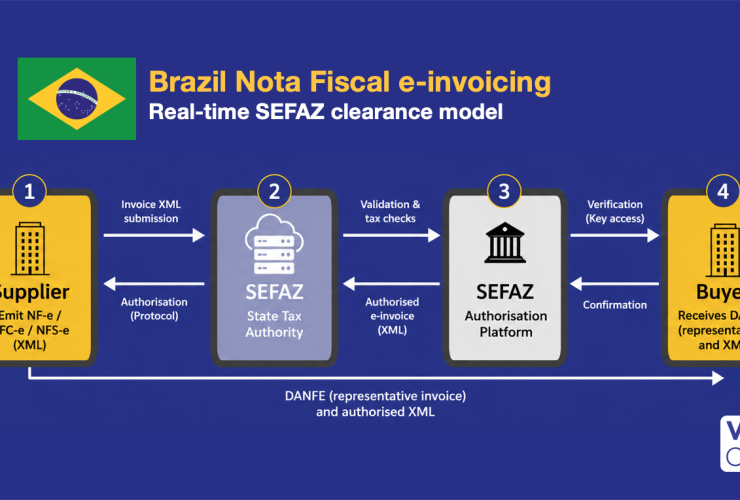
The new mechanism for reporting Split Payments in the existing mandatory electronic DF-e (Documento Fiscal Eletrônico or Electronic Tax Document) has been confirmed.
Under this system, payment service providers will not only split the payment but also verify, through the tax administration system, whether the supplier has VAT credits available to offset against the VAT due on a transaction. If the supplier has sufficient VAT credits, the payment service provider will transfer the full amount to the supplier, as the VAT obligation will be covered by the credits. This approach aims to mitigate cash flow issues and minimise the need for VAT refund claims.
This system marks another pioneering step for Brazil, which, along with Chile, led the way in electronic invoicing during the 1990s.
Unexpected Features of the New Legislation
Despite the broad framework of the new indirect tax system being incorporated into Brazil’s Constitution, the approved supplementary law contained some notable surprises.
- Intelligent Split Payment as a Default Rule – During the transition period, split payment will apply to nearly all payment operations (except cash transactions). A key feature of this system is a consultation mechanism where financial operators must access and verify tax authority databases to determine whether the tax reported on an invoice has been paid. This advanced structure will necessitate significant technological investment by banks and other financial institutions.
- Credit-Deduction Condition – Under the new system, buyers can only claim VAT credits once the supplier has effectively paid the corresponding tax. This represents a major shift from the current regime, where VAT credits can be deducted as soon as the buyer receives the invoice. This change will introduce new accounting complexities, necessitate enhanced controls, and create cash flow challenges for businesses.