Implementing regulation sets the technical for OSS expansion and 2028 Single VAT Registration reforms
The European Commission has published Commission Implementing Regulation (EU) 2026/1869, providing the detailed technical and administrative rules needed to operate the Single VAT Registration (SVR) pillar of the VAT in the Digital Age (ViDA) reforms.

There are now two SVR channels: extension of the One Stop Shop (OSS); and Securing Import One Stop Shop IOSS. The first January 2027 Single VAT Registration changes were confirmed in separate Explanatory Notes.
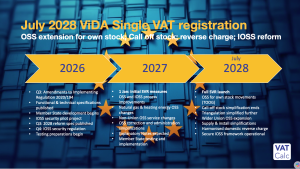
While the regulation introduces no new VAT obligations, it establishes the common electronic registration, reporting and data exchange framework that will underpin the expanded One Stop Shop (OSS) from 2027 and the wider Single VAT Registration regime from July 2028.
The regulation updates the existing rules governing the Union OSS, non-Union OSS and Import One Stop Shop (IOSS), whilst introducing the administrative framework for the new Transfer of Own Goods scheme.
Transfer of Own Goods scheme takes shape
One of the most significant changes is the introduction of the new Transfer of Own Goods scheme, a key element of ViDA’s Single VAT Registration package.
From 1 July 2028, qualifying cross-border movements of a business’s own stock between EU Member States will be reportable through a new OSS-based mechanism, reducing the need for multiple local VAT registrations. The implementing regulation defines the registration processes, electronic reporting formats and VAT return structure needed to operate the scheme.
Common electronic reporting across the EU
The regulation introduces a harmonised electronic data model for all VAT special schemes. Businesses will submit standardised VAT returns covering:
- Union OSS
- Non-Union OSS
- Import OSS (IOSS)
- Transfer of Own Goods
The new return structure captures considerably more information, including Member States of dispatch and consumption, VAT rates, taxable amounts, transfers of own goods and subsequent corrections. This common format is designed to enable automated processing and reconciliation by tax authorities across the EU.
Stronger data sharing between tax authorities
Member States will also automatically exchange OSS and IOSS registration information through a central register or other trusted data-sharing platform. This includes VAT identification numbers, intermediary registrations and registration status, ensuring every tax authority has access to up-to-date information. Registration forms will also be pre-filled using existing national data wherever possible, although taxpayers remain responsible for verifying its accuracy.
More information required at registration
The new registration dataset expands the information businesses must provide, including:
- VAT group status
- electronic interface (marketplace) indicator
- fixed establishments
- previous OSS registrations
- intermediary details
- website information
These additional data fields support the expanded scope of ViDA and improve cross-border administrative cooperation.
SVR January 2027 to July 2028 implementation
The regulation will apply in two stages:
- 1 January 2027 – new registration data requirements supporting the first phase of the expanded Union OSS.
- 1 July 2028 – the main operational changes take effect, including the Transfer of Own Goods scheme and the revised electronic VAT returns.
Although largely technical, the regulation provides the blueprint that software providers, ERP vendors and tax engines will need to implement the next phase of ViDA.
EU VAT in the Digital Age reforms
| EU VAT in the Digital Age | |
| 3 pillars to improve efficiency of VAT for all and reduce fraud | |
| 1. Digital Reporting Requirements; e-invoicing | Jul 2030-35: Mandatory digital reporting of intra-community transactions; obligation to be able to issue and receive intra-community e-invoices; member states free to impose own e-invoicing or real-time reporting but most conform to EU e-invoice standard EN 16931 |
| Read more about EU Digital Reporting Requirements (DRR) | |
| Structured e-invoices mandated for intra-community supplies | |
| EC Sales lists replaced by Digital Reporting Requirements | |
| 10-day e-invoicing deadline for intra-community sales | |
| 5-day e-reporting time limit intra-community purchases | |
| Withdrawal of EU permission requirements for e-invoicing | |
| Central VIES database launch | |
| 2 Platform economy | Jul 2028 / Jan 2030: Travel & accommodation sharing platforms to become deemed supplier / liable to users' VAT. New definitions of the roles of providers, users and platforms to avoid double and no-taxation (voluntary Jul 2028) |
| Read more - Travel & accommodation platforms deemed suppliers for EU VAT | |
| 3 Single VAT Registration; extension of OSS | July 2028: Following the 1 July 2021 introduction of the One Stop-Shop (OSS), extended to cover movement of own stocks prior to cross-border B2C to reduce the foreign, non-resident VAT registrations & returns. Plus to movements of own stock with ending of 'call-off' stock burden |
| January 2027 initial changes | |
| Transfer of own goods OSS extension | |
| Call-off stock VAT simplification ends | |
| Harmonisation of B2B Reverse Charge rules | |
| Creation of Single VAT Registration identiy | |
| Securing IOSS (Mar 2028) | |