Food VAT Cut Fully Reached Consumers, Challenging Critics of Temporary Tax Relief
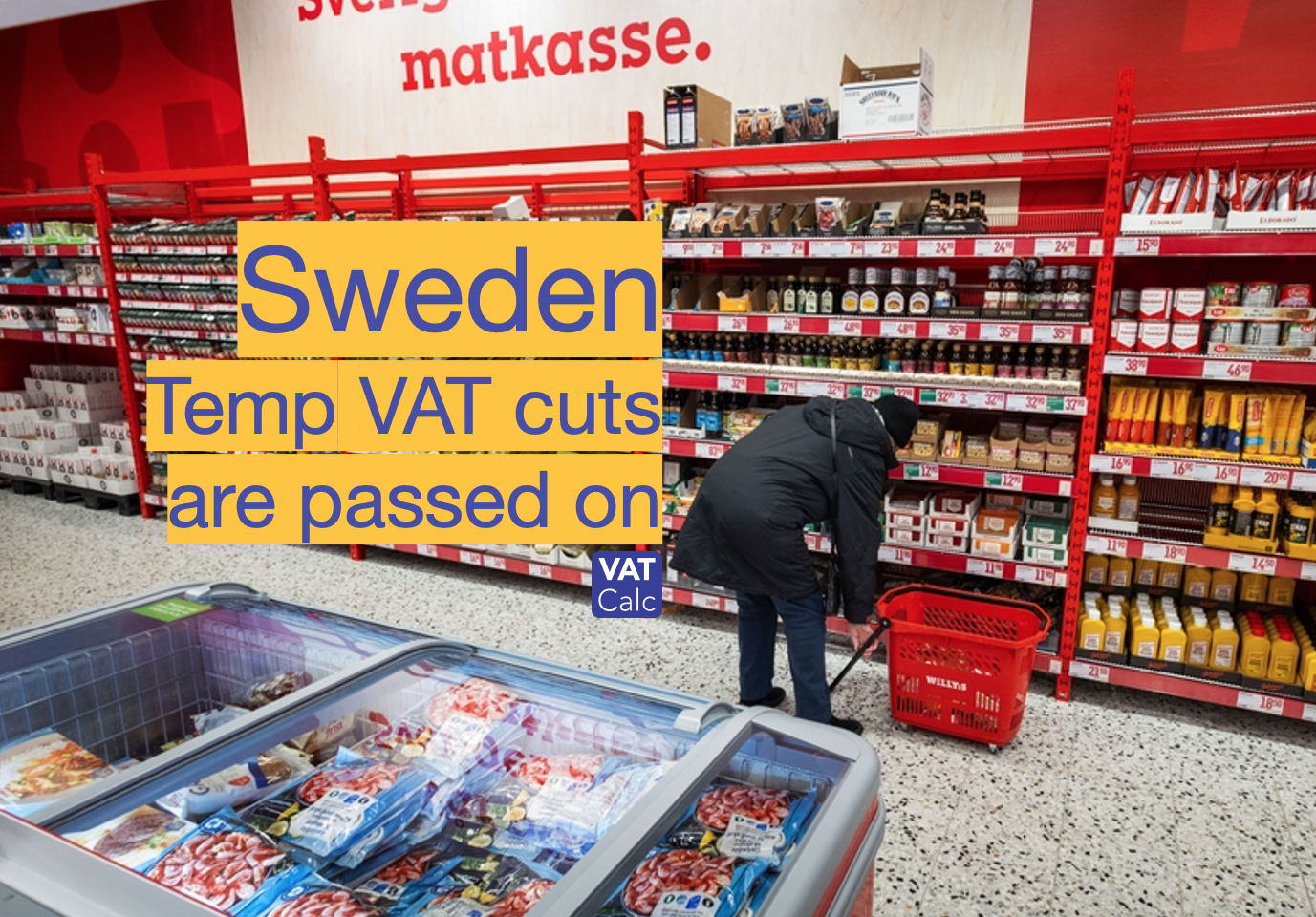
Sweden’s temporary halving of VAT on food appears to have achieved what many economists and policymakers often assume is unlikely: the tax cut was fully passed on to consumers through lower supermarket prices.

A new evaluation by the Swedish Consumer Agency and the National Institute of Economic Research concludes that retailers reduced prices by the full amount of the VAT reduction. This was a cut from 12% to 6%, introduced on 1 April 2026 and scheduled to run until 31 December 2027.
For VAT policymakers, this is a suprising result. And stumped me, too!
VAT cuts do not always benefit consumers
Temporary VAT reductions have long divided economists – and I’m not a fan as I’ve said in the past on this blog.
Supporters argue they provide rapid relief during inflationary periods. Critics counter that retailers simply absorb some or all of the tax saving into higher margins, leaving consumers with little benefit while governments sacrifice significant tax revenues.
I’ve has previously questioned whether broad VAT reductions and subsidies are always the most effective policy response. In practice, many relief measures suffer from uncertain pass-through, poor targeting or substantial fiscal cost.
The Swedish findings suggest that concern was misplaced in this case. Have we all been wrong?
According to the government-commissioned review, grocery retailers passed through the VAT reduction in full, resulting in lower food prices rather than increased retailer profits. The average family is estimated to save around SEK 6,500 annually under the measure.
Wait! Maybe Sweden is just different?
The report does not necessarily prove that all VAT cuts work. Several factors may have helped ensure full pass-through:
- the food retail sector is highly price competitive;
- the VAT reduction was simple and transparent;
- consumers could easily compare grocery prices;
- government and media scrutiny created pressure on retailers to reduce prices immediately.
Other sectors with more complex pricing structures or weaker competition may produce very different outcomes.
Lessons for future VAT policy
The Swedish experience provides useful evidence for governments considering VAT reductions as an anti-inflation measure.
Too often, debates about indirect tax relief rely on theory rather than empirical evidence. Sweden now offers one of the clearest real-world examples that, under the right market conditions, temporary VAT reductions can reach consumers almost exactly as intended.
That should not automatically revive enthusiasm for widespread VAT subsidies.
Temporary VAT rate changes remain operationally expensive for businesses, create compliance complexity and inevitably require another round of systems changes when the reduced rate expires. Governments also face significant revenue losses, making such measures difficult to sustain.
The more balanced conclusion is that effectiveness depends less on the VAT cut itself and more on market structure.
Where competition is strong and prices are highly visible, Sweden demonstrates that VAT reductions can genuinely reduce consumer prices. In less competitive markets, policymakers should remain cautious before assuming tax cuts will automatically benefit households.
That is the VAT multiplier that matters.
See more in our Swedish VAT guide.