HMRC is getting sharper on legal issues resulting growing need for human VAT expertise
- HMRC is combining increased enforcement with AI-driven insight to sharpen VAT enquiries
- Disputes are becoming more technical, with legal interpretation now dominant
- AI is increasing demand for VAT specialists, not reducing it

The UK’s HMRC is not just increasing VAT enforcement. It is getting better at it. And in a neat twist, Artificial Intelligence may be fuelling a hiring boom amongst VAT advisory firms, not replacing it – a twist in the Jevons Paradox (new tech generates more demand which begets more employment).
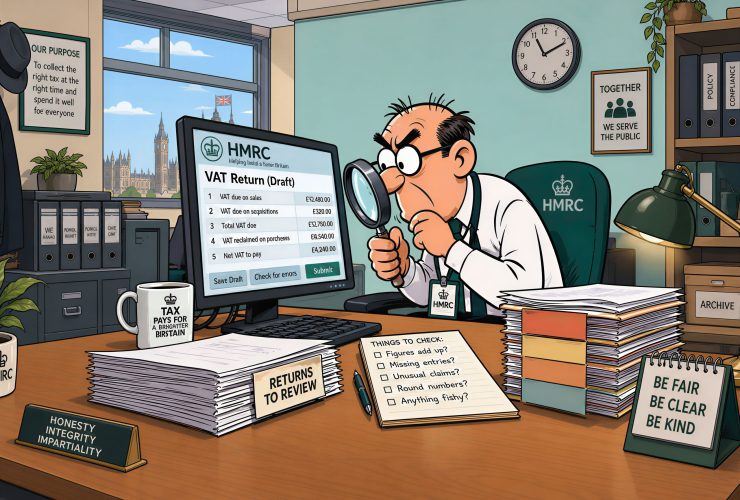
Investigations into large and mid-sized businesses rose 31% to 11,894 in the year to March 2025, part of a deliberate push to close the UK’s £11.9bn VAT gap. But this is not just more cases. It points to a tax authority using AI and advanced analytics to generate better risk insights, ask more precise questions, and pursue higher-value technical positions.
HMRC’s VAT audit pivot to legal interpretation
Around 85% of VAT disputes now centre on legal interpretation – a shift process error. This is HMRC moving upstream: challenging how businesses apply exemption, partial exemption methods and zero-rating, rather than whether they followed process.
The direction of travel is clear: fewer blunt audits, more forensic challenges.
There is a persistent narrative that AI will reduce demand for tax advisers. In VAT, the opposite is emerging. Better-informed challenges from HMRC.
UK HMRC is building Large Language Model to help identify VAT evasion
The jobageddon irony: more AI equals more advisers
AI is raising the VAT capability of HMRC and other tax authorities. But instead of simplifying VAT, it is making disputes more sophisticated. That changes what businesses need internally:
- Deeper legislative expertise, not just process control
- Audit-ready legal reasoning behind every VAT position
- Capacity to manage longer, more technical enquiries
And with HMRC opening more cases than it closes, those enquiries are lasting longer.
AI was supposed to reduce reliance on human expertise. In VAT, it is probably doing the opposite – or at least upskilling the level of hire.
Global adoption by tax authorities of Artificial Intelligence
Beyond the UK, many other tax authorities have been engaging with AI to detect errors and fraud, as well as improve the tax payers’ experience:
- Malta claims it raised tax tax by €400m in 2024 using predictive AI
- Greece is establishing a specialist AI unit using MyDATA VAT transactions for detecting fraud.
- Austria AI unit has been targeting missing trader VAT fraud with impressive results.
- Romania claims to have boosted VAT receipts by up to 1% in the last 12 months via AI and robot adoption.
- Italy, possibly the most fervent users of AI for detecting tax evasion, last year identified over 1 million high-risk cases with AI-driven data analysis. This includes a latest algorithm that cross references financial data to identify taxpayers at risk of not paying. Its VeRa algorithm compares tax filings, earnings, property records, bank accounts and electronic payments looking for discrepancies. High-risk taxpayers then receive a letter asking them to explain the differences. The more data VeRa processes, the smarter it becomes.
- Vietnam has announced that it will be adopting Artificial Intelligence before the end of 2023 to help identify tax fraud. This includes, for example, to flag firms that issue invoices too often, for unusually high amounts or in other ways indicating attempts to slash taxable revenue.
- Australia claims to have identified over $530 million in unpaid tax bills and prevent $2.5 billion in fraudulent claims using AI models, including deep learning and natural language models.In addition to detecting underpayments, the ATO’s AI systems have also been utilized to combat GST fraud. This includes the ATO has employing gradient-boosting machine learning models, which have been successful in identifying fraudulent behavior patterns.
- US, the Inland Revenue Service has drawn-up a second-half 2023 plan to adopt Artificial Intelligence technologies and algorithms. It will be adding AI tools to identify taxpayers who make $1 million and up, and have more than $250,000 The IRS’ initial focus will be using AI analysis to replace existing paper-based reporting and returns. Its existing Modernized e-File (MeF) system already accepts 76% of paper tax returns processed without human intervention. This next phase will be about experimenting and adopting AI models to extract valuable information from this exercise.
- India from May 2023 is using AI to identify fraudulent applications for input tax credits via false GST registrations. The central government’s Business Intelligence and Fraud Analyst (BIFA) site, the e-way portal, and the Rajasthan government’s Business Intelligence Unit (BIU) would collaborate to detect GST numbers that appear to be false.
- India‘s Income Tax Department is using AI to identify falsified income tax deductions. It uses algorithms designed to identify unusual ratio’s between income and political or charitable donations.
- Malta, UK, Canada, the Netherlands and Ireland use an AI system that daily compares wealth based on public sources with that declared in their VAT and tax returns. It also sources public registers, bank accounts (in limited circumstances) to identify undeclared assets and spending.
- Sweden deploys AI to identify and highlight tax risk issues when businesses apply for new incorporations. Since 2021, it has been able to review for tax avoidance flags in registration applications. This has also helped speed-up the application process by reducing the manual time required in reviewing documentation.
- Poland’s System Teleinformatyczny Izby Rozliczeniowej (STIR), analysis data provided daily by banks and credit unions report account data and clearinghouse data on a daily basis for all transactions carried out by taxpayers. It enables the National Revenue Administration (NRA) to detect potential carousel frauds in near-real-time, versus the two months that might have been needed previously.
- France uses AI satellite image scanning to identify signs conspicuous consumption. This can include multiple cars or swimming pools appearing at residents of person under tax investigation. This is particularly useful for local direct taxes (real estate tax).
- Singapore’s Inland Revenue Authority has developed an in-house network visualiser with graph database as an underlying technology to address its auditors’ needs. This tool provides auditors with customised functionalities to analyse intricate, multi-layered relationships between entities during audits/investigations. It can also uncover relationships more than 10 connections deep in a real-time manner.
- Xenon is a tool used by six European countries to investigate tax evasion based on internet searches and surveillance. It was originally developed by The Netherlands
- Brazil has been using AI behavioural insights (called ‘High Performance Inspection’ (FAPE)) to analyse the outcomes of varying standard tax letter requests to taxpayers. It has been evaluating the response of the taxpayer based on their particular background and circumstance to determine the optimum tax communications tone and lever of affirmation. From this, the authorities are able to determine the best approach to take with future taxpayer queries or audits.
- Aside from using AI to detect potential tax fraud or errors, most authorities are now using AI to assist the efficiency of their own compliance and administrative activities. This can include recruitment processes. Countries such as Canada and Singapore are leading the way on this.
- As common on must large private sites, the tax authorities are increasingly using AI-driven virtual assistants. The list of countries includes: Spain, Peru, Australia, Canada, the United Kingdom, Ireland, Finland, Sweden, Latvia, Estonia, the Republic of China, Russia, Singapore, Guatemala, Chile, Mexico, Costa Rica, Colombia and Brazil.