What could go wrong with the EU’s VAT in the Digital Age 3 reform pillars?
With a history of delayed EU member state VAT and e-invoicing govt IT projects, the European Commission has been thinking about the launch risks of the EU’s VAT in the Digital Age (ViDA) reform.
This also includes the challenges for businesses where member states adopt differing approaches to the overhaul of the EU VAT regime.

The Commission has this week flagged multiple potential pitfalls across the three pillars of ViDA, along with strategies to mitigate them. On hidden gem is a risk from trading partners “if our legislation is considered negative for their businesses” – an alert to the Trump White House aversion to VAT regimes.
So what could go wrong, and how might businesses and policymakers prepare?
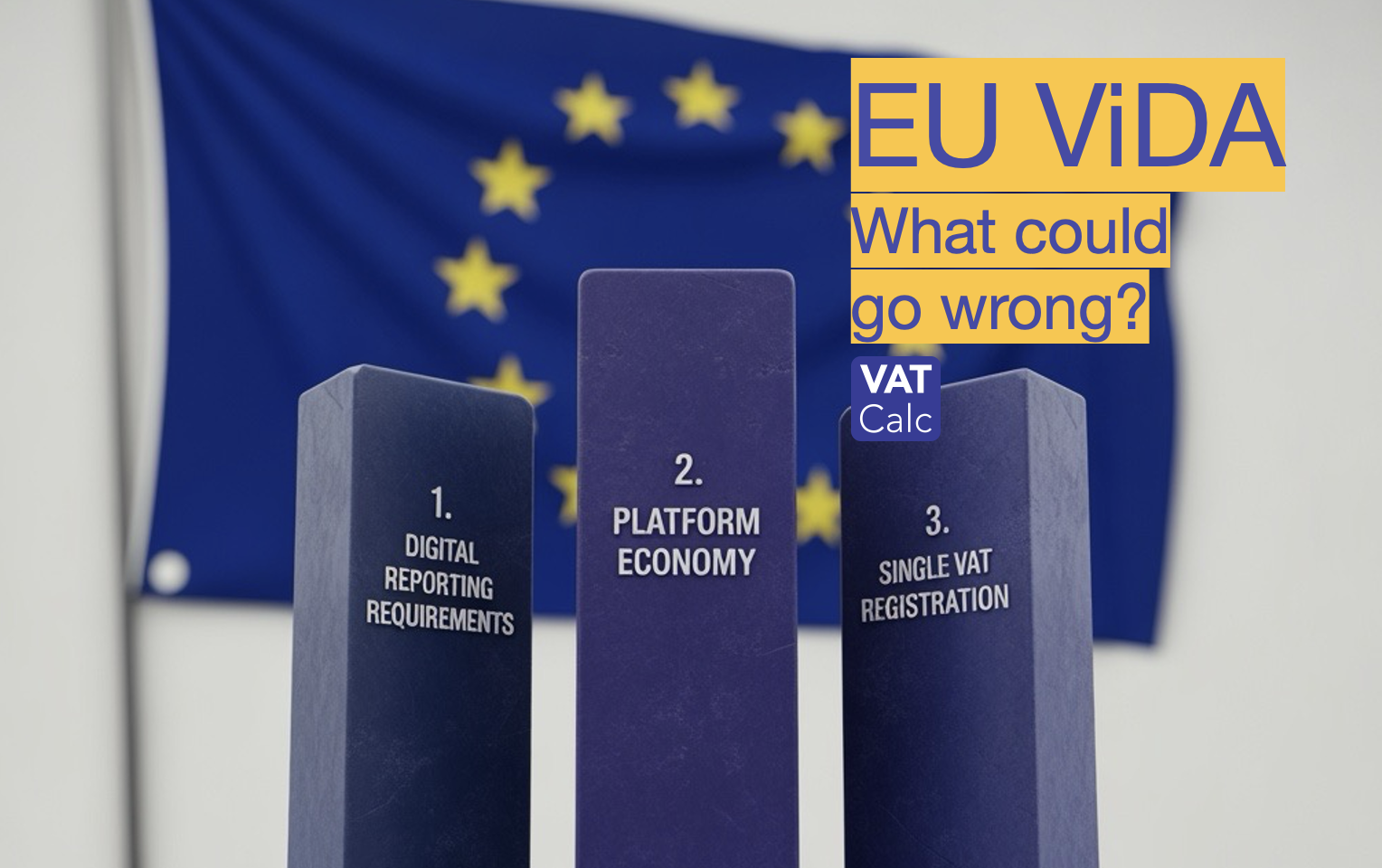
1. Digital Reporting Requirements (DRR)
The DRR pillar is perhaps the most ambitious: a real-time digital reporting system built around e-invoicing between companies for intra-community supplies and a central EU VIES database. But ambition comes with complexity.
The Commission knows that a number of member states have ongoing problems with upgrades on their VAT and e-invoicing IT stacks. Recent examples include:
-
Netherlands (Belastingdienst) — The government has openly said that creating an extra VAT rate isn’t technically possible until at least 2027 because the tax authority is still building a new VAT system.
-
Germany — with its decentralised, federal setup (different platforms at federal/state level) is widely noted as a challenge for a unified B2B model—there is no single national platform, and interoperability has to be managed across systems (XRechnung/ZUGFeRD/Peppol). Germany e-invoicing consolidation is in their plan for the 2025-28 mandate.
-
Poland (KSeF) — After planning mandatory B2B clearance from July 2024, Poland postponed the mandate when critical defects were found in the KSeF platform. The government has since confirmed a new staged go-live in 2026.
-
France — France has twice postponed its nationwide B2B e-invoicing/e-reporting reform—now scheduled to start 1 Sept 2026.
-
Portugal — A string of deferrals and grace periods (e.g., B2G e-invoicing for SMEs and micro-enterprises; qualified e-signature (QES) requirement for PDFs; ATCUD/QR-code timings) point to ongoing implementation and IT readiness challenges for both government and vendors.
Risks called out by the EC
-
As we see above, Member State readiness: If national I.T. systems or specifications aren’t ready by the July 2030 deadline, cross-border sales reporting could stall. Businesses in compliant Member States would be left hanging when trading with those that aren’t ready.
-
Technical specifications delays: If Member States publish final specifications late—or change them midway—businesses won’t have enough lead time to build or adjust their systems.
-
Gold plating: There’s also a risk of Member States imposing additional national requirements beyond the EU standard, creating fragmentation instead of harmonization.
-
Certification chaos: If different Member States adopt different certification schemes for invoice software and service providers, multinational businesses would face costly parallel compliance burdens.
-
Standardization delays: Any lag in the EU’s standard for e-invoicing, being developed by CEN, could slow down adoption across the board.
Mitigations identified by the EC
The Commission has outlined a phased rollout, regular checkpoints against the overall plan, and clear legislative guardrails (e.g., no additional invoicing obligations beyond EU law). It also plans to publish explanatory notes and work closely with Member States to align certification processes. But the reality is that success will depend on Member States sticking to the timeline and resisting the urge to deviate.
2. VAT Rules for Platforms
Platforms are at the heart of the digital economy, and under ViDA, they’ll carry greater VAT responsibilities on behalf of home and ride sharing providers. But different national approaches could unravel the uniformity the EU is aiming for.
Risks called out by the EC
-
Divergent national rules: If Member States impose different obligations on platforms, multinationals could end up having to run different systems for each country. Especially around the initial 2028 voluntary phase were countries will have options other than impose their deemed supplier obligations on the platforms early.
-
Other legal or international events: Shifts in international trade rules or legislative changes could introduce new requirements, or even prompt retaliatory measures from trade partners.
Mitigations identified by the EC
The Commission plans to rely on explanatory notes, communication campaigns, and active monitoring of international developments. The existence of a shared transmission network for e-invoicing should also reduce fragmentation. Still, the complexity of platforms operating across multiple jurisdictions means even small deviations can become big headaches.
3. Single VAT Registration (SVR)
SVR aims to simplify VAT obligations by allowing businesses to register once for VAT in the EU via One Stop Shop (OSS return) rather than in each Member State they operate in. But here too, risks loom.
Risks called out by the EC
-
Delays in implementing national systems: For example, if the “Transfer of Own Goods” scheme isn’t ready by July 2028, businesses won’t benefit from SVR on time.
-
Slow updates to technical specifications: Delays in the Commission’s implementing regulation could cascade into Member State readiness problems.
-
Awareness gaps: Businesses may not be aware of the new rules early enough to adapt their systems and processes.
-
Coordination with customs: A lack of alignment between VAT and customs teams could jeopardize secure IOSS (Import One-Stop Shop) operations.
Mitigations identified by the EC
The Commission is working closely with Member States on specifications, with back-up solutions on standby for those that fall behind. Communication campaigns are also planned to ensure businesses are prepared. Still, the risk of uneven implementation across Member States remains a major hurdle.
Political and practical realities
Even beyond the technical and legislative risks, the biggest threat to ViDA may be inconsistent political will across Member States. National governments may be tempted to delay, tweak, or “gold-plate” requirements, undermining the very harmonization ViDA is designed to achieve.
Add to that the challenges of aligning 27 tax administrations, thousands of platforms, and millions of businesses—and the risk of bottlenecks, delays, and disputes is very real.