ViDA divergence risks raises pressure for Unified VAT Determination and Reporting Systems
EU officials warn national deviations from ViDA could undermine harmonised digital VAT reporting across Europe

The European Union’s VAT in the Digital Age (ViDA) reforms were designed to create a more harmonised digital VAT environment across Member States. But concerns are already emerging that differing national implementations could instead produce a more fragmented compliance landscape for businesses operating across Europe.
See ViDA outstanding issues analysis.
Member states fragment on digital reporting
Speaking at a European Tax Adviser Federation conference last week, senior Belgian tax official Wouter Bollaert warned against Member States introducing additional domestic reporting obligations beyond the ViDA framework. Ongoing EU discussions continue around practical implementation issues, including invoice corrections, payments on account, sensitive goods reporting, and the interaction of platform economy rules with existing VAT regimes.
The risk is that businesses may ultimately face not one EU digital reporting framework, but multiple overlapping domestic variants layered on top of ViDA requirements.
For multinational businesses, this creates a major operational challenge.
Over the coming years, many companies will already be adapting ERP systems, invoicing processes, and compliance controls for new domestic mandates in France, Belgium, Germany, Poland, Spain, and other Member States. If national implementations diverge significantly from the eventual ViDA reporting architecture, businesses may face repeated system redesigns, additional integrations, duplicated reporting flows, and ongoing compliance remediation projects.
The issue extends far beyond invoice formatting.
Digital Reporting Requirements to expose VAT anomalies
Under ViDA DRR pillar 1, tax authorities will increasingly compare:
- structured e-invoices;
- digital reporting submissions;
- ERP transaction data;
- payment information; and
- VAT return declarations
to identify inconsistencies and compliance risks in near real-time.
This means businesses must ensure complete integrity between what is determined at transaction level and what is ultimately submitted across multiple reporting channels.
Where businesses operate disconnected systems for VAT determination, e-invoicing, local reporting, reconciliations, and VAT returns, the risk of mismatches increases significantly.
Tax authorities will increasingly detect:
- inconsistent VAT treatment;
- missing or duplicated transactions;
- incorrect invoice annotations;
- unreconciled digital reporting;
- discrepancies between e-reporting and VAT returns; and
- incomplete audit trails.
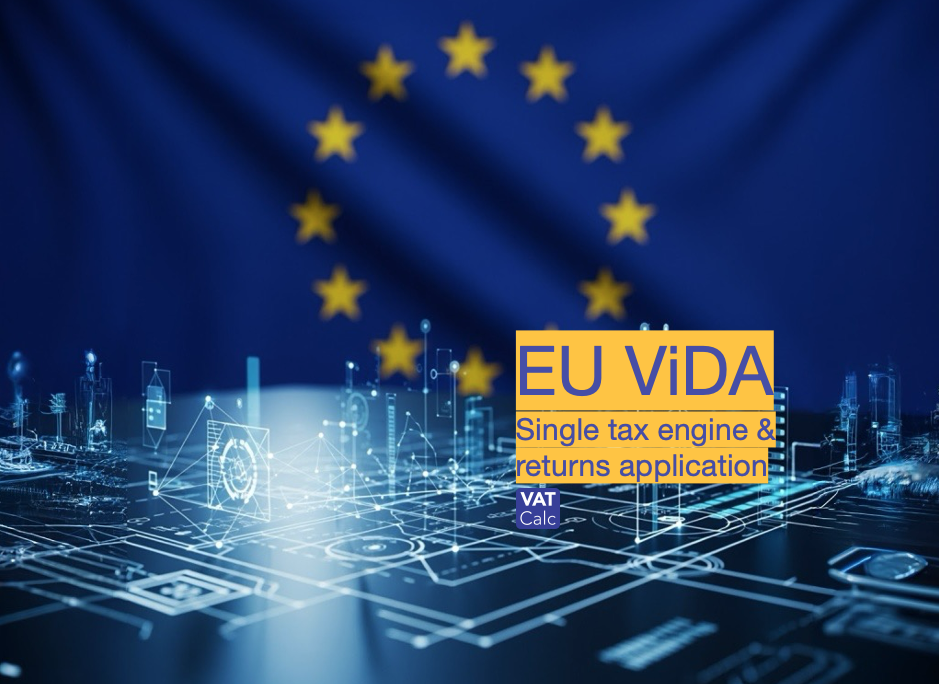
This is precisely why VATCalc has built its legislative-coded, single tax engine and reporting application architecture.
Rather than relying on separate systems attempting to reconcile data after submission, VATCalc performs VAT determination, invoice generation, e-invoicing, e-reporting, reconciliation, and VAT return preparation from the same underlying transaction logic.
The VAT treatment is therefore determined once, with:
- invoice content generated directly from the determination;
- e-reporting submissions aligned to the same transaction data;
- VAT returns populated from the same compliance logic; and
- full audit evidence maintained across the complete reporting chain.
As ViDA implementation evolves across Member States, preserving consistency between transactional data, invoice content, digital reporting, and VAT returns will become increasingly critical.
The challenge for businesses is no longer simply submitting a correct VAT return.
It is ensuring that every digital compliance channel presents the same underlying version of the transaction to tax authorities, without gaps, inconsistencies, or reconciliation failures.