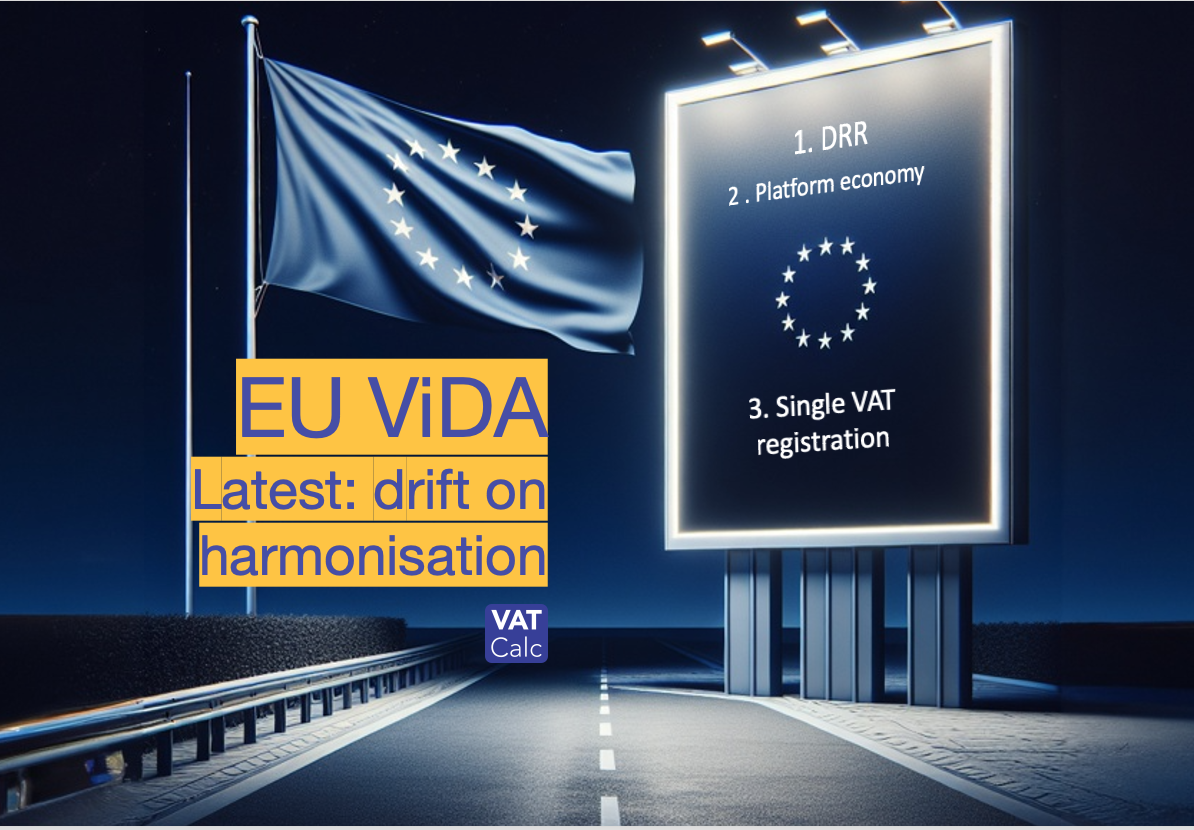
Progress on 3 ViDA pillars but technical & liability threatens harmony on details
The latest technical discussions by the 42nd VAT Expert Group meeting (13 March 2026) and Future of VAT Group (3 March 2026) show that VAT in the Digital Age reforms have moved into implementation design. Good progress and more delays not a threat for the moment; but real-world gaps and drift from harmonisation risks are clear.

Below is a breakdown of where each pillar stands. The final papers are expected late 2026 or early 2027. Draft Explanatory Notes are now circulating across all three pillars; whilst the detail reveals progress on structure, there is diversion which may convert into harmony being diluted. Final version are targeted for late 2026 or early 2027.
1. Digital Reporting Requirements (DRR) and E-Invoicing: Convergence meets resistance
The July 2030 Digital Reporting Requirements pillar remains the most ambitious and contentious. While technical drafting is advancing, fundamental disagreements persist and issues are deepening rather than narrowing.
Progress on EN 16931; Peppol pilot
- Second draft Explanatory Notes now in circulation
- More detailed work needed on invoice definitions, structure, acceptance and transmission flows, including interoperability
- Processing of corrections, credit notes and hybrid invoices also questioned
- Public consultation launched until June 2016
- Early thinking on transitional regimes up to 2035
- EN16931 – approved 13 February 2026 for ViDA
- EU e-invoice common messaging proposal
- Ongoing ViDA Peppol pilot with tax authorities
Disagreement on definitions, corrections and 2035 harmonisation
- Definition gaps persist: No consensus on what constitutes issuance, transmission, or receipt of an invoice, with calls for clearer and more consistent terminology
- Transaction ambiguity: The definition of a “transaction” for DRR purposes remains unclear, increasing system design risk
- Attachments and data scope: The updated EU standard allows attachments within structured data, but treatment is unresolved
- Corrections and payments: Diverging views on invoice corrections and the handling of advance payments continue
- Hybrid and intra-EU complexity: Treatment of hybrid invoices and intra-Community extensions remains unsettled
- Accreditation fragmentation: Proposed EU criteria for service provider accreditation are now explicitly advisory, not mandatory
- Operational realities emerging:
- B2B supplies may proceed without a VAT number at issuance
- Formal controls are not a prerequisite for invoice validity
- Sanctions and reporting scope: Uncertainty remains around penalties and the reporting of non-required data
- Transitional measures contested: No agreement on how Member States transition into the harmonised regime
The tension between EU standardisation and entrenched national systems (Italy, France, Spain) continues to define this pillar.
2. Platform Economy: Liability is the battleground
The Jul 2028 to Jan 2030 platform economy pillar is moving into practical scoping, but the debate is shifting from policy intent to operational liability.
Key progress:
- First draft Explanatory Notes issued
- Increased focus on real-world platform scenarios and facilitation models
- Broad alignment emerging on chain transaction treatment
Risk in overlap with other regimes; defining liability; Article 28;
- Scope expansion risk: Inclusion of sectors such as farmers under flat-rate schemes signals widening application of deemed supplier rules
- Supplier identification challenges: Requirement for underlying suppliers to provide VAT numbers raises onboarding and enforcement issues
- Legal interaction unresolved: Ongoing tension in aligning Article 28, Article 28a and TOMS
- Transitional timing uncertainty: No clear treatment for transactions booked before July 2028 but fulfilled after
- Multi-platform chains: Identifying the “facilitating platform” in layered ecosystems remains unresolved
- Failure scenarios undefined: No agreed process where a platform incorrectly assumes, or fails to assume, deemed supplier status
- Definition gaps persist: The concept of “facilitation” remains insufficiently precise
- Short-term accommodation exemption still debated
- Heavy reliance on examples: Delegates are pushing for real-life scenarios, indicating current guidance is too abstract
This pillar is increasingly about how liability is engineered in practice, not just defined in law.
3. Single VAT Registration (SVR): Advancing, but technically contested
The July 2028 SVR pillar remains the most procedurally advanced, with focus on Phase 1 changes effective 1 January 2027. However, discussions highlight unresolved technical and legal detail.
Staging Jan 2027 changes advance
- Draft guidance on 2027 OSS expansion and SVR mechanics under development
- Clarification work underway on Article 59c and the €10,000 threshold
- Alignment efforts across Member States ahead of 2027 go-live
WIP: SME & IOSS friction; Group of 4 issue persists; Jul 2028 voluntary state
- Threshold ambiguity: Ongoing uncertainty on whether the €10,000 threshold includes stock held across multiple Member States
- SME vs IOSS exclusivity: Confirmed as mutually exclusive, limiting flexibility for smaller businesses
- Taxable event complexity: New rules for Union and non-Union schemes require further clarification
- Tax representative uncertainty: Lack of harmonised criteria, likely leaving Member State divergence via OSS portals
- Fixed establishment tension: Stock without creating a fixed establishment remains a sensitive issue
- “Group of Four” uncertainty: Continued divergence in interpretation within deemed supplier rules
- Phased complexity: 2027 changes are largely technical, with more complex structural elements deferred to July 2028
Further delays unlikely but harmonisation drift is concern
Across all three pillars, the direction is clear but the detail remains unsettled:
- Core legal definitions are still in flux
- Real-world scenarios from VAT experts are exposing gaps in the framework
- Member State flexibility continues to threaten harmonisation
The risk is no longer delay. It is divergence, with a harmonised framework in theory, but fragmented implementation in practice.