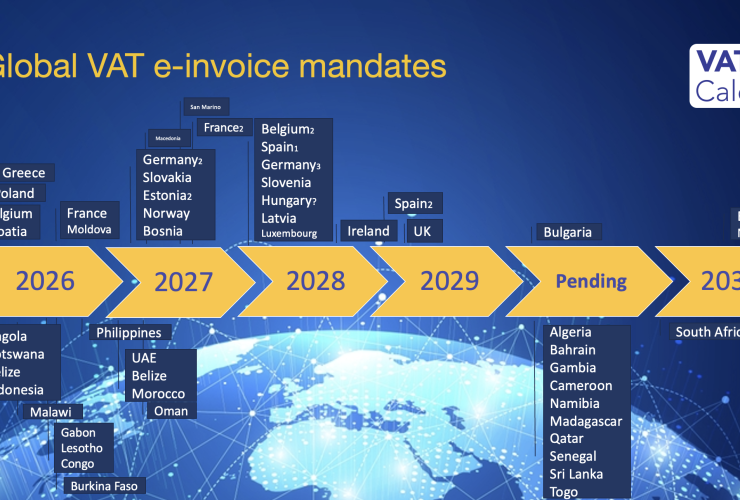
ViDA-ready tax determination will no longer just be about calculating VAT. It must determine how that transaction is reported to tax authorities in real-time
For decades, tax engines have had a clear purpose: determine the correct VAT or sales tax treatment of a transaction. They identify the applicable rate, place of supply, exemptions, reverse charge rules and other legislative requirements before passing the calculated tax back to the ERP or billing system.

But tax authorities have fundamentally changed the compliance landscape – as we’re seeing with EU VAT in the Digital Age.
This raises an important question.
Does your tax engine understand e-invoicing?
VAT calculation is no longer enough
A modern transaction must answer far more than “How much VAT should I charge?”
It must also determine:
- Is this transaction subject to mandatory e-invoicing?
- Does it require clearance before the invoice can be issued?
- Is e-reporting required instead?
- Which invoice schema or format applies?
- Which government platform or PEPPOL network should receive the document?
- What additional mandatory tax information must be included?
- How should the invoice be reconciled with the VAT return?
These are legislative decisions just as much as VAT determination itself.
Yet many organisations rely on separate products to answer these questions. One system calculates VAT, another creates the e-invoice, another submits it to the tax authority, and another prepares the VAT return.
The result is multiple versions of the same tax logic.
The cost of disconnected tax technology
Maintaining separate determination rules across multiple applications creates unnecessary complexity.
When legislation changes, every platform must be updated. When an invoice is rejected, businesses often struggle to understand whether the error originated in the ERP, the tax engine, the e-invoicing platform or the reporting solution.
As governments increasingly reconcile invoices, e-reporting submissions and VAT returns automatically, inconsistencies become far more visible.
The challenge is no longer simply producing compliant invoices. It is ensuring that every tax obligation arising from a transaction remains consistent from the original invoice through to the final VAT return.
One legislative decision, multiple compliance obligations
The most effective approach is to treat tax determination as the starting point for every downstream obligation.
A single legislative engine should determine:
- the correct VAT treatment;
- whether e-invoicing applies;
- whether e-reporting is required;
- the required reporting data and formats;
- and ultimately the figures appearing on the VAT return.
Rather than maintaining separate rule sets, businesses gain a single source of truth for every tax event generated by a transaction.
How VATCalc approaches the problem
VATCalc was designed as an integrated tax execution platform rather than a standalone tax calculator.
Our legislative determination engine sits at the heart of the platform, driving VAT calculation, indirect tax reporting and digital compliance obligations from the same tax logic.
That means one application can determine the correct tax treatment, generate the appropriate reporting outputs, and support reconciliation between invoices, e-reporting submissions and VAT returns.
As more countries introduce mandatory digital reporting, this integrated approach reduces implementation effort, simplifies legislative maintenance and provides greater confidence that every tax obligation remains consistent.
The future of tax technology is not simply calculating tax more accurately.
It is understanding every compliance obligation that flows from each transaction.
The question organisations should now be asking is no longer, “Does our tax engine calculate VAT correctly?”
It is, “Does our tax engine understand e-invoicing?”