ViDA 2030: purchasers of cross-border goods or services have just 5-days to e-report to tax authorities
The 10-day intra-community B2B e-invoicing obligation on sellers has grabbed the headlines, but it’s tougher for their customers
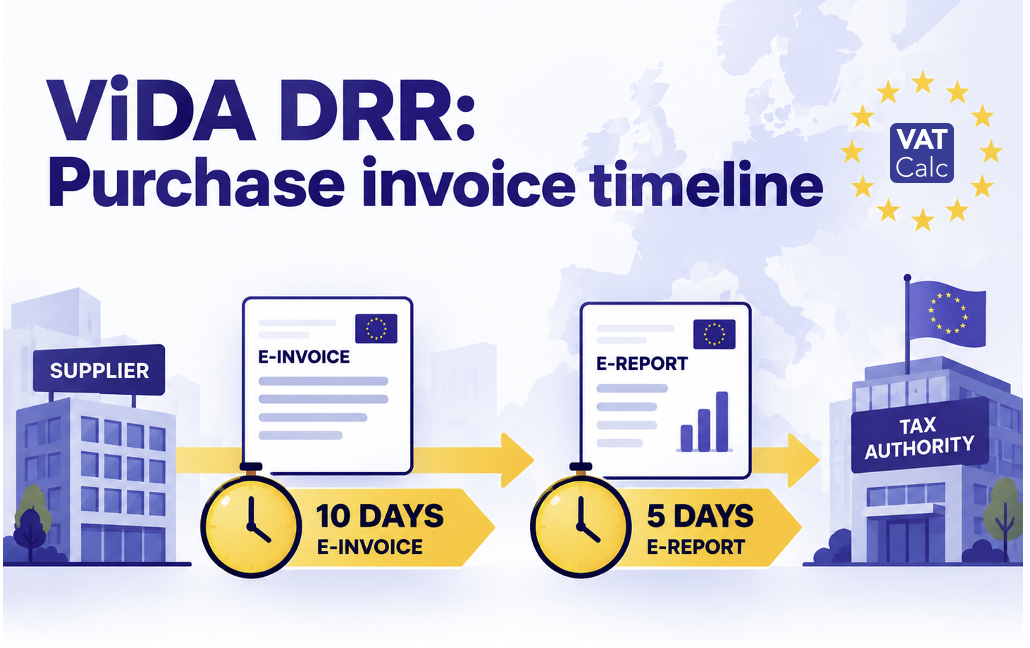
From July 2030, businesses making qualifying cross-border supplies must issue structured e-invoices and digitally report them within 10 days.
But many finance teams have overlooked the other side of the transaction e-reporting obligations.
Member States may also require businesses receiving cross-border purchases to digitally report those invoices within five days of receipt of the e-invoice. That requirement applies unless a Member State decides it can obtain equivalent information by other means.
That sounds straightforward. It isn’t.
Five days is not an invoice processing cycle
Most multinational businesses do not fully process purchase invoices within five days.
Many struggle to do so within several weeks.

A typical accounts payable process involves:
- receiving the invoice;
- validating supplier details;
- matching to purchase orders and goods receipts;
- resolving exceptions;
- obtaining business approvals;
- checking VAT treatment;
- posting to the ERP;
- scheduling payment.
Member States may also require businesses receiving cross-border purchases to digitally report those invoices within five days of receipt. That requirement applies unless a Member State decides it can obtain equivalent information by other means.
That sounds straightforward. It isn’t.
Large organisations often operate shared service centres, approval workflows and exception queues. Purchase invoices frequently remain “in process” long after five days have elapsed.
ViDA introduces a new regulatory deadline that sits well ahead of many existing finance processes.
It is not simply an accounts payable problem
Reporting cannot begin simply because an invoice has arrived.
Before a digital report can be submitted, businesses must determine whether reporting is required at all.
That means answering several VAT questions:
- Is this an intra-Community purchase of goods or services?
- Does another DRR reporting obligation apply?
- Is the transaction within scope?
- Has the relevant Member State exercised its option to require purchaser reporting?
These are tax determination questions, not accounting questions.
The challenge therefore moves beyond Accounts Payable and directly into the tax function.
Live VAT calculation validation becomes critical
The purchaser cannot simply report the supplier’s invoice. They must first verify that the VAT treatment is correct.
Errors on supplier invoices remain commonplace:
- incorrect VAT numbers;
- wrong place-of-supply treatment;
- incorrect exemptions;
- reverse charge errors;
- incorrect VAT rates.
Submitting incorrect invoice data to a tax authority within five days risks creating mismatches before the invoice has even completed internal review.
This places far greater importance on automated, live VAT validation before any digital report is submitted.
One Europe. Twenty-seven different purchaser obligations?
Perhaps the biggest practical complication is that purchaser reporting is optional. Member States may require it.
Or they may decide they already receive sufficient information through other mechanisms and dispense with the obligation.
That creates an immediate compliance challenge.
Businesses operating across Europe will need to understand:
- which Member States require purchaser reporting;
- which transactions trigger it;
- when deadlines begin;
- what information must be submitted.
That matrix will evolve over time as Member States implement ViDA differently.
New digital barriers as implementation will not be harmonised
The Commission has deliberately left implementation to national tax authorities.
Each Member State will establish its own reporting protocols, connectivity methods and technical interfaces. That is understandable from an implementation perspective.
But it also recreates one of the challenges ViDA was intended to reduce.
Instead of tracking different VAT return formats, businesses may soon need to maintain country-by-country digital reporting connections, authentication methods, submission processes and operational controls.
The reporting obligation may be harmonised. The implementation almost certainly will not be.
The next compliance battleground – purchase-to-pay
Much of the discussion around ViDA has centred on e-invoicing.
The harder challenge may lie inside the finance department.
Businesses will need to automate four decisions almost immediately after receiving an invoice:
- approve the invoice for processing;
- validate the supplier’s VAT treatment;
- determine whether digital reporting applies;
- submit the required report through the relevant Member State’s platform.
For many multinational organisations, five days is not simply another filing deadline.
It represents a fundamental redesign of the purchase-to-pay process.
EU VAT in the Digital Age reforms
| EU VAT in the Digital Age | |
| 3 pillars to improve efficiency of VAT for all and reduce fraud | |
| 1. Digital Reporting Requirements; e-invoicing | Jul 2030-35: Mandatory digital reporting of intra-community transactions; obligation to be able to issue and receive intra-community e-invoices; member states free to impose own e-invoicing or real-time reporting but most conform to EU e-invoice standard EN 16931 |
| Read more about EU Digital Reporting Requirements (DRR) | |
| Structured e-invoices mandated for intra-community supplies | |
| EC Sales lists replaced by Digital Reporting Requirements | |
| 10-day e-invoicing deadline for intra-community sales | |
| 5-day e-reporting time limit intra-community purchases | |
| Withdrawal of EU permission requirements for e-invoicing | |
| Central VIES database launch | |
| 2 Platform economy | Jul 2028 / Jan 2030: Travel & accommodation sharing platforms to become deemed supplier / liable to users' VAT. New definitions of the roles of providers, users and platforms to avoid double and no-taxation (voluntary Jul 2028) |
| Read more - Travel & accommodation platforms deemed suppliers for EU VAT | |
| 3 Single VAT Registration; extension of OSS | July 2028: Following the 1 July 2021 introduction of the One Stop-Shop (OSS), extended to cover movement of own stocks prior to cross-border B2C to reduce the foreign, non-resident VAT registrations & returns. Plus to movements of own stock with ending of 'call-off' stock burden |
| January 2027 initial changes | |
| Transfer of own goods OSS extension | |
| Call-off stock VAT simplification ends | |
| Harmonisation of B2B Reverse Charge rules | |
| Creation of Single VAT Registration identiy | |
| Securing IOSS (Mar 2028) | |