Artificial Intelligence can transform VAT compliance
But that doesn’t mean you should ask an AI model to calculate your VAT
AI is rapidly moving into corporate tax technology, with much of the discussion focused on whether large language models can answer tax questions, interpret legislation or calculate the correct tax treatment.
But that may be starting with the wrong problem.
VAT compliance involves two fundamentally different challenges. Businesses first need to understand huge volumes of imperfect real-world data, and then apply tax law to that data accurately and consistently. AI is exceptionally useful for interpreting the data. Applying the tax law requires something rather different: controlled, consistent and auditable tax logic.
VAT starts with messy data
Before anyone can determine VAT, they need to know what happened. In practice, this is one of the hardest parts of VAT compliance.
Tax teams receive data from multiple ERPs, spreadsheets, procurement platforms, billing systems and product catalogues. Descriptions can be abbreviated, fields may be missing, different subsidiaries use different tax codes, and the same product may be described differently across systems.
Traditional tax technology projects therefore spend considerable time on mapping, transformation and manually maintained rules. This is precisely the sort of problem where AI can help.
VATCalc’s AI Mapping Studio can interpret source data, identify relationships, propose mappings and flag exceptions. It can help turn messy ERP data into structured tax data, with mappings tested against VATCalc before being deployed.
But another problem remains: understanding what was actually bought or sold.
Understanding the transaction
Correct VAT treatment frequently depends upon the underlying supply, and a product description alone may not provide enough information.
“Windows”, for example, means something rather different when supplied by Microsoft than when supplied by a glazing company. Counterparty and transaction context can therefore be just as important as the description itself.
VATCalc AI Item Classification combines this information to understand and enrich goods and services before tax determination. It can work across existing product catalogues or dynamically classify previously unseen transaction items.
The resulting classification can then support sales VAT determination, AP invoice validation and VAT return compliance. Rather than repeatedly trying to interpret the same transaction at different stages, the tax-ready intelligence can be used across the VAT lifecycle.
But understanding the transaction is not the same as determining the tax.
Don’t ask AI to guess the VAT answer
Once we understand what happened, VAT law needs to be applied. That requires a different type of technology.
The same transaction with the same facts should produce the same result tomorrow. Businesses also need to understand why that result was reached and, where necessary, identify the legislation supporting it.
VATCalc therefore separates AI interpretation from tax determination.
AI can understand and enrich the transaction. VATCalc’s legislation-coded Tax Engine then applies controlled VAT rules, including place of supply, customer status, exemptions, reduced rates, reverse charge, deductibility, supply chains and reporting requirements.
The resulting determination is consistent and auditable.
AI handles ambiguity. The tax engine handles tax law.
That distinction becomes increasingly important as businesses move beyond experimenting with AI and start incorporating it into production tax processes.
AI across the VAT lifecycle
VAT is more than a tax calculation. Once the tax treatment has been determined, businesses still need to validate invoices, create e-invoices, satisfy digital reporting requirements, prepare VAT returns and reconcile what has been reported.
VATCalc has therefore been building AI around a single VAT platform rather than adding a chatbot to an individual tax application.
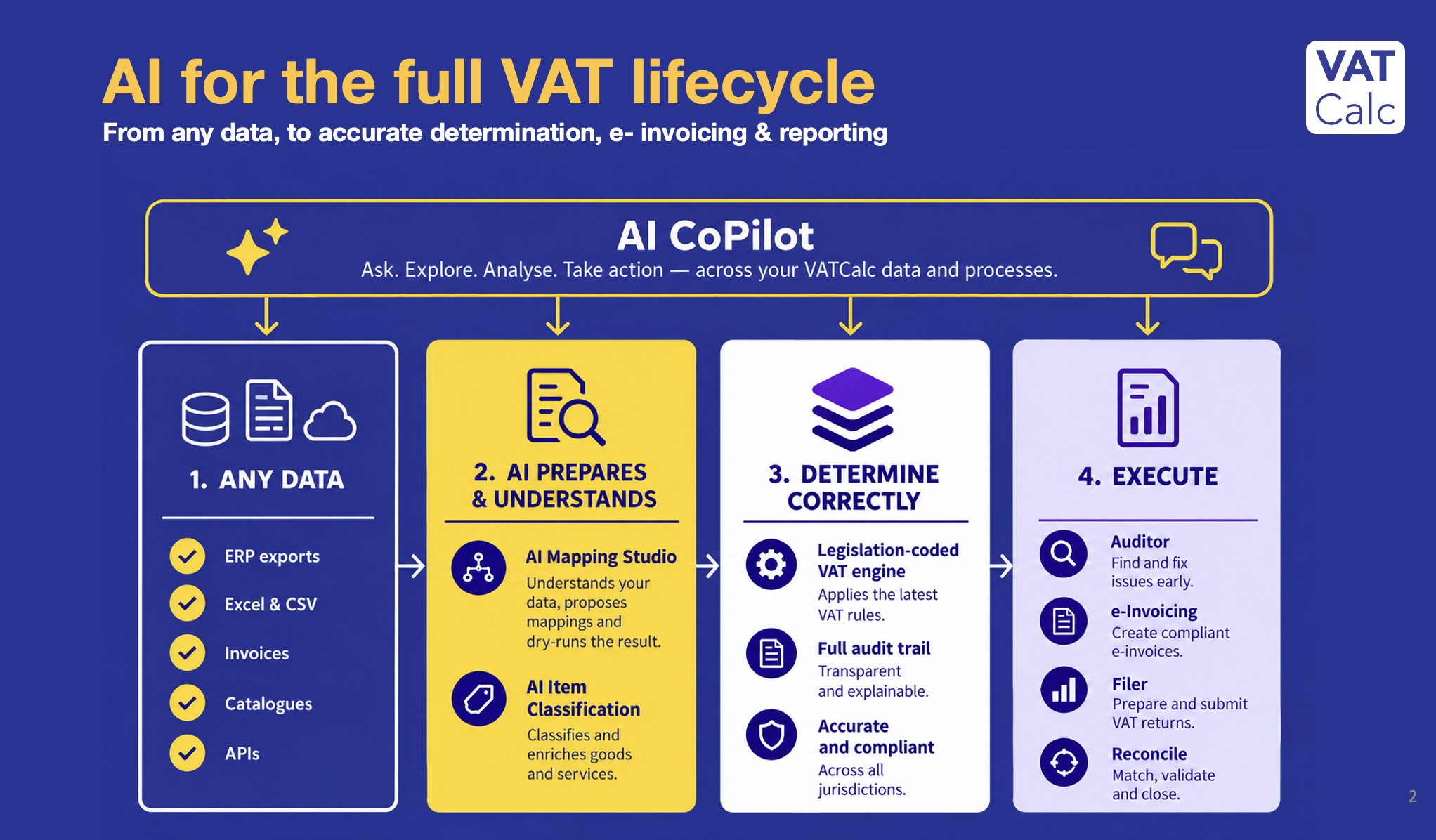
The process starts with data from ERPs, Excel, CSV, invoices, catalogues and APIs. AI Mapping Studio and AI Item Classification prepare, structure and understand that information.
The VATCalc Tax Engine then applies legislation-coded rules to determine the correct treatment. The same transaction intelligence can subsequently flow through Auditor, e-Invoicing, VAT Filer and reconciliation.
Across the entire process sits AI Copilot.
From tax chatbot to tax orchestration
Copilot changes the role AI can play in tax technology. Instead of asking an LLM to provide its own opinion on VAT, it can be used as a natural-language interface to the underlying tax platform.
A user might ask to see outstanding VAT returns, identify transactions that failed audit validation, explain why an invoice received a particular treatment or invoke an authorised VATCalc process.
The AI becomes the interface and, increasingly, the orchestrator. The underlying VATCalc applications remain responsible for the tax calculation, compliance data and audit trail.
This is fundamentally different from asking a general-purpose AI model to know the VAT answer.
The future isn’t AI replacing the tax engine
AI has the potential to remove a considerable amount of the manual work surrounding tax determination: preparing data, understanding transactions, identifying exceptions and navigating complex compliance processes.
Controlled tax technology can then do what it does best: apply tax law consistently and create an auditable result.
Combining the two starts to change the VAT technology stack. AI can make it much easier to accept and understand almost any source data, while a single tax platform determines, audits, invoices and reports the transaction.
Accept Anything → Determine Correctly → Report Anywhere.
AI increasingly makes the first part possible and the entire process easier to operate, while the tax law remains firmly in control.