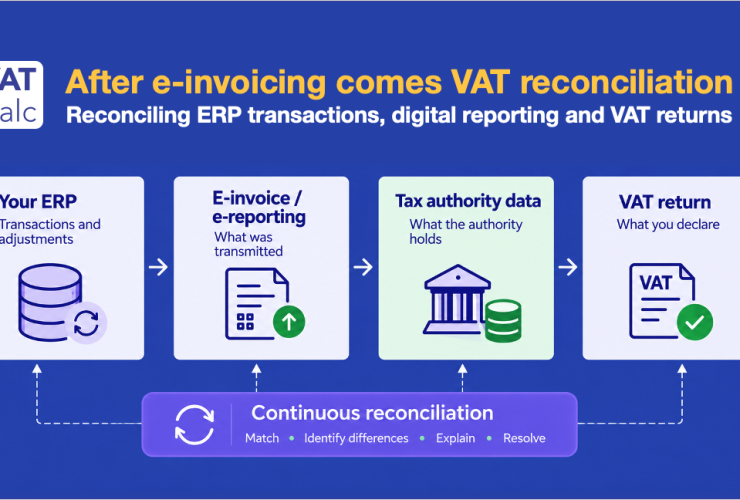

- VAT determination is moving upstream as e-invoicing and digital reporting expose transaction data to tax authorities before VAT returns are filed.
- Complex transactions still matter – bundled supplies, ancillary services and multi-party supply chains test the real legislative depth of a tax engine.
- Reconciliation is the new challenge – businesses must increasingly explain differences between ERP data, e-invoices, digital reporting and pre-filled VAT returns.
Legacy global VAT engines have traditionally been judged on calculation accuracy, country coverage and ERP integration.
But as tax authorities gain access to transaction-level data, (see regional EU’s ViDA or domestic like Hungary’s eVAT) the question is changing.
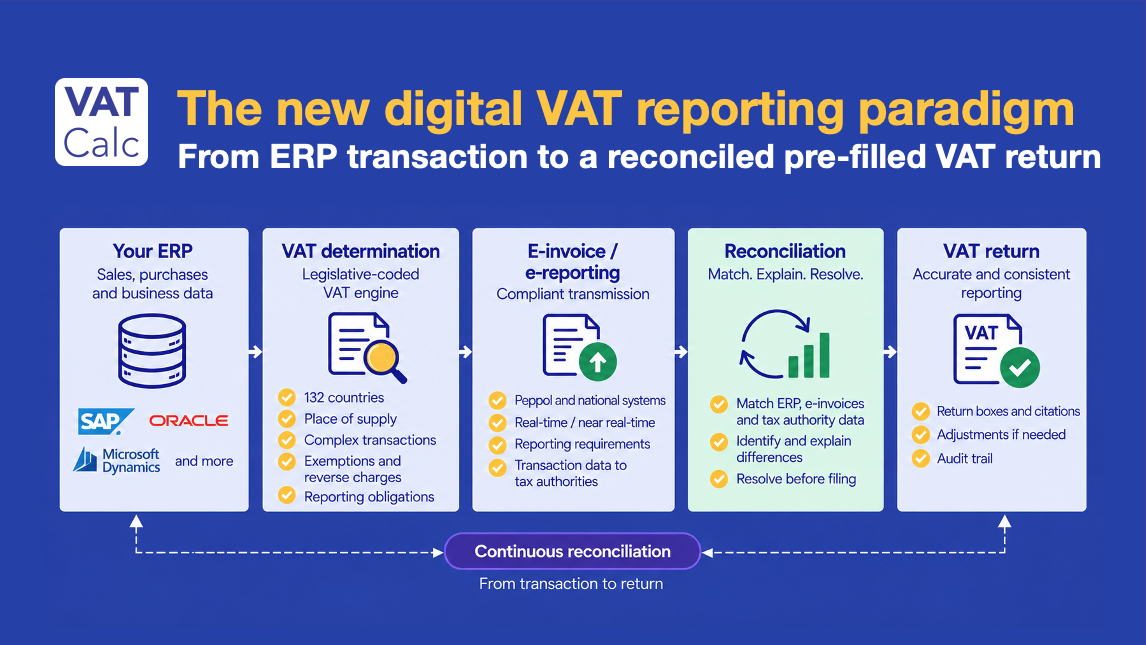
It is no longer simply whether a tax engine can calculate VAT correctly. It is whether that engine can support the transaction from determination through digital reporting and ultimately reconcile the result with the VAT return.
So how should businesses compare VATCalc with Avalara, Sovos, Vertex and Thomson Reuters ONESOURCE?
1. How much VAT legislation is actually built into the engine?
All five providers offer substantial international indirect tax capabilities. But country counts alone reveal relatively little about how a tax engine works.
The more important question is how much VAT knowledge is already encoded and how much must be configured during implementation.
VATCalc takes a legislative-coded approach. Its deterministic rules engine incorporates VAT legislation across over 130 countries, covering place of supply, exemptions, reverse charges, VAT registrations and reporting obligations.
The engine doesn’t simply return a tax rate. It can determine the VAT regime, relevant legislative provisions and subsequent reporting treatment.
That has an important practical consequence:
More VAT knowledge already in the engine means less tax logic to configure during implementation and maintain afterwards.
Avalara, Sovos, Vertex and Thomson Reuters also maintain extensive global tax content and regularly update their engines for legislative change. The question for prospective users is therefore not simply “Do you cover this country?”
It is “How much configuration will we have to build and maintain to make our transactions work?”
2. Can the tax engine handle the difficult transactions?
Simple domestic sales are not much of a test for a global VAT engine. Two examples show the problems:
Transporting potatoes and wine…
Consider an invoice containing potatoes subject to 6% VAT, wine subject to 21% and one transport charge covering both.
Where the transport is ancillary to the goods, the engine needs to understand the relationship between the supplies. It may need to apportion the transport charge and apply the appropriate VAT treatment to each portion.
VATCalc’s engine has demonstrated exactly this, automatically splitting the ancillary transport charge and applying the respective treatment of the underlying goods.
Multi-party supply chains present another challenge.
A chain involving four or five businesses can contain several separate supplies, movements of goods and VAT consequences. VATCalc can analyse the VAT treatment of each transaction independently while also identifying and visualising its place within the wider commercial chain.
Other enterprise engines, including Vertex, also support complex and multi-party transactions.
This makes scenario testing important when selecting an engine. Businesses should test their difficult transactions, not simply standard sales and purchases.
3. Can it stand up to digital reporting and reconciliation?
This is where the role of the tax engine is changing most rapidly.
Under the EU’s ViDA reforms, cross-border B2B digital reporting starts from July 2030. National e-invoicing and digital reporting regimes are already moving tax authorities closer to transaction-level VAT data.
In some countries, that data is also being used to produce draft or pre-filled VAT returns.
VAT accuracy therefore increasingly has to happen upstream.
An incorrect determination can flow into an e-invoice or digital report long before the business starts preparing its periodic VAT return.
The emerging compliance chain looks like this:
ERP transaction → VAT determination → e-invoice/e-reporting → tax authority data → VAT return
This creates a new reconciliation challenge.
A difference between an ERP and a pre-filled VAT return might originate from the VAT determination, tax code, customer or supplier data, posting date, missing transaction or rejected e-invoice.
Comparing return totals can tell you that there is a difference.
The harder task is explaining why.
VATCalc’s e-Reconciliation approach is designed around this transaction-level chain, matching ERP transactions against e-invoicing and e-reporting information, tax authority acknowledgements and ultimately the VAT return.
Crucially, the underlying VAT engine can also establish the expected legislative treatment and reporting outcome.
Competitors recognise the same challenge. Thomson Reuters offers ONESOURCE reconciliation capabilities, while Sovos provides cross-source reconciliation through Sovos Intelligence. Avalara and Vertex also include reconciliation capabilities within their wider VAT compliance offerings.
The differentiating question is becoming:
Can your tax technology merely identify a discrepancy, or can the underlying tax engine help explain it?
4. What does it cost to implement and maintain?
This brings the comparison back to implementation.
Multinationals may operate SAP, Oracle and other ERP, billing and accounting systems simultaneously. Connecting a global tax engine can require transaction mapping, tax configuration, integrations and extensive testing.
VATCalc’s API-first architecture separates its VAT intelligence from the source ERP. The same centrally maintained legislative engine can therefore serve multiple systems without recreating the underlying VAT logic within each application.
AI-assisted transaction and item mapping can further reduce implementation work.
Avalara, Sovos, Vertex and Thomson Reuters also provide APIs, maintained tax content and enterprise integrations.
So businesses should compare more than licence fees.
They should ask how much tax logic must be configured during implementation, how much must subsequently be maintained and what happens when legislation changes.
The real cost of a tax engine includes the cost of getting the VAT logic into production – and keeping it correct.
From preparing VAT returns to controlling VAT transactions
The traditional VAT compliance model was:
Transact → account → prepare VAT return → find and correct errors
Digital reporting is creating a different model:
Determine correctly → invoice and report correctly → reconcile → VAT return
The VAT return increasingly becomes the consequence of transaction-level decisions and data already reported to the tax authority.
That makes the tax engine more important, not less.
Avalara, Sovos, Vertex, Thomson Reuters and VATCalc are all responding to this change. The key question for businesses is no longer simply which engine can calculate VAT globally.
It is how much VAT intelligence is built into that engine – and whether it can carry that intelligence from the original transaction through digital reporting, reconciliation and the VAT return.