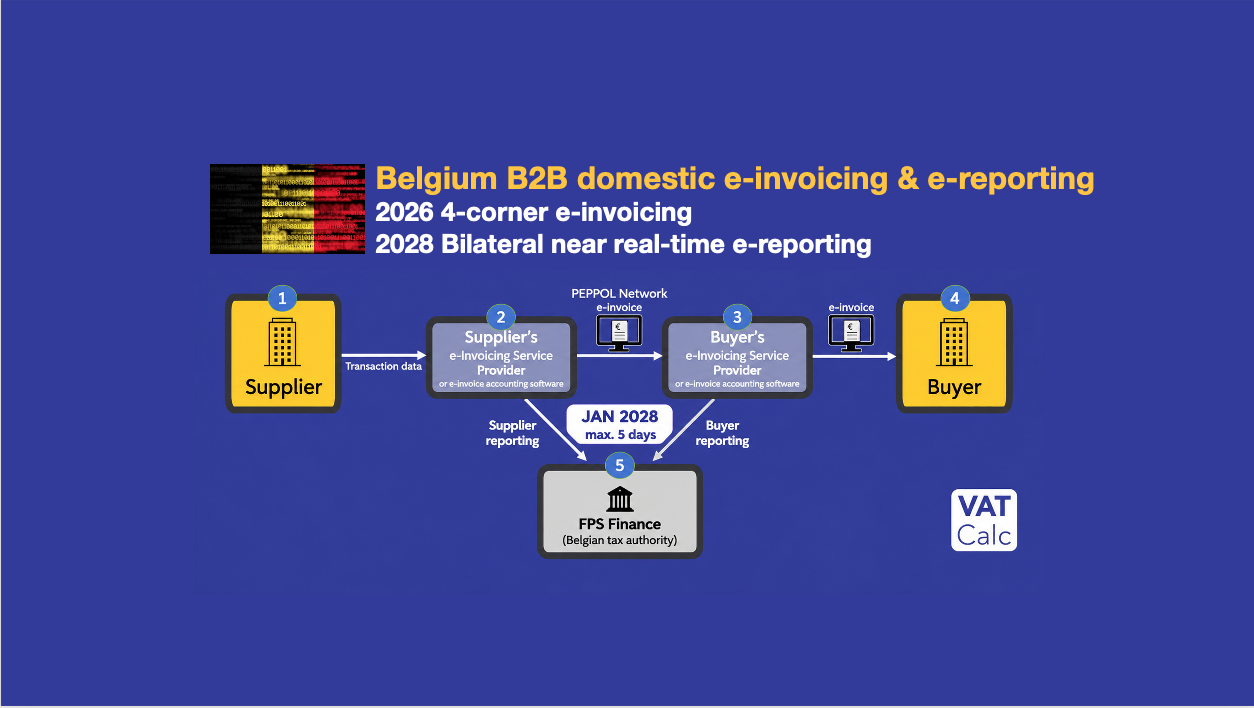
Belgium has submitted legislation to Parliament introducing near-real-time VAT transaction reporting from 1 Jan 2028
This builds on its 2026 mandatory B2B e-invoicing regime

The government submitted the Bill on 27 October 2026. It would amend Article 53 quinquies of the VAT Code, replacing the existing annual customer listing with electronic transaction reporting for affected taxpayers.
Belgium’s mandatory structured B2B e-invoicing regime has applied since 1 January 2026. The new reporting obligation effectively adds the tax authority as the next destination for selected data from those invoices.
Bilateral reporting within five days
A significant feature is that reporting will generally be bilateral. Both the supplier issuing the structured electronic invoice and the Belgian customer receiving it will report transaction data, allowing the tax authority to compare the two sides of the transaction.
The precise deadlines will be set in implementing rules, but the Bill limits the maximum reporting period to five calendar days. Data will be transmitted through Peppol, rather than through a separate FPS Finance reporting application or API.
Only information already required under Belgian VAT rules to appear on the structured electronic document may be required for reporting. The tax authority will therefore receive invoice-level transactional information that can be used for matching, risk analysis and automated anomaly detection.
Importantly, a mismatch between supplier and customer reports will not automatically constitute a VAT irregularity. The Bill recognises timing differences, disputes and corrections, with significant or persistent discrepancies potentially triggering further investigation.
VAT returns stay
The periodic Belgian VAT return is not being abolished. E-reporting does not capture everything required to calculate the return, including transactions with non-taxable persons and accounting adjustments affecting deductible VAT.
Instead, it is the annual list of VAT-registered customers that disappears for taxpayers subject to e-reporting.
What about non-established businesses? Excluded
Non-established taxpayers merely VAT-registered in Belgium will generally not be subject to mandatory e-reportingfrom 2028. They will continue submitting the annual customer listing during the transitional period to 30 June 2030, although they may opt into electronic reporting instead.
However, a Belgian-established supplier making an otherwise reportable Belgian transaction to a non-established customer holding a Belgian VAT number will still report that transaction — even where there is no obligation to issue the customer with a structured e-invoice.
Belgium gets ahead of ViDA
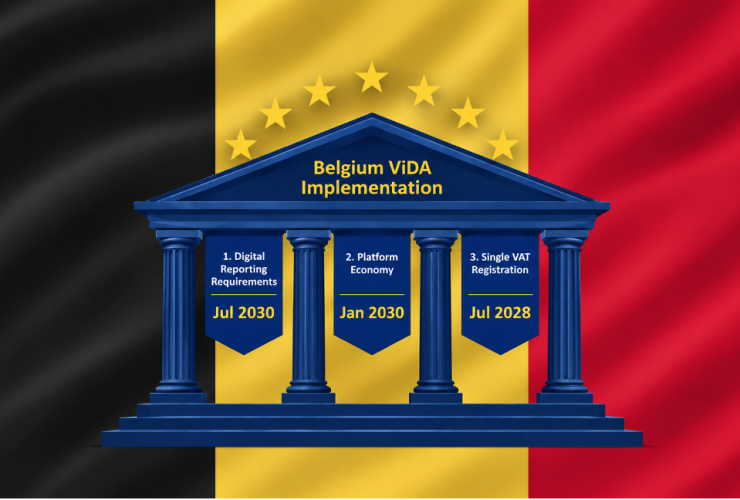
The 2028 regime is deliberately being designed around the future VAT in the Digital Age (ViDA) framework. ViDA introduces harmonised digital reporting for intra-EU transactions from 1 July 2030 and sets conditions for domestic transaction-reporting systems. Belgium has designed its earlier domestic model to minimise the changes required again in 2030.
The roadmap is therefore becoming clear:
- 2026: structured B2B e-invoicing
- 2028: domestic near-real-time VAT reporting
- 2030: ViDA intra-EU digital reporting
Belgium is moving from e-invoicing into continuous VAT controls — with the same transaction increasingly visible to the supplier, customer and tax authority.