OECF hails Brazil’s 2026-33 VAT reform as the most ambitious tax overhaul in Latin America’s history
Brazil is embarking on one of the most significant tax transformations in decades, introducing a dual Value-Added Tax (VAT) system that will come into effect from 2026 with a six-year phase in. The OECD’s Economic Unit has this week published a positive review of the reforms

The reform, enshrined in Constitutional Amendment No. 132/2023and detailed in Supplementary Law No. 214/2025, has been hailed by the OECD as an “historic achievement.” It replaces one of the world’s most fragmented, distortionary, and compliance-heavy consumption tax systems with a unified framework designed to promote transparency, neutrality, and economic efficiency.
Aside from the ambitious overhaul of the overlapping existing taxes, the reforms include many forward-thinking policies, such as split payment mechanisms and financial service VAT reforms, that are being monitored by other authorities.
From fragmentation to integration: simplifying Brazil’s Consumption Taxes
For decades, Brazil’s consumption tax regime has been characterised by five overlapping taxes — IPI, PIS, COFINS, ICMS, and ISS — each with separate rules, jurisdictions, and filing systems. The result was a labyrinthine compliance burden that inflated business costs and distorted investment decisions.
The 2026 reform consolidates these taxes into a dual VAT model comprising:
-
CBS (Contribuição sobre Bens e Serviços) – a federal VAT levied on goods and services; and
-
IBS (Imposto sobre Bens e Serviços) – a sub-federal VAT, jointly administered by states and municipalities.
Both are governed by a single, uniform legal framework, ensuring consistency in the definition of taxable persons, taxable events, exemptions, and input tax credit rules. Only the IBS rate may vary between states and municipalities, and even then, within limits established by federal legislation to safeguard national uniformity.
The reform also introduces a Selective Tax (Imposto Seletivo, IS) — a federal excise duty on goods and services deemed harmful to health or the environment, such as tobacco or certain energy products. Revenues from this tax will be shared between federal and sub-federal governments.
Embracing the Destination Principle
A cornerstone of the reform is Brazil’s shift from origin- to destination-based taxation — a fundamental principle of modern VAT systems worldwide. Under the old regime, taxes were levied where goods were produced, incentivising businesses to relocate to low-tax states and triggering long-standing “fiscal wars.”
The new system instead taxes goods and services where they are consumed, aligning with the OECD International VAT/GST Guidelines. Exports will be zero-rated, ensuring full input tax recovery, while imports will be taxed on the same basis as domestic supplies. This change brings Brazil closer to the VAT frameworks of Canada and India, whose dual systems also rely on the destination principle to ensure neutrality and prevent internal tax competition.
Rate structure: balancing uniformity and autonomy
While the dual VAT system allows states and municipalities limited autonomy over their standard rates, the Federal Senate will set reference rates to promote consistency across the country. Rates for both CBS and IBS will be designed to be revenue neutral, maintaining the overall tax burden while simplifying administration.
The reform also provides for predefined rate reductions — of 30%, 60%, or 100% — for specific goods and services such as education, healthcare, public transport, agriculture, and cultural activities. Essential food items forming part of the National Staple Food Basket (Cesta Básica Nacional) will be zero-rated to ensure affordability and nutritional access.
These reductions will be reviewed every five years to assess their economic and social impact, including their contribution to gender equality and income redistribution.
Modernisation, neutrality, and digital compliance
The move to a non-cumulative VAT marks a major structural shift. Both CBS and IBS will grant full input tax credits to businesses, eliminating the cascading “tax-on-tax” effect that inflated costs under Brazil’s old cumulative regime. To manage credit recovery across thousands of municipalities, the reform establishes a central IBS Steering Committee that will administer credit offsets and revenue distribution between states and cities.
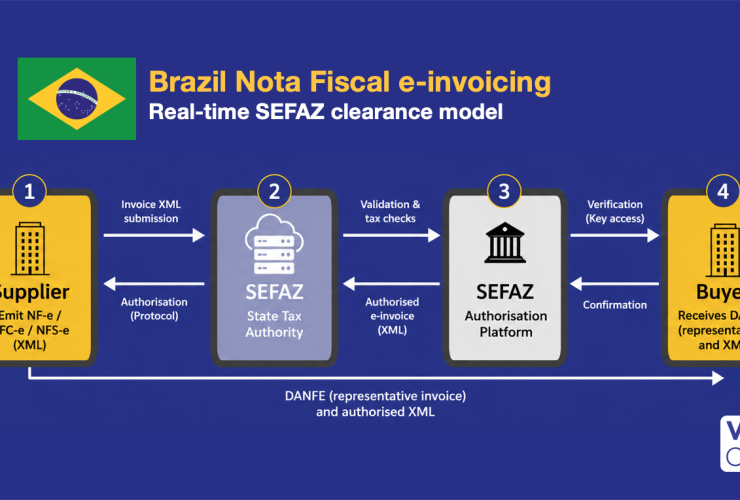
A key innovation is the planned split-payment mechanism, allowing the VAT portion of transactions to be remitted directly to tax authorities rather than through suppliers. This will reduce fraud, enhance transparency, and potentially enable real-time tax reporting and pre-filled VAT returns, echoing digital compliance systems seen in the EU.
Inclusion, equity and transitional support
The reform is not only about efficiency — it also incorporates strong social equity mechanisms. A new cashback systemwill refund VAT paid by low-income households on essential utilities such as electricity and cooking gas. Small enterprises will continue to benefit from Simples Nacional, a simplified regime that now allows business customers to claim input credits on purchases from Simples suppliers.
Transitional measures will ensure revenue neutrality and gradual adaptation for businesses and governments between 2026 and 2033, with temporary reference rates applied during the phase-in period.
A global model for modern VAT design
By consolidating multiple taxes, adopting a destination-based approach, ensuring input credit neutrality, and embedding digital and social innovation, Brazil’s dual VAT represents a model for large federal economies seeking balance between fiscal autonomy and national coherence.
Once implemented, the CBS and IBS are expected to cut compliance costs by over 60%, strengthen competitiveness, and improve transparency across the supply chain. The reform positions Brazil as a regional leader in VAT modernisation, aligning it with OECD best practices and setting a global benchmark for fiscal integration, simplicity, and inclusiveness in the digital age.