From 1 January 2027, the EU’s VAT in the Digital Age (ViDA) reforms will extend marketplace deemed supplier rules to certain exempt businesses and organisations.
The European Commission has also issued updated guidance clarifying VAT liability where multiple electronic interfaces participate in a transaction.
The changes build on the EU’s 2021 e-commerce VAT reforms, under which marketplaces can be treated as buying and reselling goods for VAT purposes, making them responsible for collecting and remitting VAT.

Deemed supplier rules extended to the ‘Group of Four’
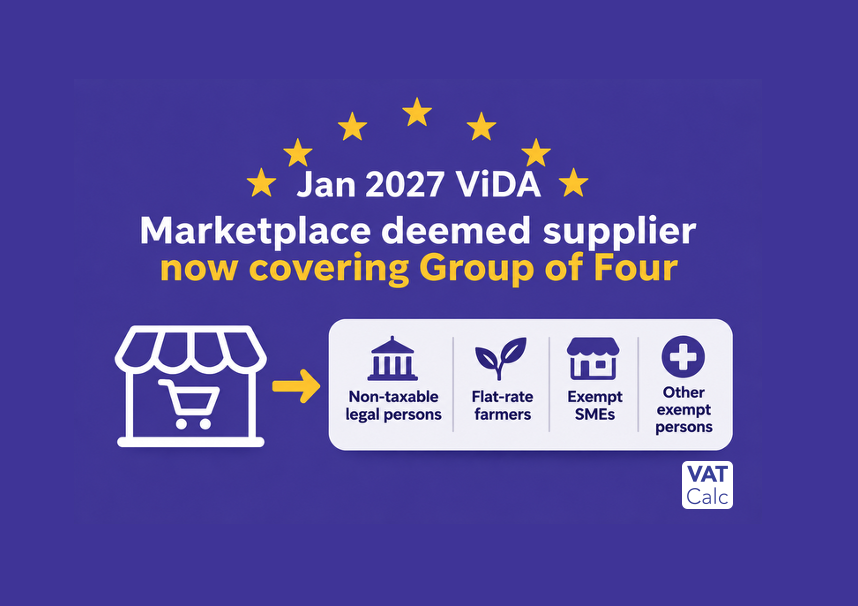
The January 2027 reforms extend deemed supplier treatment for qualifying supplies of goods to four categories of customers:
- Non-taxable legal persons, including certain public bodies and organisations.
- Flat-rate farmers operating under special agricultural VAT schemes.
- Exempt SMEs benefiting from the EU small business VAT exemption.
- Other exempt taxable persons, including certain healthcare providers.
Collectively known as the ‘Group of Four’, these customers may not be required to account for VAT on their intra-Community acquisitions.
Previously, such transactions could fall outside the marketplace deemed supplier rules despite resembling conventional B2C sales. The extension brings qualifying supplies within the marketplace VAT collection framework.
Which marketplace is liable when several platforms are involved?
The Commission’s revised July 2026 VAT e-commerce Explanatory Notes also clarify how to identify the deemed supplier where several electronic interfaces participate in the same transaction.
The determining factor is which platform actually facilitates the sale, rather than merely advertising goods, redirecting customers or processing payments.
This distinction determines which marketplace assumes VAT liability and the associated invoicing and record-keeping obligations. The guidance explains the existing framework rather than introducing a separate new liability regime.
Why customer classification matters
The changes make accurate customer classification increasingly important for marketplaces.
A customer may be a business or organisation but still fall within the deemed supplier rules because of its VAT-exempt status. Platforms must therefore look beyond a simple B2B or B2C distinction when determining who is liable for VAT.
This requires reliable customer data and VAT determination capable of applying the correct treatment across different marketplace arrangements.
Further platform reforms from July 2028
These changes precede ViDA’s broader deemed supplier reforms for short-term accommodation and road passenger transport platforms, scheduled from July 2028, with transitional flexibility for Member States until January 2030.
The direction is clear: marketplaces are assuming greater responsibility for VAT collection. But determining that liability increasingly depends on correctly identifying both the customer and the platform facilitating the transaction.