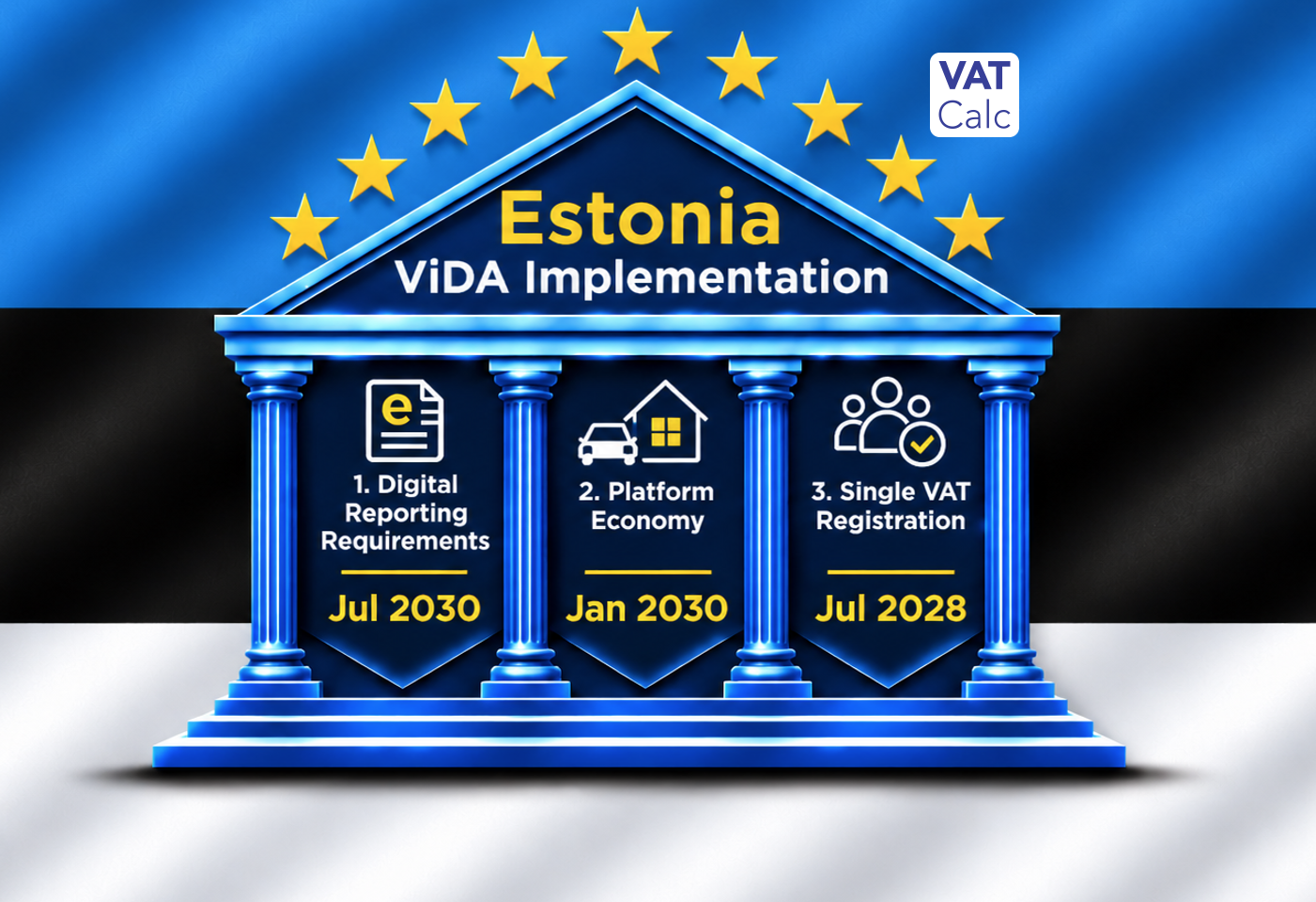
Estonian Parliament approves initial EU VAT in the Digital Age legislation
Extending OSS to energy supplies from Jan 2027 and introducing wider Single VAT Registration reforms from July 2028

Estonia’s Parliament (Riigikogu) adopted amendments to the Value Added Tax Act (Bill 992 SE) on 11 November 2026, implementing the first stages of the EU’s VAT in the Digital Age (ViDA) reforms.
The legislation transposes elements of Council Directive (EU) 2025/516, focusing on the Single VAT Registration (SVR) pillar. The changes are intended to reduce the need for businesses trading across the EU to maintain multiple national VAT registrations.
January 2027: OSS extended to energy supplies
From 1 January 2027, Estonia will extend the One Stop Shop (OSS) scheme to certain cross-border supplies of:
- Natural gas supplied through networks.
- Electricity.
- Heating and cooling energy.
The extension allows qualifying suppliers to account for VAT through a single Member State rather than registering separately in each country of consumption.
July 2028: Wider Single VAT Registration reforms
Further changes from 1 July 2028 will broaden the scope of OSS to additional cross-border transactions, including:
- Sales of goods to consumers at fairs, exhibitions and markets in other Member States.
- Supplies of goods requiring installation or assembly.
- Sales of goods on board ships and aircraft.
These changes form part of ViDA’s wider SVR reforms, designed to simplify VAT compliance for businesses operating across multiple EU markets.
Online marketplace services
The legislation also revises the place-of-supply rules for online marketplace intermediation services.
VAT on these services will generally follow the location of the underlying transaction rather than the customer’s location. For example, an accommodation booking platform’s intermediation service would be taxed where the accommodation is located.
ViDA digital reporting reforms still to come
These amendments do not implement ViDA’s mandatory intra-EU B2B e-invoicing and Digital Reporting Requirements (DRR), scheduled for July 2030.
Estonia’s initial legislation instead concentrates on the SVR pillar, with the broader EU digital reporting reforms requiring further implementation.
See more in our Estonian VAT guide.