Diverging transaction reporting; manual reconciliations to returns; audit trigger risks
How VATCalc solved it in a single app
For many businesses trading internationally, VAT compliance doesn’t stop at filing a return. Across Europe, companies with foreign or non-resident VAT registrations face a maze of additional transactional reporting obligations — from Control Statements, to SAF-T to purchase and sales listings, ledgers, and more.

These obligations are designed to give tax authorities a detailed view of each transaction, often cross-checked against counterparties’ submissions to detect fraud or errors. But for businesses, they can be a major compliance burden.
Complexity of VAT Control Statements
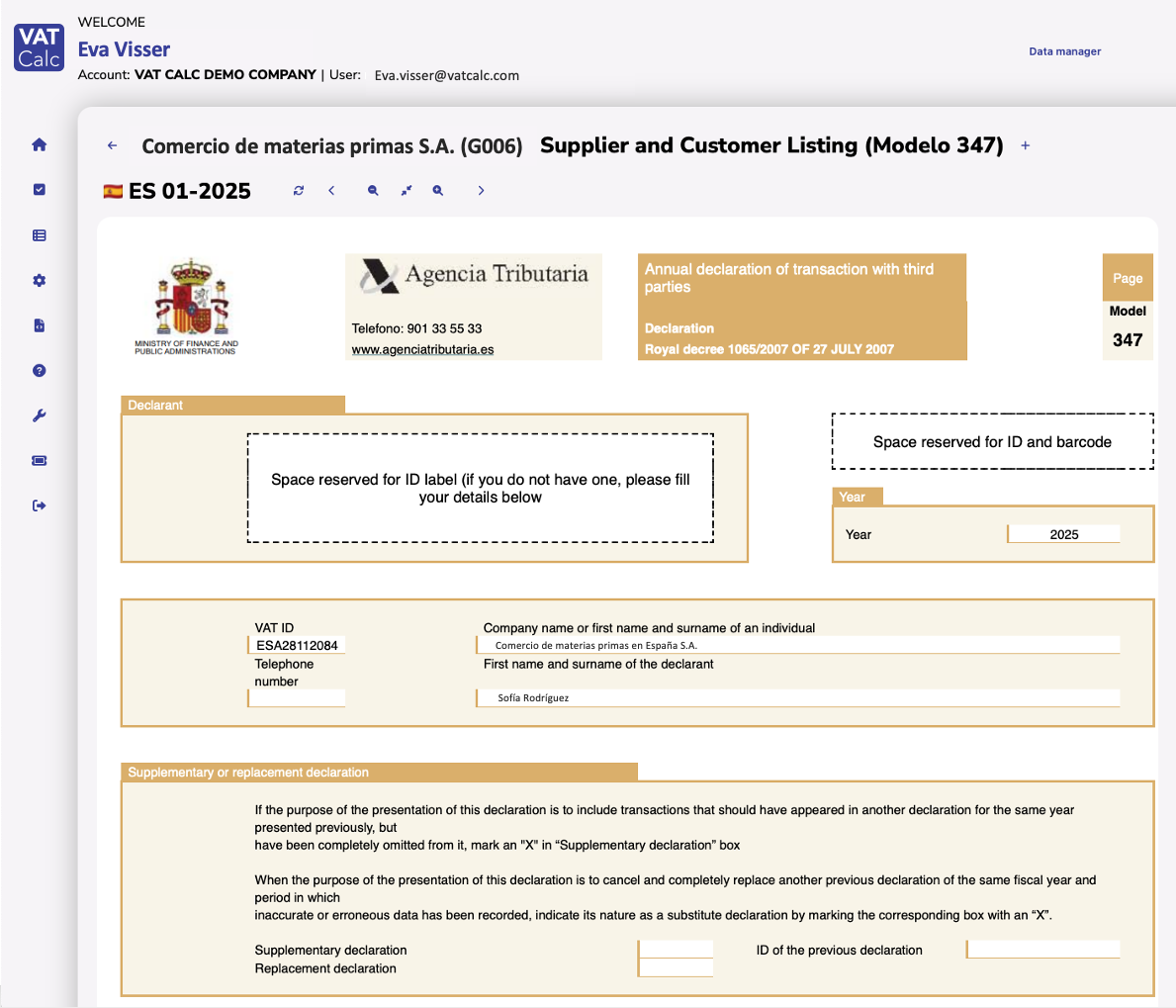
Each country has developed its own rules for transactional reporting:
-
Hungary’s “M Sheet” is widely regarded as the most complex submission in Europe, requiring invoice-level reporting with precise classification logic.
-
Czech Republic requires Control Statements that reconcile VAT returns against detailed sales and purchase listings.
- Poland has SAF-T (JPK) files that combine return data with transactional-level reporting.
- Slovakia imposed its transaction control statement in 2024 alongside its regular VAT return.
These obligations are designed to give tax authorities a detailed view of each transaction, often cross-checked against counterparties’ submissions to detect fraud or errors. But for businesses, they can be a major compliance burden.
For multinational businesses, this patchwork of formats, thresholds, and rules creates confusion. Which transactions must be included? How should they be classified? Does the data match the VAT return? If not, discrepancies often trigger audits and penalties.
Why businesses struggle with VAT transaction reporting
The main challenges include:
-
Determination at scale: Manually working out which transactions belong in which statement is slow, error-prone, and doesn’t scale.
-
Inconsistent systems: ERP outputs rarely align cleanly with reporting schemas, creating constant mapping and reconciliation work.
-
High risk of mismatches: If Control Statements don’t reconcile with VAT returns, tax authorities immediately spot gaps.
For non-resident businesses — often lacking local expertise or advisors — these issues become even more acute.
VATCalc’s Solution: Legislative-Driven Tax Engine, Real-Time Processing
VATCalc solves this problem at the source with its codified tax engine:
-
Every transaction is determined or redetermined in milliseconds, applying the exact VAT law of the country to decide if and how it must be included in a Control Statement.
-
This eliminates guesswork and manual classification, ensuring consistency across returns, listings, and ledgers.
Once determined, transactions flow directly into VATCalc’s Filer:
-
Filer accepts transactions seamlessly from the engine, producing draft Control Statements and listings automatically.
-
Because they are generated from the same dataset as VAT returns, there are no reconciliation gaps or manual fixes required.
-
Full audit trails by user give confidence in review, approval, and submission.
Coverage Across Europe
VATCalc supports all transactional reporting obligations across Europe, including:
-
Central Europe: Hungary’s M Sheet, Czech and Slovak Control Statements, Poland’s JPK files.
-
Southern Europe: Spain’s SII, Italy’s invoice ledgers, Portugal’s SAF-T.
-
And more — from Nordic SAF-T variations to Baltic listings.

One VAT Application, one source of truth
With VATCalc, transactional reporting isn’t an extra project. It’s part of the same single application that calculates invoice VAT and prepares VAT returns. That means:
-
No multiple vendors.
-
No separate mapping tools.
-
No endless reconciliations.
Just accurate, legislative-driven Control Statements generated from the same source of truth as your VAT compliance.
For businesses with non-resident VAT registrations, VATCalc takes the most confusing, error-prone part of VAT compliance and makes it seamless.