France’s Sept 2026 e-invoicing: why fixing invoice errors after submission may no longer be an option
The French e-invoicing mandate is highlighting an issue many businesses have overlooked: once an invoice reaches an Approved Platform (PA), correcting and resubmitting it under the same invoice number may no longer be possible.
This is set to catch most taxpayers out who haven’t automated validation and reconciliation.

The French tax code has not changed, but…
French accounting and VAT legislation has always required invoices to remain authentic, complete and unaltered once issued. Where an error is identified, the correct approach has been to cancel the original invoice and issue a new one.
Historically, however, many ERP and EDI processes allowed users to amend a rejected invoice and resend it using the same invoice number. While common in practice, this was never fully aligned with the underlying legal principles.
Approved Platform validation now makes the rule unavoidable
Under France’s new e-invoicing framework, Approved Platforms are responsible for validating invoice structure, business rules and duplicate invoice numbers before processing invoices.
Once an invoice number has been submitted to the platform, businesses should assume that it cannot simply be reused if validation fails. Instead, a rejected invoice may need to be cancelled and recreated with a new identifier.
Prevention is becoming the necessity rather than correction
This shifts the focus from correcting invoices after submission to preventing errors before they are transmitted. Businesses that validate invoice data, VAT treatment and mandatory fields within their ERP before sending invoices can significantly reduce rejected documents, operational delays and unnecessary rework.
This is where robust data validation and reconciliation become increasingly important.
E-reconciliations on invoice details essential
VATCalc’s E-Reconciliation application helps organisations compare ERP transactions, invoices and VAT reporting data before submission, identifying inconsistencies, missing information and potential VAT errors at an early stage.
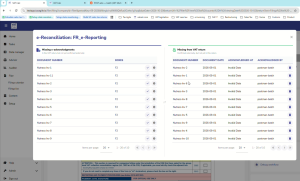
By resolving issues before invoices enter regulated e-invoicing workflows, businesses can reduce rejection rates, avoid costly manual intervention and maintain cleaner, more reliable VAT data.
As continuous transaction controls and e-invoicing mandates expand globally, success will depend not only on transmitting invoices in the correct format, but on ensuring the underlying transaction data is accurate before it leaves the ERP.