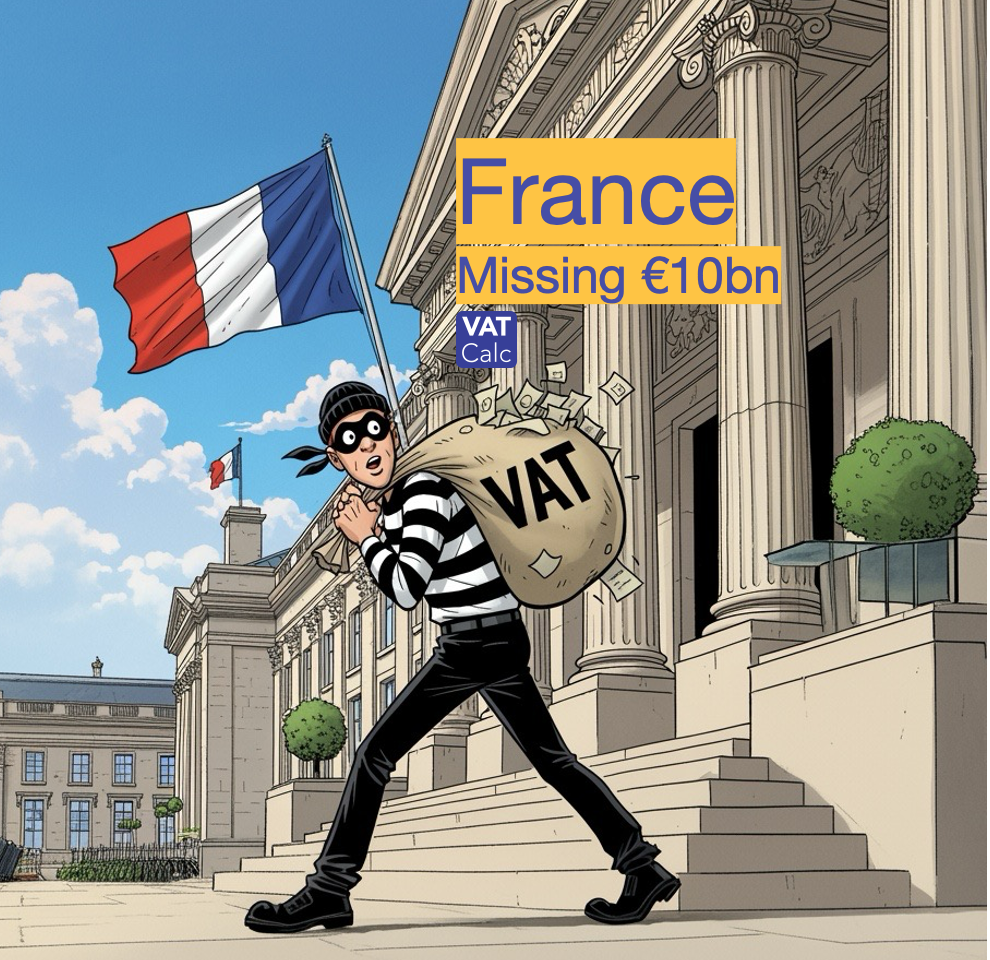
France’s great VAT vanishing act: Bercy points finger at multiple culprits to €10 billion VAT shortfall
Move over Louvre jewel heist: France has a new national mystery. This time, the missing treasure is €10 billion in VAT revenue that has simply… evaporated. One minute the government thought it had it; the next minute Bercy, home of the Finance Ministry, was staring at its cash registers like a shopper who pops open a wallet expecting a €50 note and finds lint.

And this isn’t even part of the French VAT gap – this is a new hole in the public finances of an already heavily indebted country.
The shock discovery: VAT revenues don’t add up
Cue the alarm bells. The Ministry of the Economy and Finance has launched an “emergency mission” to figure out what on earth is going on. Inspectors, analysts, the Treasury, the General Finance Inspectorate—everyone has been dispatched.
And the first suspect? Import e-commercepackages . Tiny ones. Very tiny ones. The kind arriving by the million from China, stuffed with fast fashion, peculiar gadgets, or things nobody remembers ordering at 2 a.m. According to Public Accounts Minister Amélie de Montchalin, these feather-weight parcels might be the macro-level villain.
Their declared values are often so low—sometimes implausibly low—that the VAT leakage becomes a death by a thousand cuts. A few cents lost here, a few euros missing there, multiplied by tens of millions of shipments, and suddenly France is short a small fortune.
Small parcels aren’t the only culprit
But even Bercy knows the “mystery of the micro-parcels” isn’t enough to explain the full €10 billion disappearance. Other culprits float ominously around the case file:
-
A rise in intra-EU VAT fraud—long recognised as the easiest tax to manipulate.
-
Shifting consumer behaviour: inflation has nudged households into low-VAT or zero-VAT items, reducing the tax take.
-
Margin compression at businesses, which lowers sale prices and therefore VAT per transaction.
That’s already quite the cocktail of complications, but the plot twist is bigger. This is the third straight year the Finance Ministry has got its VAT forecasts significantly wrong. After a €20 billion overshoot last year, what was once a technical quirk is now a chronic forecasting headache.
Why Are France’s forecasting models failing?
Forecast models built for a calmer, more predictable economy are struggling to keep up with a marketplace dominated by cross-border e-commerce, volatile consumer sentiment, and geopolitical uncertainty. Economists warn that even small shifts in consumption can have seismic effects when VAT brings in more than €200 billion annually.
France’s own experts point to structural issues: optimism bias in government growth assumptions, limited visibility into digital trade flows, and the lingering drag of austerity policies that suppress consumption.
Measures to tackle French VAT gap
France is not just wringing its hands. Several measures—many already proposed or legislated—aim to tighten the VAT net:
-
2026 e-invoicing & e-reporting mandate to close data gaps and tackle carousel fraud.
-
€2 customs levy 2026 on low-value imports in 2026 to discourage under-declared consignments and bolster border checks.
-
Stricter valuation controls on fast-growing e-commerce parcels.
-
A full overhaul of VAT forecasting models, aligning them with digital trade, marketplace imports and new patterns of consumer spending.
Electronic invoicing alone might recover a couple of billion euros, but even that will not fill a €10 billion crater.
The mystery continues
Until Bercy cracks the case, the €10 billion remains an unsolved mystery. But it’s clear that in modern tax administration, the biggest disappearing act is not performed by jewel thieves—it’s executed one tiny parcel at a time.
See more in our French VAT guide.