Germany plans voluntary testing from early 2029 before launching its digital VAT reporting system alongside EU ViDA reforms in July 2030
Germany’s Federal Ministry of Finance (BMF) has set out a timetable for the introduction of a digital VAT e-reporting mandate, building on the country’s phased B2B e-invoicing mandate which started in 2025.
The Germany phased e-invoicing is rolling out 2025-28, and intra-community EU e-reporting starts July 2030 under ViDA.

BMF outline plans for e-reporting
Michael Schrodi, Parliamentary State Secretary at the BMF, confirmed that the planned reporting system is targeted to go live on 1 July 2030, with a voluntary pilot from the beginning of 2029.
Schrodi outlined the roadmap at a 22 September 2026 event organised by the German Electronic Invoice Association (VeR). The BMF described the reform as a staged move from conventional accounting, through structured electronic invoices, towards the digital reporting of specified data to the tax administration.
Germany e-reporting & e-invoicing timetable
The emerging German timetable is:
- 1 January 2025 – businesses required to be able to receive structured domestic B2B e-invoices
- 1 January 2027 – mandatory issuance for businesses with prior-year turnover above €800,000
- 1 January 2028 – remaining B2B e-invoicing transitional relief expires
- Early 2029 – voluntary pilot of the digital VAT reporting system
- 1 July 2030 – planned launch of the reporting system
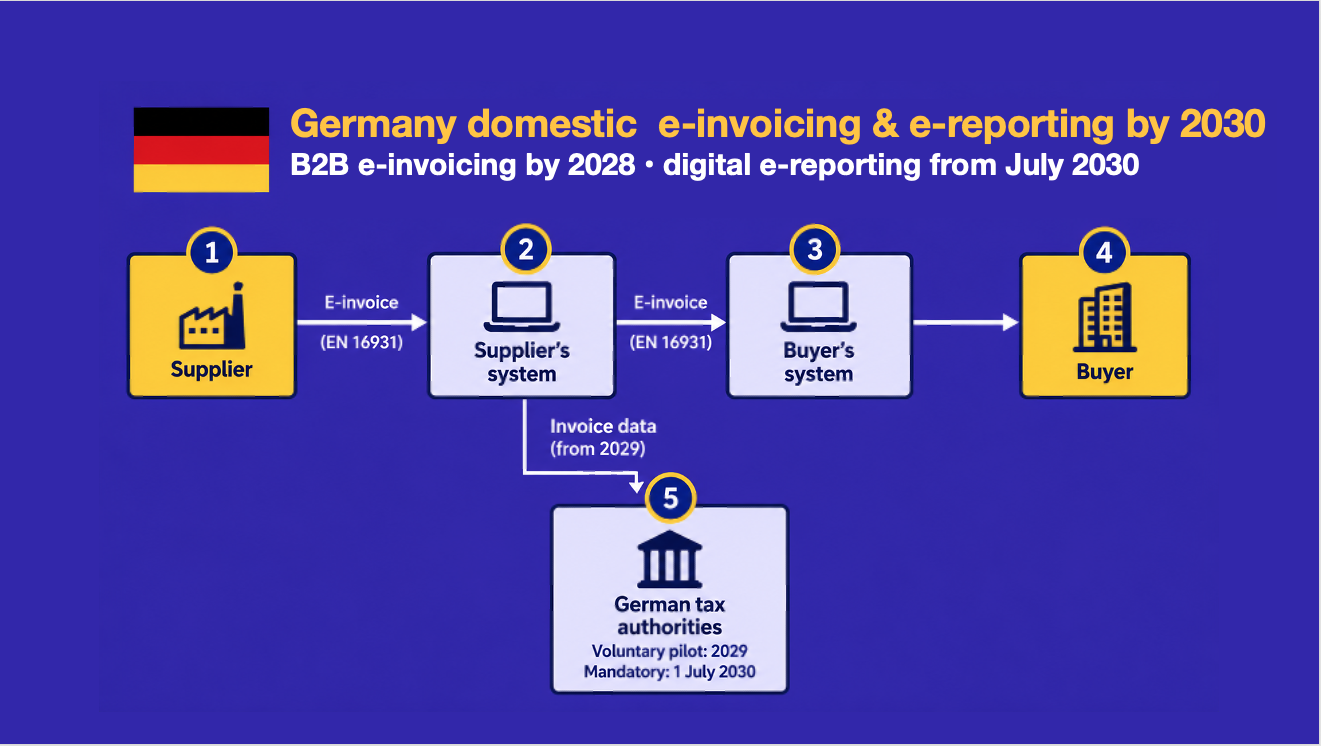
Germany’s existing e-invoicing rules require structured, machine-processable invoices compliant with EN 16931. Permitted formats include XRechnung and compliant versions of ZUGFeRD.
E-invoicing becomes the foundation for e-reporting
The announcement confirms more clearly the relationship between Germany’s current e-invoicing programme and its future VAT reporting regime. Structured e-invoices create standardised transaction data. The next stage is to use that data for digital reporting to the tax authorities.
The direction is therefore:
Structured e-invoice → invoice data → digital VAT reporting
The BMF also sees a potential role for commercial IT providers and e-invoicing platforms. Schrodi said they could contribute both to invoice transmission and, subsequently, the reporting of invoice data to the tax administration.
However, the technical architecture has not yet been confirmed.
There is currently no BMF confirmation that Germany will mandate Peppol, adopt a particular four- or five-corner model, or require separate buyer-side reporting. VeR has proposed models using existing e-invoicing infrastructure, including Peppol and a five-corner model incorporating the tax authority, but these remain industry proposals rather than the final German reporting design.
Germany aligns e-reporting with ViDA
The 1 July 2030 target is particularly significant because it coincides with the EU VAT in the Digital Age (ViDA) Digital Reporting Requirements. ViDA will introduce harmonised digital reporting for relevant intra-EU B2B transactions from that date. Germany is therefore developing its domestic reporting system against the same 2030 timetable.
This potentially gives Germany an opportunity to align the data and technology underpinning domestic reporting with the wider EU framework, although the detailed German requirements remain to be determined.
For businesses, the latest announcement confirms that Germany’s e-invoicing mandate should not be treated simply as a change in invoice format.
It is the first stage of a wider transition towards transaction-level digital VAT reporting. ERP data, VAT determination, structured invoice data and VAT reporting will increasingly need to reconcile as parts of the same digital compliance process.