Getting VAT right on global digital services: traditional model no longer works
For businesses supplying digital services across borders, VAT compliance on digital services has become one of the most complex areas of indirect taxation – over 120 countries levy VAT obligations on foreign or non-resident providers and intermediaries.

Determining who is responsible for VAT, which rate applies, and how the transaction must be reported now depends on a dense mix of local domestic laws, special digital-services rules, and marketplace obligations. The challenge is not theoretical: it must be solved in real time, with global e-invoicing and EU ViDA coming over the horizon, at the point of transaction, and then carried through accurately into VAT returns. This is despite efforts of OECD guidelines on VAT and digital services looking to provide some consistency.
The B2B vs B2C Problem
One of the most common points of failure is the distinction between B2B and B2C supplies of digital services.
-
In B2B scenarios, many jurisdictions apply a reverse-charge mechanism on digital, shifting the VAT accounting obligation to the customer. But around 20 countries apply VAT on non-resident digital services.
-
In B2C scenarios, VAT is often due in the customer’s location, requiring the supplier (or marketplace) to charge and remit VAT locally, sometimes via special regimes such as EU OSS or equivalent domestic rules.
Critically, these distinctions are not globally consistent. What qualifies as B2B evidence, when reverse charge applies, and how marketplaces are deemed suppliers all vary by country. Relying on static rules or manual decision trees inevitably leads to errors, inconsistent invoicing, and audit risk.
Calculating VAT live — not after the fact
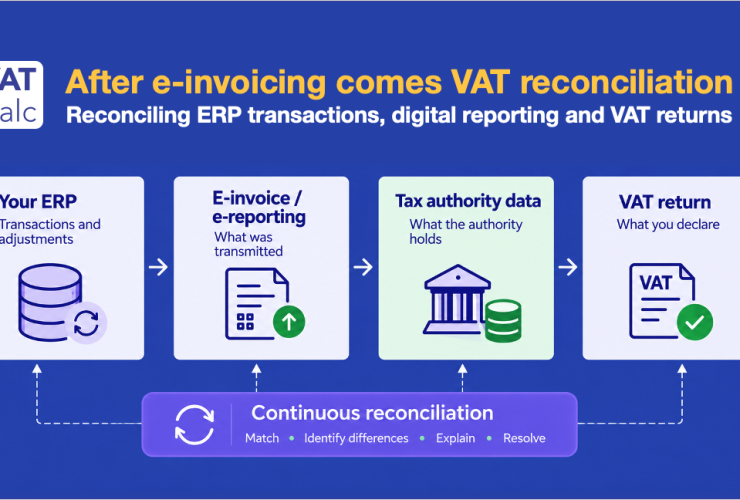
Many traditional tax solutions treat VAT determination and VAT reporting as separate problems. Tax engines may determine a tax outcome, but they are detached from the invoicing logic, marketplace flow, or downstream VAT returns.
In contrast, digital services VAT must be:
-
Determined live, during checkout or invoice creation;
-
Applied correctly based on supply type, customer status, and local law; and
-
Reported consistently, without reinterpretation, reconciliation, or manual mapping.
This is where most legacy vendors struggle. Their architectures rely on:
-
Lengthy implementation projects;
-
Multiple applications stitched together with APIs;
-
Jurisdiction-by-jurisdiction configuration; and
-
Ongoing support to resolve inevitable mismatches between calculation and reporting.
How VATCalc solves the End-to-End Problem
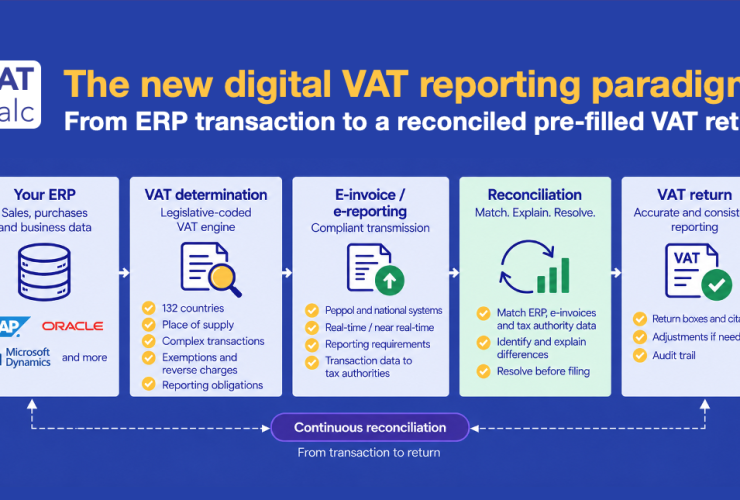
VATCalc takes a fundamentally different approach. It codifies local domestic VAT law directly into a single global engine, including the precise differences between B2B and B2C digital-services obligations in each jurisdiction.
This means:
-
B2B vs B2C treatment is legally defined and automated, not inferred or manually configured.
-
Reverse-charge rules, marketplace deemed-supplier logic, and place-of-supply rules are embedded at source.
-
VAT is calculated live within the invoice or marketplace flow, using the same logic that will later drive reporting.
Crucially, that same transaction data then feeds seamlessly into VAT return reporting within the same application. There is no hand-off, no re-interpretation, and no risk of divergence between what was charged and what is reported.
A Structural Advantage, Not an Integration Exercise
Unlike traditional vendors, VATCalc does not rely on separate calculation engines, reporting tools, or country-specific add-ons. The result is:
-
Faster deployment as all jurisdictions are tax codified – no length use cases or custom rules;
-
Lower total cost of ownership since just one vendor for determination and reporting;
-
Minimal ongoing support; and
-
A single, auditable source of truth for digital-services VAT globally.
As governments continue to tighten digital-economy VAT rules, getting VAT right is no longer just about compliance — it is about having the right architecture. For global digital services, only a single, codified, end-to-end VAT engine can keep pace.