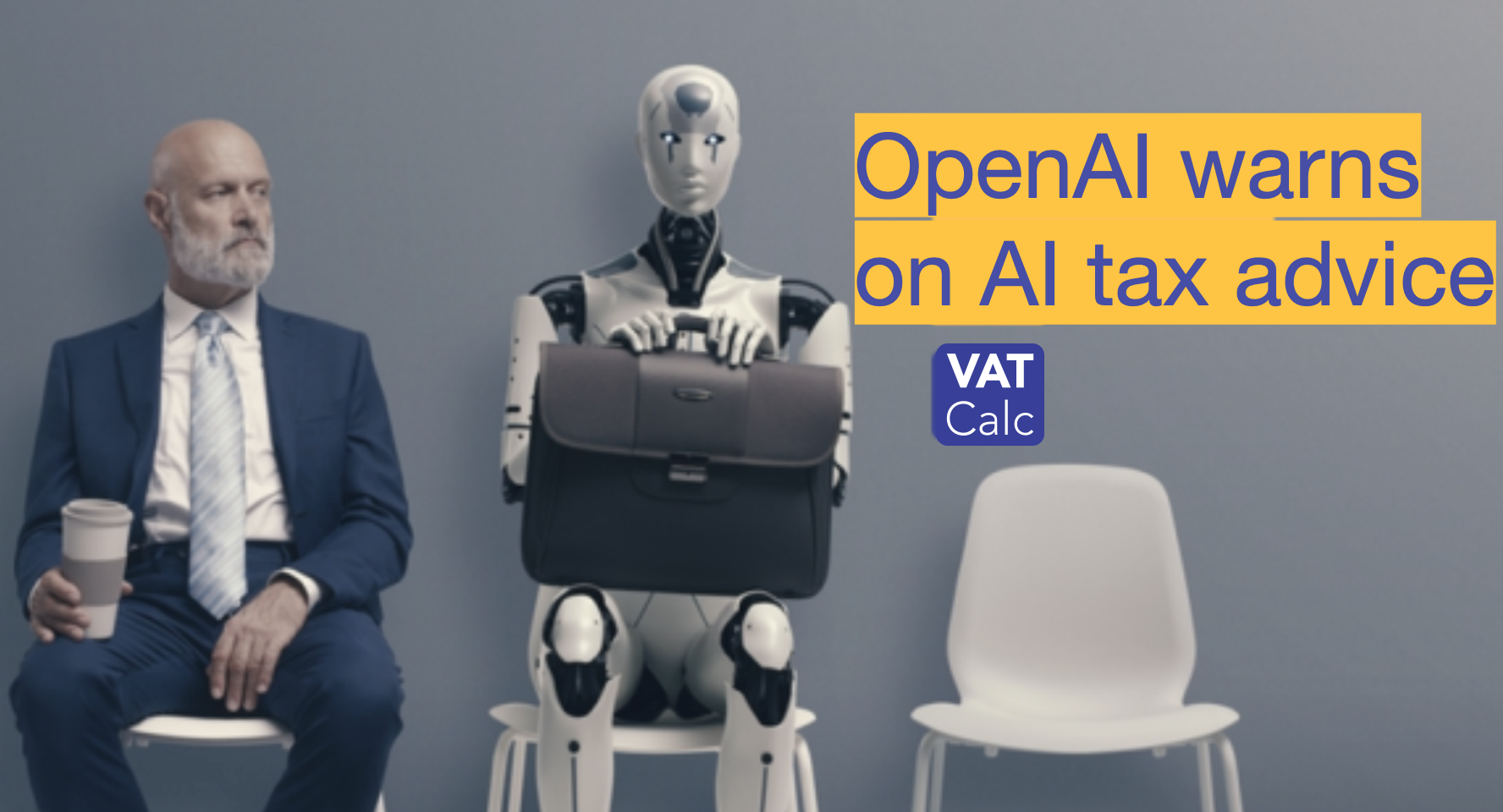
OpenAI redefines ChatGPT on liability fears: it’s no longer your tax advisor
In a quiet but significant policy shift, OpenAI has reclassified ChatGPT as an educational tool rather than a consultant, effectively barring the system from providing specific medical, legal, or financial advice—including tax guidance.
It comes as cases such as Polands ruling on fabricated VAT rulings generated by public chatbots have exposed businesses to millions in losses.

The move marks a tightening of boundaries around how users can rely on AI for professional decisions.
At VATCalc have been adopting closely controlled AI in our single tax engine and reporting application since 2023, including for template AI advise for review by experts and item classification for rate determination. But this is all heavily monitored by our expert content and engineering team.
Liability rears drive a new caution
At the heart of the change is liability. As AI chatbots have become more sophisticated and trusted, users increasingly treat them as digital consultants—asking for tax planning strategies, investment tips, or even legal templates. But these interactions carry risks. Unlike licensed professionals, AI systems aren’t regulated, insured, or bound by confidentiality protections like attorney–client privilege. That leaves OpenAI exposed to potential legal and reputational fallout if users act on incorrect or misleading information.
From AI “Advisor” to “Educator”
Under the updated policies, ChatGPT can still discuss general principles—for example, what VAT is, how tax brackets work, or what a will typically contains—but it must not offer personalised or actionable advice. Users asking for VAT restructuring strategies, case law templates, or VAT exemptions recommendations are now met with safety filters and redirection toward qualified professionals.
In practice, this means queries such as “How should I structure my business to minimise VAT?” or “Which country should I register in for the lowest VAT?” are out of bounds. Instead, ChatGPT might explain the concept of VAT registration thresholds or outline common approaches used by tax authorities, leaving the specifics to certified accountants or legal advisers.
Why this matters for the Tax and Legal Sectors
This move will undoubtably play well with the concerned VAT and broader tax and legal profession who worried about loss of earnings on basic advisory work. The view AI as a powerful efficiency companion but not a substitute for professional judgment. For the tax technology world—where automation, digital reporting, and compliance tools are accelerating—this boundary, in their opinion, underlines the need for audited, legislative-coded systems that can provide legally reliable outcomes.
It also highlights the distinction between conversational AI and regulated tax engines like VATCalc, which embed actual legislation into their calculation and reporting logic. ChatGPT might explain how VAT works; VATCalc determines what the law requires—and proves it.
OpenAI’s concerns beyond VAT and tax
OpenAI’s move extends beyond tax and finance. The same restrictions now prevent ChatGPT from naming medications, suggesting dosages, or generating legal filings. These are part of a suite of “user safety” measures meant to prevent harm and misuse. The system also introduces new support features for users in distress, focusing on mental health and crisis scenarios.
Where VATCalc Fits In
For professionals seeking digital precision in compliance, tools like VATCalc go beyond explanation. They’re built on legislative code—not probabilistic language models—ensuring every VAT determination, e-invoice validation, or return submission aligns exactly with national law.
In an age where conversational AI is stepping back from advice, VATCalc stands forward as the trusted, compliant automation engine—bridging the gap between real-time data and legally certain tax outcomes. See how we have adapted AI for VAT to deliver a better product and experience for businesses, without the liability risks.