1 August 2026 preparations for ‘Lekuka’ e-invoicing rollout under new regulations
Lesotho in southern Africa has introduced the legal framework for mandatory VAT e-invoicing through the Value Added Tax (E-Invoicing) Regulations, 2026, which entered into force on 1 April 2026.
The new rules establish a clearance-style e-invoicing model overseen by the Revenue Services Lesotho (RSL), requiring invoice data to be transmitted electronically for validation and tax administration purposes. VAT-registered businesses may be required to adopt approved electronic invoicing and point-of-sale systems from 1 August 2026.
Surrounding South African e-invoicing may start 2028.
Centralised e-invoicing platform
“Lekuka”: The New E-Invoicing Platform
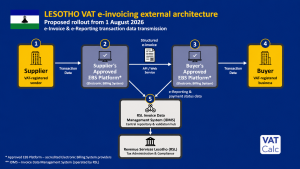
The e-invoicing project is being implemented through a platform locally branded as “Lekuka”, based on the Virtual Fiscal Device Management developed by NRD Companies. Lekuka is designed to serve as a national e-invoicing ecosystem, integrating businesses, buyers, solution providers, and the tax authority into a single digital environment.
The regulations establish a two-part architecture:
- The Revenue Services Lesotho Invoice Data Management System (IDMS)
- Taxpayer-operated Electronic Billing Systems (EBS)
Invoice data must be transmitted from accredited EBS solutions to the IDMS, which acts as the central repository for transaction data and invoice verification.
The system uses digital certificates, digital signatures and QR codes to authenticate invoices and support real-time or near real-time VAT controls.
Accredited software providers required
Suppliers of Electronic Billing Systems must obtain accreditation from the RSL before their solutions can be used by taxpayers. The Commissioner-General has powers to:
- Approve or reject accreditation applications
- Publish approved providers
- Withdraw accreditation where compliance requirements are not met
Businesses should therefore ensure any invoicing software selected for Lesotho is formally approved by the tax authority.
New obligations for VAT-registered businesses
Under the regulations, vendors must:
- Operate an accredited Electronic Billing System
- Register the system with the RSL
- Issue invoices for taxable transactions
- Include prescribed invoice details, digital signatures and QR codes
- Transmit transaction data to the IDMS
- Maintain accurate records and support tax audits
The regulations prohibit the use of non-compliant invoicing systems.
Customers drawn into compliance controls
The regime also introduces limited obligations for customers. In business-to-business transactions, customers may be expected to verify invoice accuracy and report discrepancies, creating an additional layer of compliance oversight within the VAT system.
Significant penalties for failure to issue e-invoices
Lesotho has adopted a strict enforcement approach.
Administrative penalties ranging from M50,000 to M300,000 may apply for offences including:
- Failure to issue compliant invoices
- Use of unaccredited systems
- Failure to cooperate with audits
- Failure to comply with reporting requirements
More serious breaches may attract fines of up to M500,000 or imprisonment for up to six months.