SARS firms up five-corner e-invoicing model; near real-time VAT reporting; pre-filled returns; phased mandates from 2030
Update 8 September 2026: South African Revenue Service (SARS) has provided further details of its proposed Digital VAT Model, for mandatory e-invoicing, near real-time VAT transaction reporting and ultimately pre-filled VAT returns.
This builds on the Tax Administration Laws Amendment Bill (TALAB), which was passed into law on 1 April 2026.

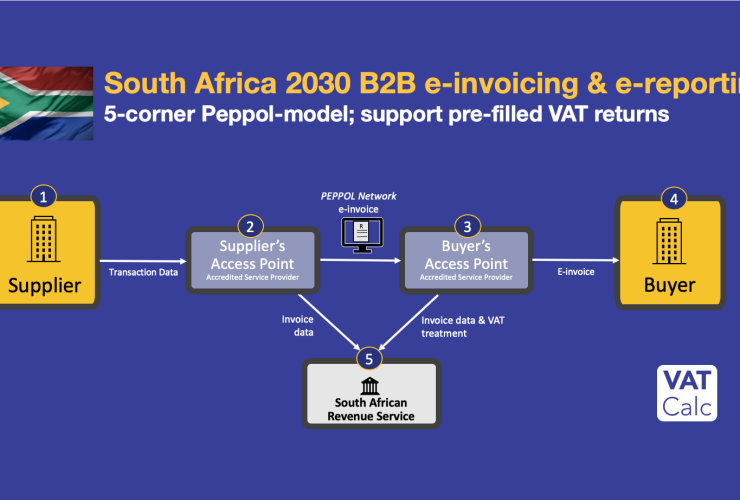
Peppol-based 5-corner real-time VAT transaction reporting
The reform remains subject to consultation, which runs to 18 October, detailed design and approvals. There are significant further issues to resolve, including the obligations of non-resident vendors.
Roadmap includes:
- 2026 – stakeholder consultation
- 2027-28 Solution development and regulations
- 2028-29 Testing
- 2029 – Pilot
- 2030 – Large businesses mandate launch; mid and govt to follow
Consultation on Digital VAT Model launches till Oct 2026
The consultation proposes three integrated components:
- structured electronic invoices
- an interoperability framework (IF)
- near real-time e-VAT reporting by both supplier and customer.
Together these form what SARS calls its Digital VAT Model, designed to replace today’s post-audit approach with continuous transaction controls (CTC). The longer-term ambition is pre-filled VAT returns and eventually automated VAT assessments, whilst retaining taxpayer review rights.
SARS describes the objective as making VAT compliance something that “just happens” through normal business processes, with ERP, accounting, invoicing and payment systems exchanging transaction data in near real time.
Mandatory structured e-invoices
The consultation confirms that future VAT invoices will need to be structured, machine-readable electronic invoices rather than PDFs or scanned documents. SARS is considering internationally recognised invoice standards including:
- EN16931
- UN/CEFACT Cross Industry Invoice
- Peppol PINT BIS.
Technical specifications will later define South African VAT-specific requirements, including treatment of zero-rated supplies, deemed supplies and apportionment.
Five-corner interoperability model
SARS proposes a five-corner architecture:
- Supplier
- Supplier’s accredited Access Point
- Buyer’s accredited Access Point
- Buyer
- SARS Access Point.
Both supplier and buyer exchange invoices through certified service providers. Those providers validate invoice data before transmitting the required VAT data to SARS. The buyer also confirms the VAT treatment of purchases, creating a duplex reporting process that provides SARS with information from both sides of the transaction.
This decentralised model is intended to avoid a single point of failure while allowing businesses to choose their preferred accredited network provider.
Near real-time e-reporting – limited invoice info
SARS intends to receive VAT transaction data before, during or shortly after invoices are exchanged.
SARS says the proposed model will provide it with the VAT-relevant information required for tax administration, rather than necessarily the complete commercial invoice. The final dataset remains to be determined through detailed design and consultation.
This potentially separates the commercial exchange of a structured invoice between supplier and customer from the subset of tax data simultaneously reported to SARS.
This continuous transaction control model will provide near real-time visibility of business transactions and ultimately support:
- pre-filled VAT returns
- faster VAT refunds
- AI-driven risk analysis
- earlier fraud detection
- automated VAT assessments in the future.
Mandatory implementation would then continue over approximately three years using turnover thresholds and sector-based rollouts.
The proposed order is:
- large businesses (B2B)
- government procurement (B2G)
- SMEs
- finally business-to-consumer transactions (B2C).
Large businesses will connect ERPs directly
The September 2026 guidance is also much clearer about what the model will mean operationally for larger businesses.
SARS expects a large business to connect its ERP system to an accredited service provider, allowing both sales and supplier invoices to flow automatically into:
- Accounts Receivable
- Accounts Payable
- VAT compliance processes.
This goes considerably further than simply replacing PDF invoices with structured electronic documents.
South Africa is effectively looking to connect the invoice, AR/AP processing, VAT treatment and VAT return into one continuous data flow.
Finance and tax teams would consequently move away from relying principally on month-end VAT preparation towards continuous transaction validation and exception management.
Purchase VAT treatment creates two-sided reporting
One of the more ambitious elements of the model is the involvement of both sides of the transaction.
The supplier reports the transaction through the e-invoicing network, while purchase-side information can provide SARS with visibility over how the recipient treats the acquisition for VAT purposes.
That creates the potential for SARS to reconcile:
Supplier e-invoice → supplier VAT reporting → buyer invoice → input VAT treatment → VAT return
This is important for input VAT control. It gives SARS data against which deductions can ultimately be checked rather than relying solely on the supplier’s invoice information.
It also helps explain SARS’s longer-term ambition to produce pre-filled VAT returns and eventually VAT auto-assessments.
Non-resident vendors – unresolved
The proposals appear capable of extending to non-resident businesses registered for South African VAT. SARS generally describes the future e-invoicing and e-reporting obligations as applying to VAT “vendors”, which can include non-residents, rather than limiting them to businesses established in South Africa.
However, SARS has not yet expressly confirmed whether all non-resident VAT vendors will fall within both the e-invoicing and e-reporting mandates. Their precise scope, including treatment of foreign electronic-services suppliers and other non-established vendors, will require clarification in the implementing regulations.