
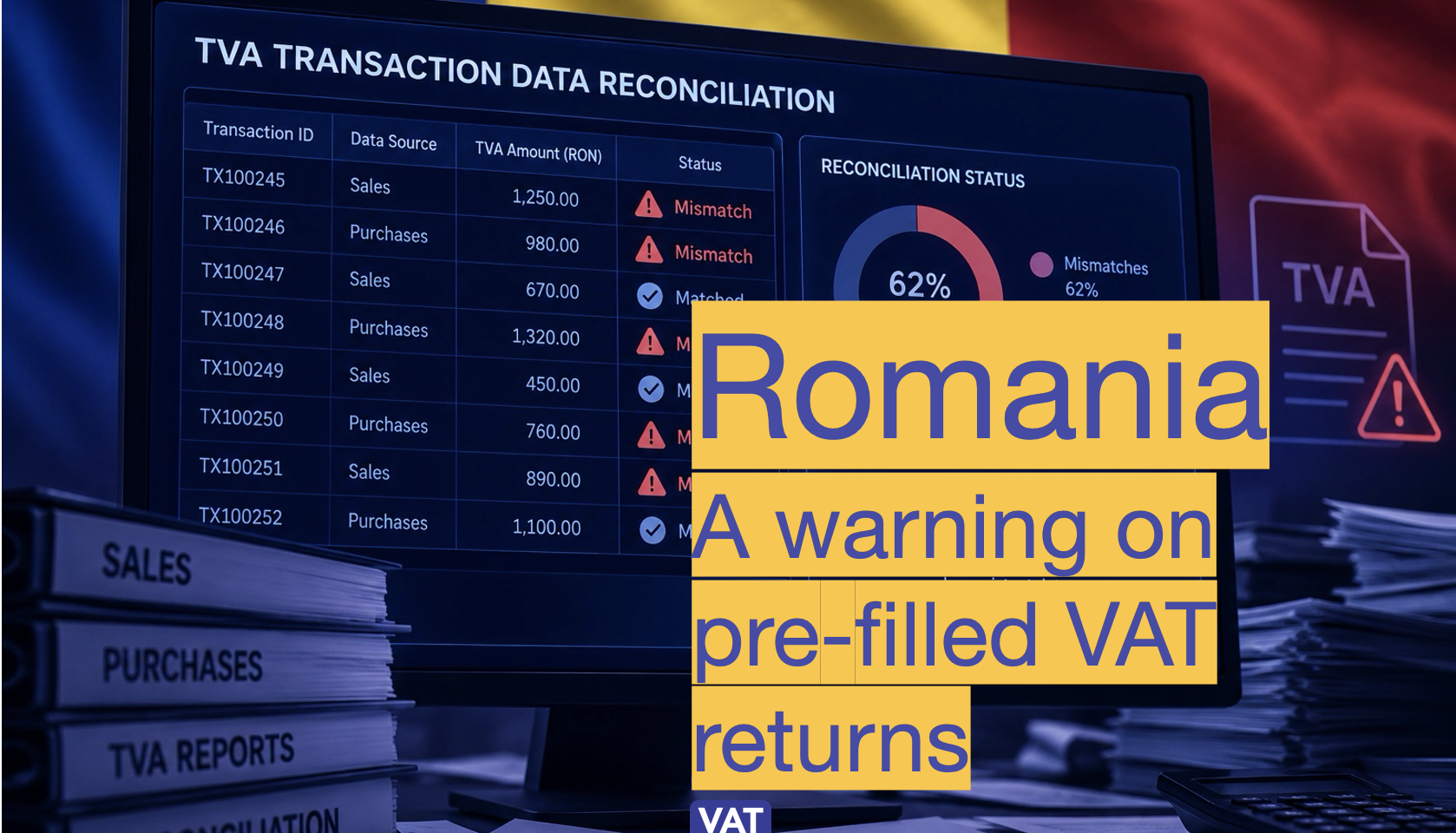

Romania’s retreat from enforcement of its eVAT pre-filled return offers an early warning for governments looking to use e-invoicing and digital reporting data to calculate taxpayers’ VAT liabilities.
The attraction is clear: if tax authorities already receive transaction-level data, why require businesses to calculate VAT returns themselves?
Romania shows where that becomes difficult.
Romania’s RO e-TVA experiment
Romania launched RO e-TVA from 1 August 2024, covering transactions from July 2024. ANAF uses information from RO e-Factura, SAF-T, customs, electronic cash registers and other reporting systems to produce a pre-filled VAT statement.
However, RO e-TVA does not replace the taxpayer’s D300 VAT return. ANAF produces its own calculation after the filing deadline and compares this with the taxpayer’s return.
Originally, differences exceeding both 20% and RON 5,000 could trigger an e-TVA compliance notification requiring an explanation within 20 days. Enforcement was subsequently postponed until the end of 2025.
Romania then changed direction. From 1 January 2026, key obligations and sanctions surrounding responses to discrepancies were repealed. In March 2026, further provisions of the compliance framework were removed. RO e-TVA continues, but without the original enforcement model. (Legislație)
Why pre-filled VAT gets complicated
The Romanian experience highlights a problem other tax authorities will face as they adopt pre-filled returns.
Having the invoices is not the same as having the VAT return.
Timing differences, credit notes, corrections, cash accounting, customs transactions and other VAT adjustments can all produce legitimate differences between transaction data held by the tax authority and the taxpayer’s accounting records.
Pre-filling therefore creates a new challenge: reconciliation.
Instead of eliminating VAT compliance, governments risk shifting the work from preparing the return to identifying and explaining differences between the authority’s calculation and the business’s own records.
From VAT preparation to VAT reconciliation
That does not mean pre-filled VAT returns will fail. They may ultimately make VAT compliance considerably more efficient. But Romania suggests reconciliation will be critical to making them work.
VATCalc has developed its pre-filled VAT return e-Reconciliation functionality for precisely this emerging requirement. It compares the authority’s pre-filled position with e-invoicing and e-reporting data and underlying ERP transactions, tracing differences back to invoice level for investigation.
As more tax authorities follow Romania towards pre-filled VAT returns, the compliance challenge may therefore change rather than disappear.
The taxpayer may no longer have to calculate the government’s VAT return. But it will still need to prove whether the government got it right.
See more in our Romanian VAT guide.

