UK e-Invoicing 2029; HMRC ducks real-time reporting — but it’s likely coming…
-
The UK will introduce mandatory e-invoicing from 2029 using a 4-corner exchange model, with no immediate obligation to report invoice data to HMRC.
-
Real-time reporting (RTR) / e-reporting is explicitly deferred, not abandoned, and could build on the same infrastructure at a later stage.
- July 2025 consultation responses broadly supported RTR in principle, but only after 2029 e-invoicing is embedded, with clear standards, strong governance, and phased implementation.

- And it’s a no for now to pre-filled VAT returns
The UK government’s e-invoicing consultation response to its Summer 2025 e-invoicing consultation provides welcome clarity on one of the most sensitive questions facing businesses: will HMRC require real-time reporting of invoice data as part of the 2029 mandate?
The short answer is no — for now. But the longer answer makes clear that e-reporting remains firmly on HMRC’s strategic horizon – following the example of Belgium e-invoicing and e-reporting phased approach
HMRC’s doing a Belgium e-reporting in future?
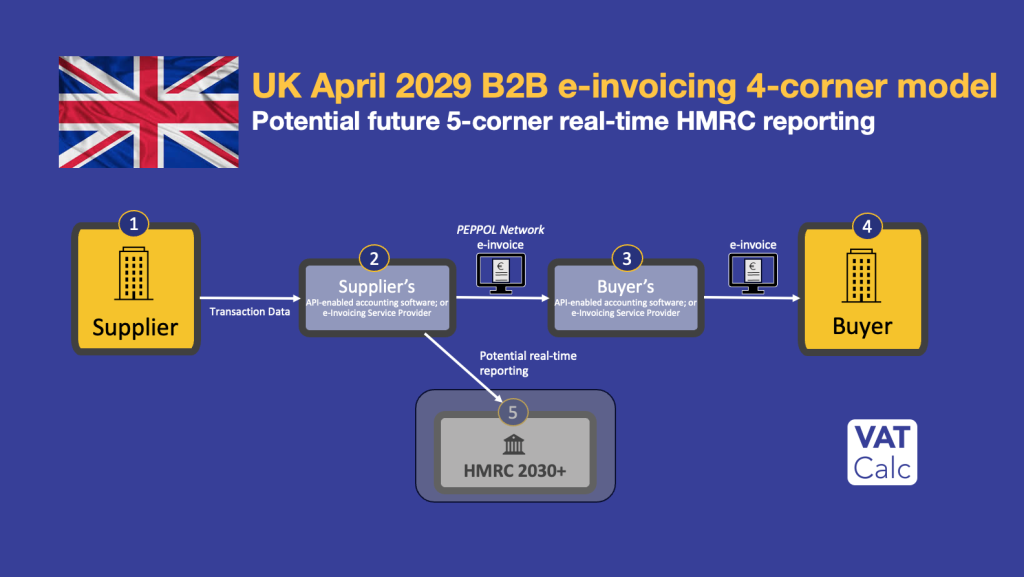
The government has confirmed that while it will “continue to explore the potential benefits of real-time reporting”, RTR will not be introduced alongside the 2029 e-invoicing mandate. Instead, the UK will focus first on establishing electronic invoicing across B2B and B2G transactions using a 4-corner exchange model, where invoices pass between supplier and buyer via service providers, without direct transmission to HMRC.
This is a deliberate design choice. Unlike clearance or continuous transaction control (CTC) regimes in parts of the EU(e.g. Italy and ViDA 2030 e-invoicing) and Asia, HMRC will not sit visibly in the transaction flow at go-live. The government’s stated objective is to reduce disruption, allow businesses to adapt gradually, and avoid duplicating compliance obligations during the initial phase.
However, the response leaves little doubt about the longer-term direction. If real-time reporting is introduced in the future, it will build on the e-invoicing infrastructure, with the explicit aim of making reporting “as seamless as possible for businesses”. In other words, e-invoicing is being positioned as a platform capability, not the final destination.
Data governance and HMRC’s transformation agenda
HMRC has also acknowledged that real-time transactional data raises legitimate questions around data protection, proportionality, and system resilience. Any future RTR regime would require careful consideration of how data is utilised, protected, and stored, and how it supports both compliance activity and customer service outcomes.
Notably, the government has linked any future steps on RTR to HMRC’s Transformation Roadmap, reinforcing that e-reporting would only proceed where it aligns with broader objectives to modernise tax administration through more joined-up, innovative systems — rather than creating a standalone compliance burden.
No pre-populated VAT returns — yet
One of the clearest statements in the response is HMRC’s admission that e-invoicing data alone is insufficient to generate a pre-populated VAT return. This reflects the structural realities of the UK VAT system: partial exemption, adjustments, non-invoice corrections, and cross-border complexity cannot be captured from invoice data alone.
That said, HMRC has not closed the door. E-invoicing data could, over time, feed into future VAT products, even if it cannot act as the sole source of truth.
Why many respondents to HMRC support real-time reporting
While HMRC has chosen not to impose RTR in 2029, consultation feedback shows that a significant number of respondents support the concept in principle.
Many viewed real-time reporting as a logical and overdue step in the UK’s digital tax evolution, particularly for B2B and B2G transactions. The most frequently cited benefits included:
-
Improved VAT compliance and fraud reduction
-
Greater transparency between taxpayers and HMRC
-
More streamlined tax processes and fewer retrospective audits
Respondents often described RTR as transformational, provided it is implemented in a seamless, low-friction manner. International examples such as Hungary and South Korea were referenced as evidence that well-designed real-time reporting systems can operate at scale without undue disruption.
Taxpayers hope for more accurate VAT returns and less admin
Beyond compliance outcomes, respondents highlighted the operational upside of timely data sharing with HMRC. In theory, RTR could enable:
-
More accurate VAT returns and fewer post-submission corrections
-
Reduced administrative burden through automation
-
More targeted compliance support from HMRC
Many also linked RTR to broader digital finance innovation, arguing that once transactional data flows are standardised, it becomes easier to introduce smarter tools across accounting, tax, and cash-flow management functions.
Access conditions — and security cautions — from respondents
Support for RTR was not unconditional. Respondents repeatedly stressed that success would depend on:
-
Clear technical and data standards, aligned with international norms
-
Robust infrastructure, capable of handling real-time data securely
-
A phased rollout, allowing both businesses and HMRC to adapt
A consistent theme was sequencing. Respondents argued strongly that e-invoicing must first become established throughout supply chains before any RTR obligation is introduced. Premature reporting requirements risked undermining e-invoicing adoption itself.
A smaller group raised more fundamental concerns, including administrative complexity, integration challenges, GDPR risks, and the disproportionate impact on SMEs. Some questioned HMRC’s readiness to manage real-time data at scale, while others highlighted cost implications and limited benefits for certain sectors.
E-invoicing falls at partial exemptions and B2C
Respondents also welcomed “smart” e-invoicing features such as prompts, reminders, automation, and AI-enabled support, particularly for SMEs with limited tax resources. Integration with procurement systems and automation of routine tasks were seen as potential efficiency gains.
At the same time, respondents were clear-eyed about limitations. E-invoicing data cannot capture:
-
Partial exemption and complex VAT adjustments
-
Bespoke contractual arrangements
-
B2C transactions, where VAT invoices are not required
These concerns closely mirror HMRC’s own conclusion that e-invoicing data can support, but not replace, comprehensive VAT reporting.
A pause — e-reporting in the UK likely
Taken together, the consultation response and stakeholder feedback tell a consistent story. The UK is not imposing e-reporting in 2029, but it is unmistakably laying the groundwork for it. E-invoicing is the first step; real-time reporting is the likely second.
For businesses, the message is clear: plan for e-invoicing now, but design systems with an eye on the future. The UK may be moving more cautiously than some international peers — but the direction of travel is firmly set.