
Upgrade to 4.0 CFDI delayed further three months until 1 July 2023
The latest version of CFDI e-invoicing system has been postponed until 1 July 2023 (planned for 1 January and then 1 April) by the Mexican Tax Administration. 4.0 changes include:
- Export information requirements
- Reporting linked invoices
- Reversal of invoices reported.
Mexico’s Servicio de Administración Tributaria, ‘SAT’ introduced Comprobante Fiscal Digital por Internet (CFDI) e-invoicing in 2011, and mandated it for most taxpayers in 2014. It includes a government and customer pre-clearance routine for e-invoices which are also available in PDF.
VAT Cal’s live VAT invoice transaction and e-invoice tracker keeps you up-to-date on global real-time reporting requirements.
Mexican CFDI e-invoice creation
Eligible taxpayers must follow the following steps
- The taxpayer must register with the SAT for a digital signature, CSD, and a login key Firma Electronica Avanzada (FIEL)
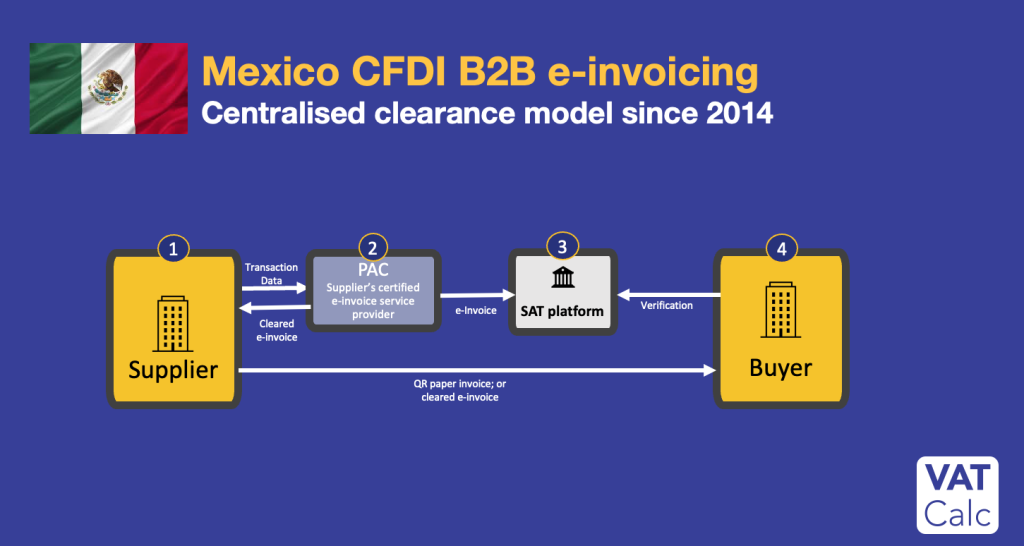
- They must appoint an authorised e-invoicing Proveedor Autorizado de Certificación, PAC. The PAC is responsible for the validation of invoices, the assignment of reference numbers, and the insertion of digital signatures before the SAT’s approval.
- The supplier sends a draft invoice to their PAC in CFDI (a XML) format. SAT also offers a free tool for small businesses to create and report e-invoices.
- The PAC issues a draft invoice in FCFI with a unique invoice code. It then forwards the invoice to SAT. The process of creating the draft invoice and the PAC transmitting to SAT must be completed within 72 hours.
- The customer may send the e-invoice or PDF with QR code to the customer.
- The customer is notified by SAT, and has three days to review the invoice before it is automatically validated as a VAT invoice.
- To cancel an invoice, the supplier must send a request via CFDI, and then the customer has to opportunity to refuse it within 72 hours
Till receipts should include a QR Code.
In addition to e-invoicing, the Mexican authorities are using pre-filled VAT returns. Check out the countries that have implemented pre-filled VAT / GST returns around the world.
Central and South America e-invoicing
| Country | Date | Comments (click for details) |
| Argentina | 2003 | e-Factura Electronic Authorization Code system |
| Belize | 2027? | E-invoicing and e-receipts |
| Bolivia | Dec 2021 | SFE Pre-clearance model |
| Brazil | 2005 | Nota Fiscal Electronic NF-e |
| Chile | 2001 | DTE tax invoice |
| Colombia | Nov 2020 | e-invoice CUFE |
| Costa Rica | 2018 | Pre-clearance |
| Dominican Republic | 2024 | Mandatory e-invoicing phased introduction |
| Ecuador | 2014 | SFEP VAT e-invoicing |
| El Salvador | 2022 | Pre-clearance e-invoicing law passed |
| Guatemala | 2019 | e-invoice FEL |
| Mexico | 2011 | Pre-clearance e-invoice CFDI |
| Panama | 2021 | SFEP VAT e-invoicing with third-party agent required |
| Paraguay | 2022 | Marangatú, a pre-clearance e-invoice system started 1 Jan 2022 |
| Peru | 2010 | Pre-clearance invoice; requirement for approved e-invoice agent |
| Uruguay | 2019 | CFE pre-clearnance e-invoicing |
| Venezuela | 2019 | E-invoicing for select groups |


