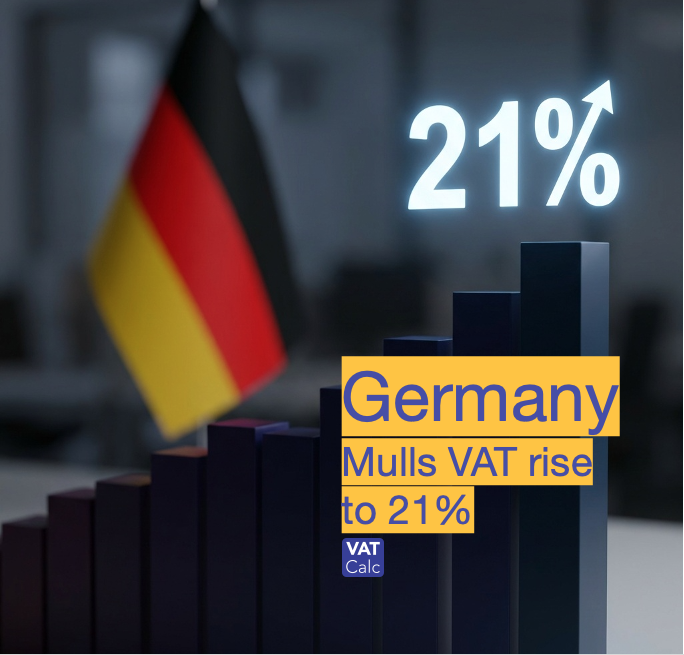
“21–10–0-Formel”: 2% VAT hike to 21%; reduced rate rise to 10%; 0% food to fund income tax cuts
- VAT increase of 2% now under active coalition discussion
- Potential revenues of ~€31bn to fund income tax and social contribution cuts
- Reduced VAT rate rise from 7% to 10%, including 0% on essential groceries

CDU/CSU-SPD coalition weighs-up switching tax burden from income to consumption – repeating the 2007 tax shift
Germany is considering a renewed major tax shift from income to consumption, with coalition discussions on raising VAT in exchange for cutting income taxes and social security contributions. Such a VAT rise from 19% to 21% would mirror the last German VAT increase from 16% to 19% in 2007 to fund income tax cuts.
Hotels, public transport books and other supplies at the current 7% reduced rate would rise to 10%. But food would drop from 7% to 0% to blunt the regressive effects of VAT on the less well off.
A standard VAT rate rise of 2% would raise up to €30 billion per annum; reducing food to 0% would reduce this to about €14 billion.
It would take Germany’s close to the EU 21.8% average VAT rate.
Coalition promised income tax cuts for less wealthy
The coalition’s commitment to largely unfunded 2027 income tax reductions materially increases the likelihood of Germany revisiting a broader VAT reform package, including a possible rise in the standard VAT rate and politically targeted revisions to reduced VAT rates. Germany’s new government is under pressure to finance tax relief for workers while simultaneously increasing defence spending, supporting weak industrial growth and operating under the country’s strict constitutional debt limits.
According to multiple government sources in Handelsblatt, the CDU/CSU-SPD coalition is discussing a VAT rise of 2% behind closed doors. This would take Germany’s standard VAT rate from 19% to as high as 21%. The proposal forms part of a broader reform package aimed at rebalancing the tax system away from income and towards consumption.
Politics tricky with inflation looming
The timing is politically sensitive. Inflationary pressures linked to the ongoing Middle East conflict have already pushed up energy and consumer prices, making any VAT rise more contentious. Many other countries are cutting VAT on fuel and food
Reshuffle with reduced rate rise from 7% to 10%; 0% on basic food
Alongside the headline VAT rise, policymakers are also examining targeted relief through reduced rates. Options under discussion include:
- Increasing the reduced VAT rate from 7% to 10% which covers public transport, books, newspapers, hotel stays as well as art and cultural events
- Introducing a 0% VAT rate on essential groceries which are currently at the reduced, 7% rate.
This dual approach reflects a clear concern: VAT is inherently regressive, and any increase risks disproportionately affecting lower-income households unless carefully balanced.
The trade-off: consumption vs income
At the centre of the debate is a classic fiscal trade-off: higher consumption taxes in exchange for lower taxes on work. The SPD, led by Lars Klingbeil, is insisting that any VAT increase must be matched by “tangible” relief for households. This includes:
- Income tax cuts for middle earners
- Lower social security contributions
- Estimated savings of €300 to €400 annually for average workers
Meanwhile, CDU leader Friedrich Merz is pushing for broader tax relief, including raising the threshold for the top income tax bracket.
See more in our German VAT guide.