Germany permits E-Invoicing in All EU Languages as Part of 2025–28 Rollout
Germany is in the midst of a historic change to the way companies issue and receive invoices. Beginning in 2025, the country will gradually mandate electronic invoicing (e-invoicing) for all business-to-business (B2B) transactions, with a full rollout scheduled by 2028. As part of this transition, the Federal Ministry of Finance (BMF) has announced an important concession: German e-invoices may be issued in any of the official languages of the European Union.
This flexibility, published in a BMF circular dated 17 September 2025, is designed to reduce barriers to cross-border trade, simplify compliance for multinational businesses, and align Germany more closely with the multilingual nature of the EU’s Single Market.
Why the language policy matters
Language has long been a practical concern in tax compliance. Until now, businesses faced uncertainty about whether invoices needed to be translated into German to remain compliant with VAT law.
The new guidance resolves this by explicitly confirming that invoices can be drawn up in any of the EU’s 24 official languages. As long as the recipient can understand the invoice and all statutory information required by the German VAT Code (UStG) is included, the invoice is valid.
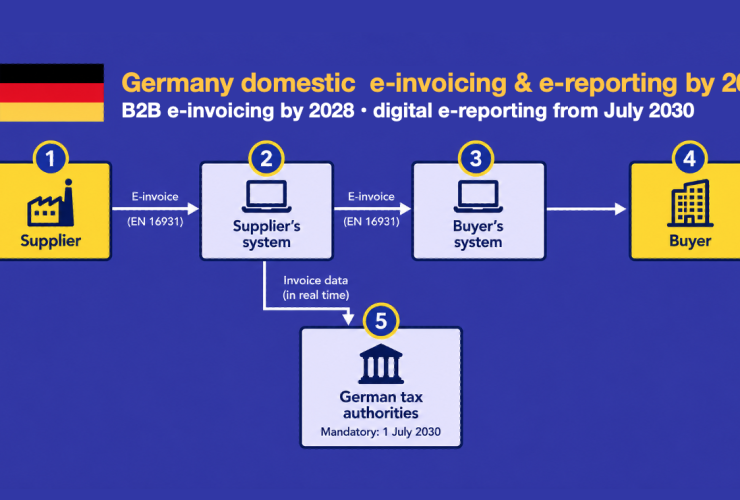
This is particularly relevant in the context of the new German e-invoicing regime, which will require structured invoice formats compliant with EN 16931, the European e-invoicing standard. Multilingual support ensures that these structured invoices remain usable across Member States without adding an unnecessary administrative burden.
BMF Circular: language relaxations; audits; deductions
The circular lays out several important points for businesses preparing their systems for the 2025–2028 transition:
-
Language Flexibility
Invoices may be issued in any of the EU’s official languages. This rule applies equally to domestic and cross-border invoices, though companies are encouraged to ensure that the recipient can clearly understand the content.
-
Audit and Verification Requirements
During tax audits, authorities must be able to verify the contents of invoices. If an invoice is issued in a language other than German, companies may be required to provide a German translation on request. Businesses therefore need internal processes or service providers ready to deliver translations if necessary.
-
Support for Cross-Border Transactions
Multilingual invoicing will be especially useful in intra-EU trade, where German suppliers issue invoices to customers in other Member States. This measure aligns with the EU’s broader efforts to harmonize e-invoicing and VAT reporting across borders.
-
Input VAT Deduction Unaffected
Using another EU language has no impact on the taxpayer’s right to deduct input VAT. As long as invoices comply with Article 14 of the VAT Application Decree (UStAE) and include all mandatory information, input VAT can be claimed normally.
-
Standardized Terminology Recommended
To avoid misunderstandings, the BMF encourages businesses to use standardized terms taken from official EU translations of the VAT Directive and invoicing requirements. Clear terminology will help ensure smooth audits and consistent interpretation across borders.
Integration with 2025-28 e-Invoicing rollout
The timing of this concession is no coincidence. Germany is beginning a multi-year journey to make e-invoicing mandatory for B2B transactions:
-
Since 2025: Large companies will be required to issue and receive structured e-invoices for domestic B2B transactions.
-
From 2026–2027: The scope will gradually expand to include medium-sized and smaller businesses.
-
By 2028: All B2B invoices in Germany will have to be issued electronically in a structured format compliant with EN 16931.
This phased approach is intended to give businesses time to adapt IT systems, update workflows, and train staff. The new multilingual flexibility will be particularly helpful during this period, as companies with international operations will not need to duplicate invoicing processes or add translation layers solely for compliance purposes.
Practical Implications for Businesses
For German companies, the policy introduces both opportunities and responsibilities:
-
Opportunities:
-
Easier invoicing for international customers, as invoices can be issued directly in the recipient’s preferred EU language.
-
Smoother integration of multinational ERP systems, since companies can maintain a single invoicing process across multiple countries.
-
Reduced administrative cost of translating invoices into German solely for compliance purposes.
-
-
Responsibilities:
-
Ensuring that all mandatory invoice fields (as defined under Sections 14 and 14a UStG and Article 226 of the EU VAT Directive) are correctly populated, regardless of language.
-
Being prepared to provide German translations during audits when requested by tax authorities.
-
Training staff or configuring invoicing software to use standardized EU terminology to avoid ambiguities.
-