Rate changes; digital assessments; right to deduct; transfer pricing; hotel services; NFT’s; and exports
From 1 January 2026, companies operating in Germany will face important changes under the 2025 Tax Amendment Act. The legislation, currently moving through the Bundestag and Bundesrat, introduces new rules that will significantly impact VAT compliance in Germany. Businesses in sectors ranging from hospitality to digital services will be affected.

Main VAT measures effective 2026
The German government’s tax reform programme brings in several VAT changes (see our German VAT guide for more):
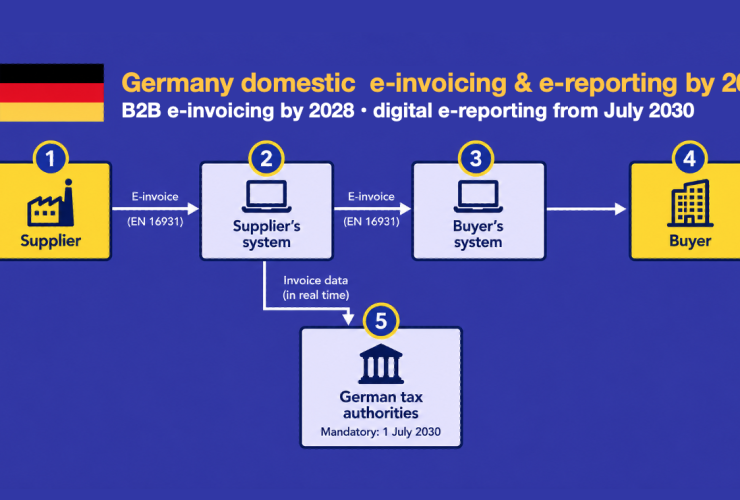
- Digital VAT assessments: VAT notices will now be deemed delivered once available for electronic retrieval. This step supports Germany’s ongoing shift to real-time digital VAT compliance.
-
Reduced VAT rate for restaurants and catering: From 2026, food served in restaurants and catering will be taxed at the reduced 7% VAT rate in Germany, although beverages will remain subject to the standard rate.
-
Central customs clearance (CCI): New VAT rules provide a special framework for businesses making use of centralised customs clearance for imports and exports, improving efficiency for cross-border trade.
Adopting German and EU VAT court rulings
In addition to legislative changes, several CJEU and German tax court rulings from 2025 are shaping how VAT is applied in practice:
- Export VAT exemptions (CJEU, Aug 2025). The court reaffirmed that the zero-rating for exports applies strictly when goods are demonstrably transported outside the EU. Businesses must keep robust evidence to defend exemption claims during audits.
-
Transfer pricing and VAT adjustments (CJEU, Sept 2025) – link between adjustments and VAT. The Court confirmed that transfer pricing adjustments can affect the taxable amount for VAT, particularly where intra-group transactions are revalued. This ruling highlights the need for multinational groups to align their VAT and corporate tax transfer pricing policies.
-
Right to deduct input VAT (CJEU, Feb 2025). The judgment strengthened taxpayers’ rights to reclaim input VAT, even in cases where the documentation was initially incomplete. It underlines that substantive entitlement to deduction takes priority over formal errors.
-
Over declared VAT refunds (CJEU, Aug 2025). The case addressed whether taxpayers can correct and reclaim VAT charged at a higher rate than required. The ruling provides reassurance that overpayments should generally be refunded, provided there is no risk of unjust enrichment.
- Voluntary payments for online content (Berlin-Brandenburg Tax Court, Apr 2025). The case considered whether donations or voluntary contributions for free digital content qualify as taxable revenue. The judgment suggests that such payments may be subject to VAT if they are linked to a clear economic benefit.
-
Bundled hotel services – breakfast, Wi-Fi, wellness, parking (Advocate General opinion, Sept 2025). The opinion explored whether bundled services offered by hotels should be taxed as a single supply or broken into different VAT rates. A final judgment could reshape pricing and invoicing structures in the hospitality industry.
-
Classification of service relationships (German BFH, July 2025). Germany’s Federal Fiscal Court examined how contractual relationships are characterised for VAT purposes. The decision clarifies when linked services count as independent versus ancillary, affecting how businesses account for VAT.
-
VAT on NFTs and digital assets (Lower Saxony Tax Court, July 2025). The court ruled that transactions involving non-fungible tokens (NFTs) are taxable supplies subject to VAT. This sets an early precedent in Germany for how digital and blockchain-based assets are treated under VAT law.
-
Exemptions for online brokerage services (Munich Tax Court, July 2025). The court examined whether brokers acting covertly in online markets can still rely on VAT exemptions. The decision highlights the complexities digital platforms face when intermediating financial services.
-
VAT on commercial rent and ancillary costs (BGH, Jan 2025). Germany’s highest civil court clarified how VAT applies when landlords pass on rent and associated charges. The ruling will be particularly relevant for property managers and commercial tenants negotiating lease terms.