Why tax engines struggle with Microsoft Dynamics — and why VATCalc doesn’t
The hidden VAT and indirect tax pitfalls in Dynamics 365 implementations — and how a modern, legislative-coded, serverless engine solves them.

Microsoft Dynamics 365 (Finance & Operations and Business Central) has become one of the dominant ERPs for mid-size and enterprise organisations moving to the cloud. But when it comes to VAT, GST and indirect tax, Dynamics’ native tax model and integration framework present well-known challenges — especially when paired with traditional tax engines that rely on configuration tables, heavy mappings, and legacy on-premises logic ported into the cloud.
As businesses face EU VAT in the Digital Age (ViDA), real-time e-invoicing mandates, Peppol interoperability, complex chain transactions and global platform rules, the shortcomings of older tax engines inside Dynamics become even more visible.
This blog explores why tax engines frequently underperform in Dynamics environments, and why VATCalc’s legislative-coded, serverless architecture is uniquely suited to solve those issues.
1. Dynamics uses legacy tax model — tradition providers’ engines reinforce problem
Dynamics depends on Tax Groups, Item Tax Groups and Tax Codes — a structure designed decades ago for simple domestic VAT. When external tax engines require these same codes to drive determination, organisations end up maintaining VAT logic twice: once in Dynamics, once in the engine.
The result: duplicate configuration, mismatches between invoice-level tax and return-level reporting, and month-end reconciliation issues.
What VATCalc does differently:
VATCalc’s legislative-coded rules only need the raw transaction data — who, what, where, when. There is no requirement for tax groups, mapping matrices, or lookup tables. VAT determination is driven entirely by law, not configuration.
2. Dynamics triggers tax calculations at unpredictable times
Sales, procurement, projects and intercompany flows all fire tax events differently. Even simple changes — adjusting price, altering a shipment date, updating a customer — can trigger a new calculation behind the scenes.
With legacy engines, this leads to:
- inconsistent tax results
- double-calculation or missed calls
- orders that change tax at posting
- credit notes that don’t mirror original invoices
Why VATCalc avoids this:
VATCalc is fully stateless and idempotent. Every call returns a complete and authoritative tax result. Whether Dynamics calls once or ten times, the outcome is identical — eliminating the race conditions that plague older connectors.
3. High-volume dynamics environments expose performance limits
Dynamics order entry is real-time. Posting routines are batch-heavy. And peak days — Black Friday, period ends, seasonal pushes — can involve hundreds of thousands of API calls.
Traditional engines, still dependent on VMs or containers, hit:
- API throttling
- latency spikes
- failed postings
- slow user experience
- scheduled downtime during upgrades
VATCalc’s advantage:
As the only serverless tax engine built on Google Cloud, VATCalc scales instantly and infinitely. Zero throttling. Zero warm-up. Millisecond response times even at extreme volume.
Dynamics users experience tax like it’s native functionality.
4. Missing localisation fields in dynamics break traditional engines
Local compliance details — invoice types, nature codes, e-invoicing flags, special regimes, use & enjoyment markers — are not consistently surfaced in Dynamics. Partners often build bespoke extensions just to provide mandatory VAT attributes for Italy, France, Poland, Gulf states, Belgium and others.
Traditional engines rely on those fields being present. When they’re not, VAT determination becomes unreliable or incomplete.
VATCalc resolves this by:
- deriving missing attributes automatically through legislative logic
- synthesising e-invoicing classifications
- applying country-specific rules without ERP customisation
The engine understands the law, so the ERP doesn’t need dozens of custom fields.
5. Chain transactions infamously difficult in Dynamics
Intercompany drops, multi-leg chain supplies, triangulation, consignment flows and cross-border fulfilment all create VAT complexity. Dynamics rarely stores the complete chain in a structured way.
Traditional engines need explicit modelling. If those fields aren’t in Dynamics, the logic fails.
VATCalc handles this natively:
Using the base fulfilment data (ship-from, ship-to, bill-to, registrations, sequence), the engine reconstructs the chain automatically — including EU triangular simplifications, DE/BE/NL chain scenarios, and multi-entity flows.
No tax team scripting. No partner custom tables. No fragile mappings.
6. Pricing, discounts and credit notes often corrupt tax bases
Dynamics’ price engine is powerful but creates inconsistent tax bases: multi-line promotions, free goods, retrospective rebates, sales agreements, and complex credit note reversal flows.
Traditional tax engines depend on Dynamics to provide a “clean base amount.” That’s rarely the case.
VATCalc solves this with:
- automatic reconstruction of taxable bases
- proportional allocation across lines
- adjustment reconciliation for credit notes
- correct treatment of free-of-charge items
- deduction caps and exemptions handled legislatively
The result is invoices that match VAT returns without offline adjustments.
7. Reporting and determination Are completely disconnected
Dynamics only stores tax amounts and a code — not the metadata tax managers need: place of supply, legal basis, exemption reason, jurisdiction, type of supply, reporting classification, or Peppol semantic tags.
Traditional engines usually require custom tables to store this information.
VATCalc removes this dependency entirely:
Every determination returns a complete posting object containing all VAT return and real-time reporting attributes. VATCalc Filer uses the same object, guaranteeing that invoices, DRR, SAF-T, EC Sales, OSS/IOSS, Intrastat and VAT returns all reconcile automatically.
No more “invoice says one thing, return says another.”
8. ViDA readiness is years away for legacy engines — VATCalc is live now
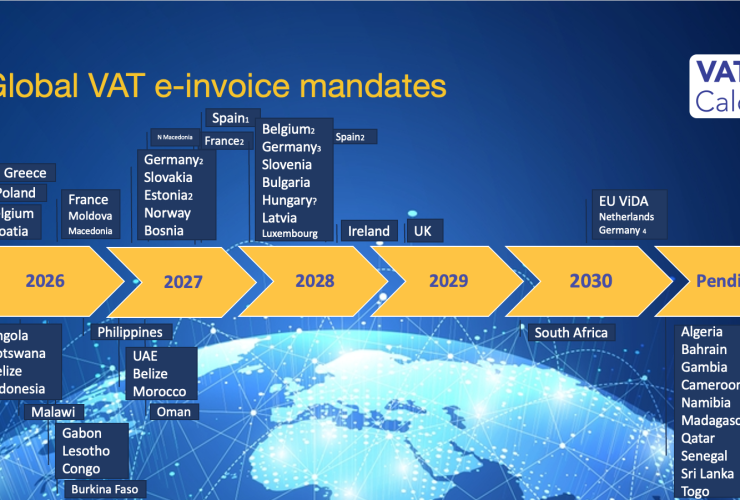
The EU’s VAT in the Digital Age reforms — Digital Reporting Requirements, Platform Economy, and Single VAT Registration — fundamentally change ERP-to-tax-engine behaviour. Traditional engines rely on patches and long upgrade cycles.
VATCalc already supports:
- DRR-compliant, transaction-level EU reporting
- Peppol tax code mapping to EN 16931
- platform economy deemed-supplier logic
- multiple VAT registrations and SVR workflows
For Dynamics users, ViDA readiness is not a future roadmap — it’s available today.
Summary – VATCalc support modern, digital VAT in Dynamics
VATCalc is the only tax engine built specifically for the cloud era — legislative, serverless, and integrated across determination, e-invoicing and real-time reporting. In Dynamics environments, this produces materially better accuracy, scale, and compliance than older config-driven engines designed in a pre-ViDA world.
Feature Comparison: VATCalc vs Traditional Tax Engines in Microsoft Dynamics 365
|
Feature / Capability |
VATCalc |
Vertex |
Avalara (AvaTax / Avalara VAT) |
Sovos |
Thomson Reuters ONESOURCE |
|---|---|---|---|---|---|
|
Core Architecture |
100% serverless (Google Cloud)infinite scale |
VMs/containers |
VMs/containers |
VMs/containers |
VMs/containers |
|
VAT Logic Basis |
Legislative-coded rules (no config tables) |
Configuration tables |
Configuration tables |
Configuration tables |
Configuration tables |
|
Dependence on Dynamics Tax Groups / Item Tax Groups |
None |
Heavy |
Heavy |
Heavy |
Heavy |
|
Dynamics Connector Modernity |
Built cloud-native for D365 |
AX→D365 ported |
AX→D365 ported |
AX→D365 ported |
AX→D365 ported |
|
Real-Time Performance Under Load |
Instantly scalable, zero throttling |
Throttling + latency |
Throttling |
Throttling |
Throttling |
|
Chain Transactions / Triangulation |
Native, automatic reconstruction |
Partial, config-heavy |
Weak |
Weak |
Partial |
|
ViDA Digital Reporting Requirements (DRR) |
Fully supported |
Not yet |
Not yet |
Not yet |
Not yet |
|
Peppol Mapping (CEN EN 16931) |
Built-in |
Add-on |
Not available |
Patch-based |
Partial |
|
Credit Note / Base Reconstruction |
Legislative + automated |
Manual config |
Manual config |
Manual config |
Manual config |
|
Reporting (EC Sales, Intrastat, SAF-T, VAT returns) |
Native in same platform |
Separate modules |
Separate products |
Separate products |
Separate products |
|
Multiple VAT Registrations & SVR workflows |
Out-of-the-box |
Patchwork |
Limited |
Patchwork |
Limited |
|
Zero ERP Customisation for VAT |
Yes – legislative engine fills gaps |
No |
No |
No |
No |