Vertex and Thomson Reuters have traditionally dominated enterprise global VAT determination.
But ViDA, SAP S/4HANA migrations and digital reporting are changing what businesses need from a tax engine.

VATCalc is challenging the established model with legislative-driven determination, faster implementation and a single platform for VAT reporting and reconciliation.
Who are the major global VAT tax engine providers?
The global VAT determination engine market is smaller than it first appears.
Many tax technology companies offer VAT rate calculations, compliance reporting or e-invoicing. Far fewer (errr…none aside from VATCalc 🙂 ) provide comprehensive legislative determination across complex international transactions.
Vertex and Thomson Reuters ONESOURCE are the two established enterprise benchmarks. Avalara and Sovos also market global determination solutions, although their traditional strengths lie in US sales tax automation and wider indirect tax compliance, respectively.
VATCalc offers an alternative approach: a modern, legislative-coded global VAT engine designed for businesses of all sizes.
|
Provider |
Principal strengths |
Global VAT determination positioning |
|---|---|---|
|
Vertex |
Enterprise tax engines, SAP and Oracle integrations |
Established global enterprise engine |
|
Thomson Reuters ONESOURCE |
Enterprise determination and international tax content |
Established global enterprise engine |
|
Avalara |
US sales tax automation and extensive integrations |
International VAT capabilities, with depth varying by product and scenario |
|
Sovos |
Global VAT compliance, e-invoicing and reporting |
Markets global determination; complex legislative capabilities require evaluation |
|
VATCalc |
Legislative determination, auditing and integrated reporting |
Global engine with a single-platform architecture |
The critical distinction is not simply whether a provider calculates VAT. It is how much tax intelligence is built into the engine, what must be configured during implementation and whether the resulting decisions can be independently verified.
What makes a genuine global VAT determination engine?
Calculating VAT once the applicable rate has been established is relatively straightforward. Determining the correct treatment of a complex international transaction is not.
A comprehensive global VAT engine must interpret place-of-supply rules, exemptions, reverse charges, customer status, cross-border movements and other legislative requirements before calculating the tax.
This distinction becomes particularly important for chain transactions, triangulation, composite supplies and transactions involving multiple jurisdictions.
A database containing thousands of VAT rates is not, by itself, a comprehensive determination engine. Nor does an ERP tax code necessarily establish whether the underlying treatment is legally correct.
A genuine global VAT engine must determine not just how much tax is due, but why, where and by whom.
The traditional enterprise tax engine model
Vertex and Thomson Reuters have built substantial businesses providing sophisticated tax determination for multinational enterprises.
Their solutions offer extensive international coverage, integration with major ERP systems and centralised tax calculation across multiple jurisdictions.
However, traditional enterprise implementations can also require significant configuration. Tax teams and external consultants may spend months identifying transaction scenarios, defining tax treatments, mapping ERP data and building customised rules.
Those configurations subsequently need maintaining as legislation, business models and ERP systems change.
Avalara has developed a different model, with particular strength in US sales tax and extensive integrations into commerce and accounting applications. Its international VAT capabilities are relevant, although complex cross-border legislative determination requires closer examination.
Sovos has established considerable breadth in global tax compliance and e-invoicing. It also markets a global tax determination product, but buyers should distinguish published geographical coverage and transaction calculations from demonstrated depth across complex international VAT scenarios.
For businesses evaluating these providers, the question is increasingly whether traditional implementation costs and complexity remain necessary.
How VATCalc challenges the traditional model
VATCalc takes a different approach, built around three advantages.
1 Legislative determination rather than customised tax rules
VATCalc’s engine incorporates codified national VAT legislation and the EU VAT Directive. It determines the appropriate treatment from the underlying transaction facts, supported by legislative references.
This enables businesses to explain VAT decisions when challenged by customers or tax authorities, rather than relying solely on configured ERP tax codes.
The same underlying engine powers VATCalc Auditor, independently re-determining transactions processed by existing ERPs, other tax engines or suppliers.
This is particularly valuable for identifying incorrect VAT charges, exemptions and reverse-charge treatments before they create wider compliance problems.
2 Implementation in days, not months
Traditional implementations often involve expensive consultants developing and maintaining customised transaction scenarios.
VATCalc reverses that process.
Rather than requiring consultants to teach the software how individual transactions should be treated, VATCalc’s legislative engine and auditing capabilities can establish the appropriate treatment from transaction data.
This substantially reduces bespoke rule development, configuration and ongoing consultancy requirements.
Combined with modern, cloud-native, serverless technology and API integration, suitable VATCalc implementations can be completed in days rather than months.
The resulting lower implementation and operating costs also make sophisticated global VAT determination commercially accessible to mid-sized businesses, not just multinationals.
3 One platform for determination, auditing and reporting
Traditional tax engines frequently operate separately from statutory VAT reporting and reconciliation applications, requiring additional integrations and data transfers.
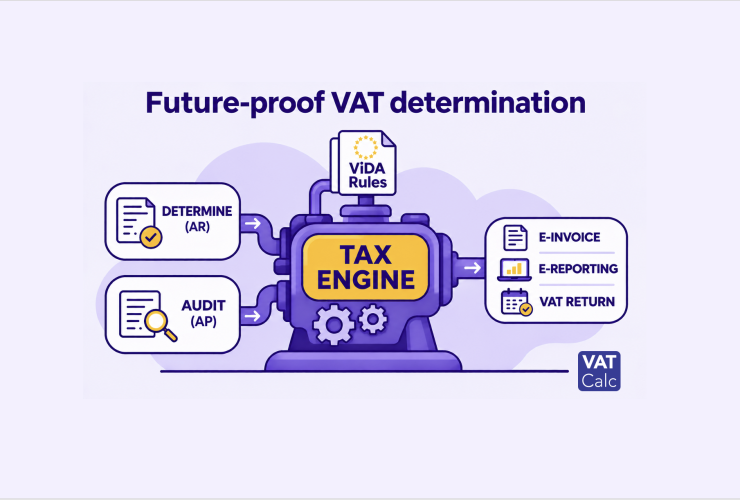
VATCalc combines its Calculator, Auditor and optional Filer applications within a single platform, using the same underlying legislative engine.
Businesses can deploy determination independently or extend it into transaction auditing, VAT returns and digital reporting without introducing a separate tax determination system.
This becomes increasingly important as compliance moves beyond periodic VAT returns towards continuous transaction-level reporting.
ViDA and S/4HANA are changing tax engine buying requirements
Future-proofing is becoming a central requirement for businesses selecting tax technology.
Companies preparing for EU VAT in the Digital Age (ViDA) reforms or migrating to SAP S/4HANA increasingly want technology that can accommodate changing legislation, mandatory e-invoicing and digital reporting without another costly implementation.
ViDA introduces digital reporting requirements for intra-EU B2B transactions from July 2030, while national e-invoicing mandates are already accelerating the transition.
These developments create two important requirements.
- Accounts receivable (AR): Businesses increasingly need to determine the correct VAT treatment before issuing customer e-invoices, ensuring that tax decisions are reflected accurately in structured invoices and digital reporting.
- Accounts payable (AP): Businesses need to independently verify the VAT treatment on supplier e-invoices rather than automatically accepting the tax charged, particularly where incorrect VAT could affect input tax recovery.
ViDA does not itself require businesses to purchase a tax engine. However, the operational case for automated determination and auditing becomes stronger as transaction-level information reaches tax authorities earlier.
For mid-market businesses, this creates a new challenge. They increasingly face enterprise-level VAT compliance requirements without enterprise-level tax technology budgets.
Modern, lower-cost engines therefore offer a practical route to future-proofing compliance.
Reconciliation: the new tax engine buying requirement
Correctly determining VAT is only the beginning.
Businesses must increasingly reconcile the tax treatment applied to customer and supplier invoices with the data transmitted through e-invoicing systems, digital reporting and ultimately their VAT returns.
A transaction may be correctly calculated but incorrectly reported. Equally, an e-invoice may pass technical validation while containing an incorrect VAT treatment.
These discrepancies become particularly significant as tax authorities introduce transaction-level reporting and pre-filled VAT returns. This changes what businesses should expect from a tax engine.
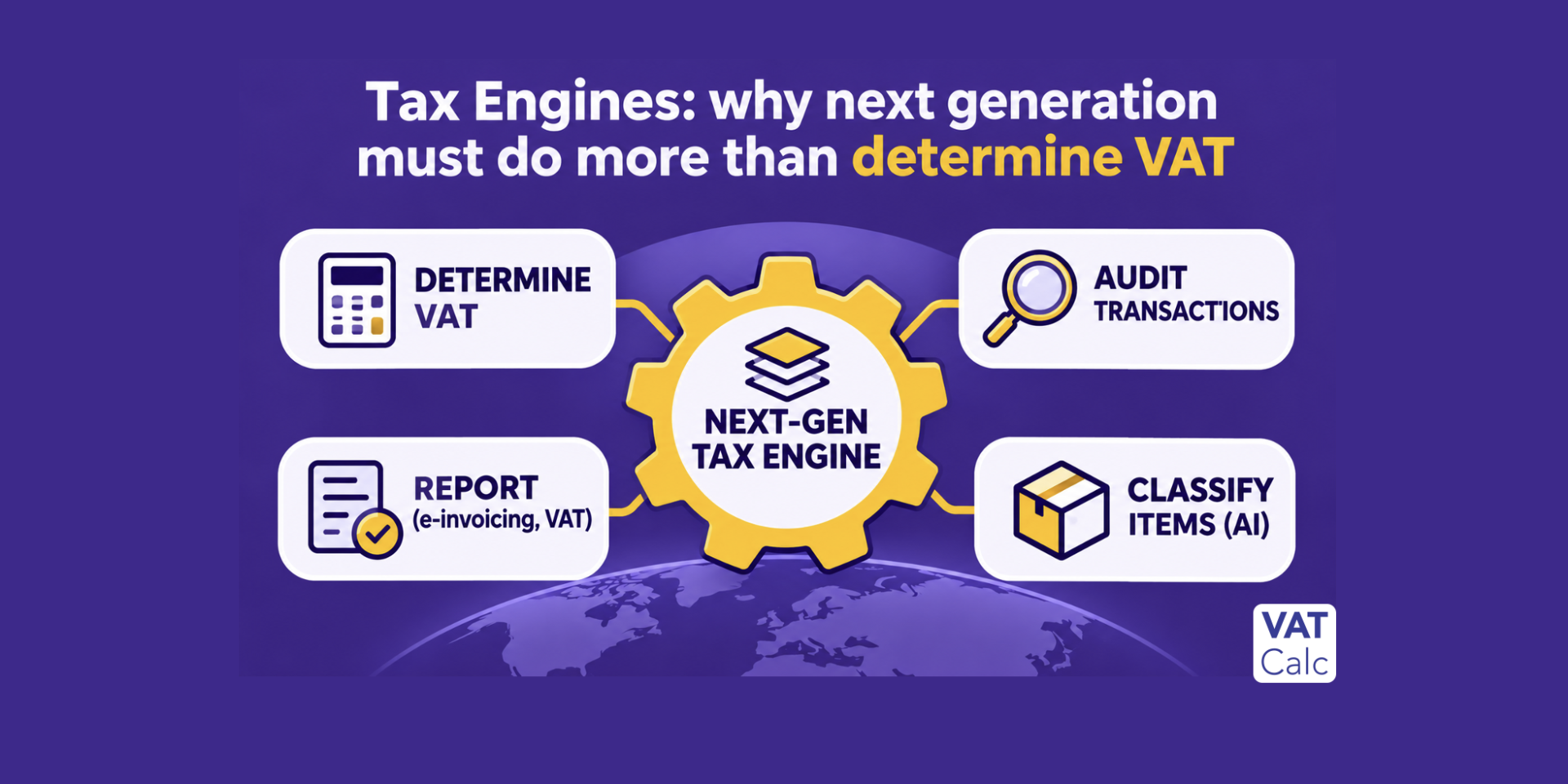
It must support the original VAT determination, independent verification of supplier transactions and reconciliation through to the final statutory declaration.
VATCalc’s single-platform architecture connects these processes. Its legislative engine establishes the appropriate tax treatment, VAT Auditor independently checks transactions, and VAT Filer supports reporting and e-invoice-to-VAT-return reconciliation.
Reconciliation establishes whether the numbers agree. Legislative determination establishes whether the tax treatment is correct. Businesses increasingly need both.
The next generation of global VAT engines
The market for sophisticated VAT determination is expanding beyond the large multinationals traditionally served by enterprise tax engines.
ViDA, national e-invoicing mandates and ERP modernisation are accelerating demand for real-time determination, independent auditing and reconciliation.
Buyers increasingly want future-proof technology that can meet these requirements without lengthy implementations, expensive consultants or disconnected compliance applications.
Vertex and Thomson Reuters remain established enterprise benchmarks. VATCalc challenges the traditional model by combining legislative depth, rapid deployment, low operating costs and optional integrated reporting within one modern platform.